
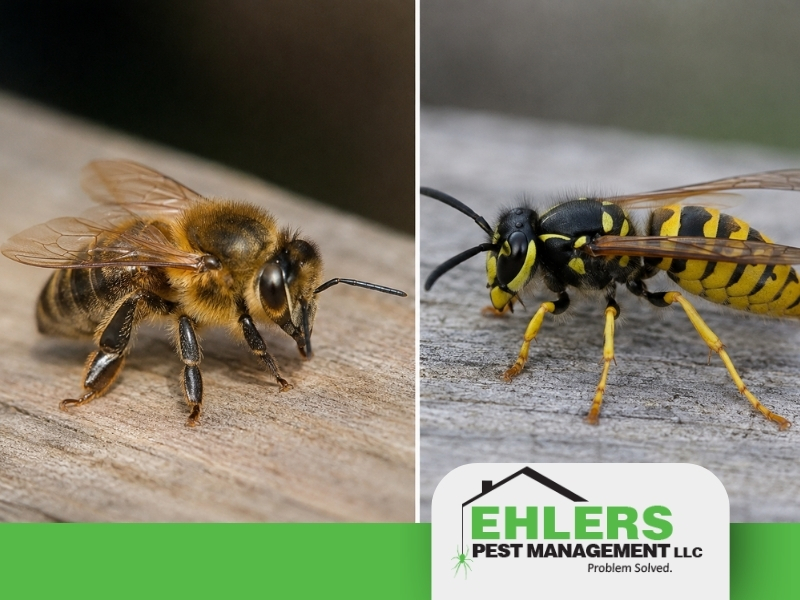

Most Milwaukee homeowners who search for bee and wasp removal are looking at wasps. That distinction matters more than it sounds, because the two get handled in completely different ways. Wasps, hornets, and yellow jackets are pest control work, and a certified technician treats the nest. Honeybees are a beekeeper’s job, and they get relocated rather than killed. Telling them apart takes about thirty seconds once you know what to look at.
Here’s how to identify what’s on your property, and what happens next depending on the answer.
What’s the fastest way to tell a bee from a wasp?
Four things give it away, and you can check them from a comfortable distance.
- Body shape. Bees are round and fuzzy, almost like they’re wearing a coat. Wasps are smooth, shiny, and pinched sharply in the middle, with an obvious narrow waist.
- Legs in flight. A wasp lets its back legs hang down while it flies. A bee tucks everything up close to the body.
- Where you find them. Bees work flowers and flowering shrubs. Wasps show up at your grill, your trash can, your pet’s food bowl, and anything sweet you left outside.
- Color. Yellow jackets are bright, sharp yellow and black with clean stripes. Honeybees are softer, more amber or golden brown, and they look dusty.
If the insect is smooth, striped, and hovering around your picnic, you have wasps. If it’s fuzzy, rounded, and busy on the hydrangeas, leave it alone.
Which stinging insects actually show up around Milwaukee homes?
Southeastern Wisconsin gives you a fairly short list, and most of it turns up between June and October.
Yellow jackets are the ones people call about most in September. Smooth bodies, bright markings, and they nest out of sight in wall voids, under decks, and in holes in the ground. They’re the most aggressive stinging insect in the state and they get worse as the season ends.
Paper wasps build the open, umbrella-shaped nest you can see hanging under a soffit or a porch ceiling. Long legs dangling in flight, slower and less aggressive than yellow jackets until you get close to the nest.
Bald-faced hornets build the enclosed gray nest that people describe as football-shaped, usually in a tree or against a wall. They defend a wide radius around it.
Honeybees are amber and fuzzy, and they don’t build exposed nests on your house. If you have honeybees, they’re either passing through, or they’ve moved into a wall void or a hollow tree and you’ll see a steady column going in and out of one small opening.
Bumble bees are large, very fuzzy, and mostly harmless to people. They nest in the ground, under sheds, and in compost piles, and a colony is usually a few dozen insects rather than a few hundred.
Carpenter bees look like bumble bees with a shiny black rear end instead of a fuzzy one. The tell is the hole: a perfectly round opening about the diameter of a pencil, drilled into fascia, deck rails, or trim.
Mining bees are the small ones that leave little dirt mounds in thin patches of lawn in spring. They’re solitary, they don’t defend anything, and they’re gone in a few weeks.
What’s nesting in the ground in my yard?
This is the question we get most often, and the answer is usually one of three things.
If it’s April or May and you’re seeing dozens of small dirt volcanoes across a bare patch of lawn, those are mining bees. Each hole is one solitary bee. They don’t swarm, they rarely sting, and they’ll be finished before Memorial Day.
If it’s summer, the insects are big and fuzzy, and there are maybe a dozen coming and going from one hole under a shed or a landscape timber, that’s a bumble bee colony. Give it space and the colony will be gone by the first hard frost.
If it’s August or September, the insects are smooth and bright, and there’s heavy traffic pouring in and out of a single hole all day long, that’s yellow jackets. This is the one that matters. A mature ground nest can hold close to a thousand insects, and running a lawn mower past the opening is how most people find out it’s there.
Do honeybees have to be removed, or can they stay?
We don’t kill honeybees, and we’ll tell you that on the phone. If you’ve got a honeybee colony, call a beekeeper. Plenty of local beekeepers will collect a swarm at no charge, because a free colony is worth having.
A colony that’s moved into a wall void is a bigger job than a swarm hanging on a branch. Comb and honey inside a wall will eventually attract ants, roaches, and rodents, and honey can work its way through drywall. That still isn’t an extermination job. It’s a removal and relocation job, and it takes a beekeeper who does structural cutouts, sometimes working alongside a contractor to open and close the wall.
Any pest control company that offers to spray a honeybee colony out of your wall should give you pause. That leaves dead bees, abandoned comb, and several pounds of honey in the cavity, which becomes a second pest problem a few months later.
When does bee and wasp removal actually mean a pest control call?
When it’s wasps, hornets, or yellow jackets, and there’s a reason to act.
Paper wasps under a soffit near a door or a deck are worth treating, especially if the nest keeps coming back to the same spot every year. Ongoing service handles that better than one-off calls, because the nests get knocked down before they establish.
Yellow jackets in a wall void, under a step, or in the ground near a walkway are worth treating now. These are the ones that put people in urgent care in September.
Carpenter bees drilling into structural wood are worth an inspection. The individual bee isn’t dangerous, and the tunneling adds up over several seasons, especially once woodpeckers start opening the galleries to get at the larvae.
Two situations where the answer is no. Yellow jacket nests above eight feet don’t get treated, because that means putting a technician on an extension ladder next to an agitated colony. And a yellow jacket nest in a far corner of the yard that nobody walks past will die off on its own once the weather turns, so waiting it out is a legitimate choice.
What if you can’t tell what you’re looking at?
Take a photo from as far back as your phone will let you, and pay attention to the traffic pattern instead of the individual insect. Steady two-way movement through one small opening tells a technician more than a blurry close-up does.
Bee and Wasp Removal Milwaukee: Which Do You Have?