
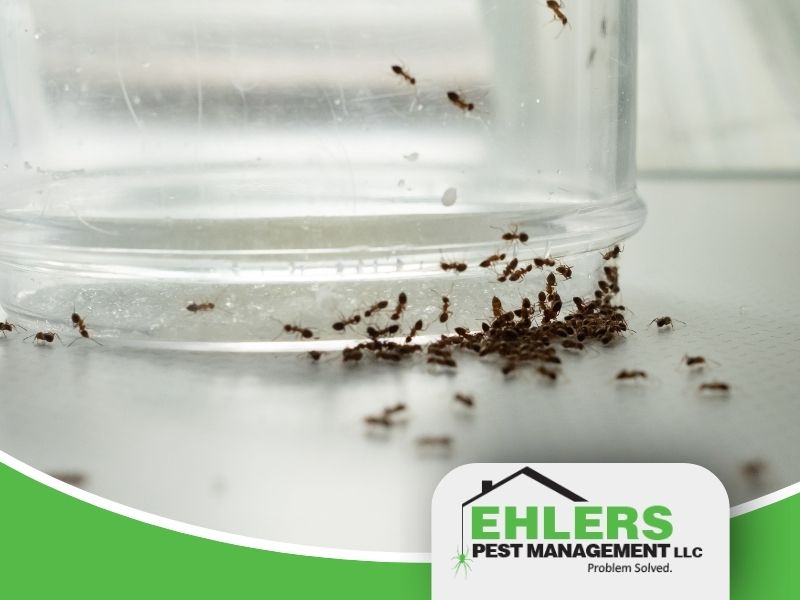

If you’ve spotted ants in your kitchen in Milwaukee, you’re not dealing with a random straggler. You’re looking at the first sign of a much bigger problem nearby.
It’s easy to wipe them up and move on. But if they keep coming back, there’s a reason. Here’s what’s actually happening inside your home, and what to do about it before it gets worse.
Why You’re Seeing Ants in Your Kitchen
Ants don’t wander indoors by accident. When a single ant finds its way into your kitchen, it’s scouting on behalf of a colony that could number in the thousands. If it finds food or moisture, it leaves an invisible chemical trail for others to follow.
By the time you notice a line of ants moving across your counter or floor, the scouting phase is already over. The colony has decided your kitchen is worth exploiting — and they’ll keep coming back until something changes.
What One Ant Is Actually Telling You
Ant activity in your kitchen usually points to three things:
- A colony is nearby. Ants don’t travel far. If they’re in your kitchen, the nest is likely in your walls, under your foundation, or close to the exterior of your home.
- They’ve found a food or moisture source. Grease behind the stove, a drip under the sink, crumbs in a cabinet corner — ants don’t need much.
- There’s an entry point they’ve found and are using. Gaps around pipes, cracks in the foundation, or unsealed windows are common access points.
None of these problems fix themselves. The trail gets reinforced every time an ant makes it back to the colony successfully.
Why Milwaukee Homes See More Ants in Spring and Summer
Ant activity in Southeastern Wisconsin spikes between May and August. Colonies expand in warmer months, and heavy spring rains push nests toward higher, drier ground — which often means toward your foundation and into your home.
The two most common species we see in Milwaukee kitchens are pavement ants (small, dark, usually near baseboards or under appliances) and odorous house ants (they emit a blue-cheese smell when crushed). Both are persistent. Neither goes away without treatment.
Why DIY Treatments Often Make It Worse
Store-bought sprays are the first thing most homeowners reach for — and they make sense in the moment. You kill what you can see, and the problem appears to go away.
Then they’re back.
Contact sprays don’t reach the colony. The queen keeps laying eggs, foragers keep following the trail, and the cycle continues. Worse, spraying can cause some colonies to “bud” — splitting into multiple satellite colonies and spreading the infestation further.
Bait traps are more effective because they let ants carry the product back to the nest. But using the wrong bait formulation for the wrong species, or placing it incorrectly, dramatically reduces effectiveness. Getting it right requires knowing what you’re actually dealing with.
When to Call an Ant Exterminator in Milwaukee
If you’ve seen ants more than once in the same area, tried a treatment that didn’t hold, or noticed activity in multiple rooms, it’s time to bring in a professional. A trained technician can:
- Identify the species and locate likely entry points
- Apply targeted treatment that addresses the colony, not just the foragers
- Recommend a prevention plan so it doesn’t come back next season
Don’t Let a Few Ants Turn Into a Season-Long Problem
Ant problems are significantly easier to resolve when they’re caught early. A small infestation today can become a well-established, harder-to-treat problem by midsummer.
If you’re seeing ants in your kitchen — even just a few — Ehlers Pest Management can help. We serve homeowners across Milwaukee and Southeastern Wisconsin with straightforward, effective pest control. Schedule your inspection today.
Frequently Asked Questions
Why do I keep getting ants in my kitchen even after cleaning? Cleanliness helps, but it’s rarely the whole solution. If a colony is established nearby, foragers will keep exploring your kitchen looking for any available food or moisture. Cleaning removes the attractant, but it doesn’t address the colony or close entry points.
Are ants in my kitchen dangerous? Most ant species in Milwaukee homes aren’t dangerous, but they can contaminate food and, in the case of carpenter ants, cause structural damage over time. The bigger concern is that a small ant problem rarely stays small.
What time of year are ants worst in Milwaukee? Spring through late summer — roughly May through August — is peak ant season in Southeastern Wisconsin. Activity typically decreases as temperatures drop in the fall.
How do I know if I have a serious ant infestation? Signs include seeing ants regularly in the same areas, noticing trails along baseboards or behind appliances, or finding ants in multiple rooms. If DIY treatments haven’t worked after a week or two, it’s time to call a professional.