Categories Pest Treatment & Services

Mouse Entry Points: How Mice Get Into Milwaukee Homes

A brown rat chewing on beige furniture near a wall—potentially taking advantage of unseen mouse entry points—with an Ehlers Pest Management LLC logo in the corner.

Mouse entry points are smaller than almost anyone expects. A house mouse fits through a gap about a quarter inch wide, roughly the diameter of a pencil, and an older Milwaukee home usually has somewhere between six and twenty openings that size or bigger. None of them look like a hole. They look like the ordinary gaps a house develops over eighty or a hundred years, which is exactly why people walk past them.

Here’s the full list, in the order a technician walks a property, starting at the ground.

How small a gap can a mouse actually get through?

A quarter inch. The limit is the skull, and a mouse skull is more flexible at the joints than you’d think, so once the head clears the opening the rest of the body follows. Young mice manage smaller gaps than that.

They also don’t need to find a perfect opening, because they’ll make one bigger. Mouse incisors grow continuously, so they gnaw constantly whether they’re hungry or not. Soft mortar, foam board insulation, vinyl, aluminum, plastic, and wood all give way. Steel mesh, hardware cloth, and properly fitted metal don’t.

So when you’re looking, you’re not looking for a mouse hole. You’re looking for a gap wide enough to start with.

Where do mice get in at the foundation?

This is where most of them come in, and the sill plate is the single most common point on older homes in this area.

The sill plate is the horizontal beam where the wood framing sits on top of the foundation. On a stone or older block foundation, the mortar under and around it deteriorates, and the top of the wall isn’t flat to begin with. That leaves a running gap that’s invisible from outside and only visible from the basement if you look up under the joists with a flashlight.

The rest of the foundation list:

  • Utility penetrations. Water service, gas line, electrical conduit, and cable or fiber drops all pass through the wall, and whoever ran them almost never sealed the hole properly.
  • Dryer vents and bath fan terminations where the damper is broken, propped open with lint, or missing entirely.
  • Basement hopper windows with rotted or shrunken frames, and window wells that collect leaf litter against the glass.
  • The garage. The bottom seal on an overhead door wears down in the middle and pulls away at both corners, and those corners are usually the largest single opening on the whole house.
  • Bulkhead and cellar doors, particularly the old steel ones that no longer sit flush.
  • Any spot where a concrete stoop, porch slab, or walkway has settled and pulled away from the house.

What about the siding and the walls?

Siding is a shell, and mice get behind it more often than through it.

Look at the inside and outside corners where the trim pieces meet, and at the bottom edge where the starter strip runs. On vinyl and aluminum, those joints open up as the material expands and contracts through Wisconsin winters. Once a mouse is behind the siding it has a protected highway running the full height of the wall.

Check anywhere two parts of the house meet. An addition, a bump-out, an enclosed porch, or a converted breezeway was framed separately and has settled at a different rate than the original structure, and a gap opens along that seam almost every time.

Also worth a look: hose bib penetrations, gutter downspout straps where they’re anchored through the siding, and the ledger board where a deck bolts to the house.

On prewar Milwaukee homes, don’t skip the coal chute or the milk door. Plenty of them were covered over with a sheet of plywood or a piece of tin decades ago and never actually sealed.

How do mice get in through the roof line?

This is the assumption that costs people the most time. Mice climb, and they climb well. Rough brick, downspouts, siding seams, tree limbs, and overhead utility lines all work as a route to the roof.

Once they’re up there, the openings are:

  • The gap where the soffit meets the wall, which on a lot of bungalows was never fully closed in the first place.
  • Soffit and fascia joints, especially where a soffit run ends at a corner.
  • Gable vents with torn, rusted, or missing screening.
  • The open ends of a ridge vent.
  • Roof-to-wall intersections, which on Cape Cods and any house with dormers are numerous and complicated.
  • Chimney flashing that’s lifted away from the brick.

If you’re hearing activity overhead rather than in the walls, start at the roof line rather than the basement.

Which mouse entry points do homeowners miss most often?

Four, consistently.

The attached garage, because people don’t think of it as part of the house. It’s heated enough to survive a Wisconsin winter, it’s full of stored food and pet food and birdseed, and it usually has both a gap under the overhead door and a worn sweep on the door into the house. Mice stage there and then move in.

The dryer vent, because the flap is on the outside and nobody looks at it.

The sill plate, because seeing it means standing in the basement with a light aimed up into the joist bays.

And the roof line, because the whole search usually happens at eye level and below.

Why does this matter more in September?

Because the timing of when a mouse gets in decides how big the problem gets.

Overnight temperatures in southeastern Wisconsin start dropping into the forties in September, and mice respond by looking for a warm cavity. That’s not a slow drift. It’s a distinct seasonal push, and it’s the reason rodent calls climb sharply this month every year.

The math after that is unforgiving. A female house mouse can produce several litters a year, five or six pups at a time, and those pups reach breeding age in about six weeks. A pair that finds a gap in September has produced multiple generations by the time you hear them in January.

Sealing the house this month is prevention. Sealing it in January is cleanup after a population has already established itself in the walls.

Can you find and seal these yourself?

Some of them, yes, and it’s worth doing.

What holds up: steel wool or copper mesh packed tightly into a gap and then sealed over with caulk or sealant, hardware cloth cut and fastened over larger openings, a new sweep on the garage service door, and a working damper on the dryer vent.

What doesn’t hold up: expanding foam on its own, which mice chew straight through in a season. Caulk on its own, for the same reason. Steel wool with nothing sealing it in place, because it works loose. Peppermint oil, ultrasonic plug-ins, and dryer sheets do nothing at all, and every fall we get called to homes where someone spent a month on them.

The honest limitation is that sealing isn’t the hard part. Finding every opening is. A technician who inspects these houses year-round knows where the gaps are on a 1920s bungalow versus a 1960s ranch versus a duplex with a stone foundation, and checks those places first. Missing two openings out of fifteen means the work didn’t accomplish much, because mice only need the two.

What to do next

Walk the outside of your house once with a flashlight, low and slow, and look at the foundation line, the garage door corners, and every place a pipe or wire enters the wall. Then go stand in the basement and aim the light up where the framing meets the foundation. Those two passes catch a good share of what’s there.

If you find openings, or if you’re already hearing something in the walls, call Ehlers Pest Management at (414) 303-6926. A certified technician will inspect the property, show you what they found, and tell you what it’ll take to close it up before winter. The person who does that inspection is often the same person who does the work.

Categories Pest Identification & Prevention

Bee and Wasp Removal in Milwaukee: Which One Do You Actually Have?

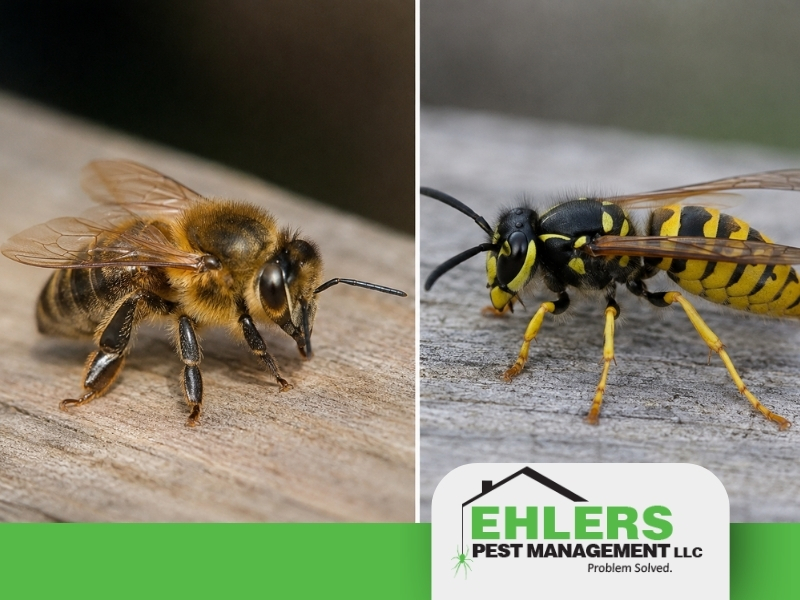
Close-up photos of a honeybee on the left and a wasp on the right, both resting on wooden surfaces, highlight the need for professional bee and wasp removal. At the bottom is the Ehlers Pest Management LLC logo.

Most Milwaukee homeowners who search for bee and wasp removal are looking at wasps. That distinction matters more than it sounds, because the two get handled in completely different ways. Wasps, hornets, and yellow jackets are pest control work, and a certified technician treats the nest. Honeybees are a beekeeper’s job, and they get relocated rather than killed. Telling them apart takes about thirty seconds once you know what to look at.

Here’s how to identify what’s on your property, and what happens next depending on the answer.

What’s the fastest way to tell a bee from a wasp?

Four things give it away, and you can check them from a comfortable distance.

  • Body shape. Bees are round and fuzzy, almost like they’re wearing a coat. Wasps are smooth, shiny, and pinched sharply in the middle, with an obvious narrow waist.
  • Legs in flight. A wasp lets its back legs hang down while it flies. A bee tucks everything up close to the body.
  • Where you find them. Bees work flowers and flowering shrubs. Wasps show up at your grill, your trash can, your pet’s food bowl, and anything sweet you left outside.
  • Color. Yellow jackets are bright, sharp yellow and black with clean stripes. Honeybees are softer, more amber or golden brown, and they look dusty.

If the insect is smooth, striped, and hovering around your picnic, you have wasps. If it’s fuzzy, rounded, and busy on the hydrangeas, leave it alone.

Which stinging insects actually show up around Milwaukee homes?

Southeastern Wisconsin gives you a fairly short list, and most of it turns up between June and October.

Yellow jackets are the ones people call about most in September. Smooth bodies, bright markings, and they nest out of sight in wall voids, under decks, and in holes in the ground. They’re the most aggressive stinging insect in the state and they get worse as the season ends.

Paper wasps build the open, umbrella-shaped nest you can see hanging under a soffit or a porch ceiling. Long legs dangling in flight, slower and less aggressive than yellow jackets until you get close to the nest.

Bald-faced hornets build the enclosed gray nest that people describe as football-shaped, usually in a tree or against a wall. They defend a wide radius around it.

Honeybees are amber and fuzzy, and they don’t build exposed nests on your house. If you have honeybees, they’re either passing through, or they’ve moved into a wall void or a hollow tree and you’ll see a steady column going in and out of one small opening.

Bumble bees are large, very fuzzy, and mostly harmless to people. They nest in the ground, under sheds, and in compost piles, and a colony is usually a few dozen insects rather than a few hundred.

Carpenter bees look like bumble bees with a shiny black rear end instead of a fuzzy one. The tell is the hole: a perfectly round opening about the diameter of a pencil, drilled into fascia, deck rails, or trim.

Mining bees are the small ones that leave little dirt mounds in thin patches of lawn in spring. They’re solitary, they don’t defend anything, and they’re gone in a few weeks.

What’s nesting in the ground in my yard?

This is the question we get most often, and the answer is usually one of three things.

If it’s April or May and you’re seeing dozens of small dirt volcanoes across a bare patch of lawn, those are mining bees. Each hole is one solitary bee. They don’t swarm, they rarely sting, and they’ll be finished before Memorial Day.

If it’s summer, the insects are big and fuzzy, and there are maybe a dozen coming and going from one hole under a shed or a landscape timber, that’s a bumble bee colony. Give it space and the colony will be gone by the first hard frost.

If it’s August or September, the insects are smooth and bright, and there’s heavy traffic pouring in and out of a single hole all day long, that’s yellow jackets. This is the one that matters. A mature ground nest can hold close to a thousand insects, and running a lawn mower past the opening is how most people find out it’s there.

Do honeybees have to be removed, or can they stay?

We don’t kill honeybees, and we’ll tell you that on the phone. If you’ve got a honeybee colony, call a beekeeper. Plenty of local beekeepers will collect a swarm at no charge, because a free colony is worth having.

A colony that’s moved into a wall void is a bigger job than a swarm hanging on a branch. Comb and honey inside a wall will eventually attract ants, roaches, and rodents, and honey can work its way through drywall. That still isn’t an extermination job. It’s a removal and relocation job, and it takes a beekeeper who does structural cutouts, sometimes working alongside a contractor to open and close the wall.

Any pest control company that offers to spray a honeybee colony out of your wall should give you pause. That leaves dead bees, abandoned comb, and several pounds of honey in the cavity, which becomes a second pest problem a few months later.

When does bee and wasp removal actually mean a pest control call?

When it’s wasps, hornets, or yellow jackets, and there’s a reason to act.

Paper wasps under a soffit near a door or a deck are worth treating, especially if the nest keeps coming back to the same spot every year. Ongoing service handles that better than one-off calls, because the nests get knocked down before they establish.

Yellow jackets in a wall void, under a step, or in the ground near a walkway are worth treating now. These are the ones that put people in urgent care in September.

Carpenter bees drilling into structural wood are worth an inspection. The individual bee isn’t dangerous, and the tunneling adds up over several seasons, especially once woodpeckers start opening the galleries to get at the larvae.

Two situations where the answer is no. Yellow jacket nests above eight feet don’t get treated, because that means putting a technician on an extension ladder next to an agitated colony. And a yellow jacket nest in a far corner of the yard that nobody walks past will die off on its own once the weather turns, so waiting it out is a legitimate choice.

What if you can’t tell what you’re looking at?

Take a photo from as far back as your phone will let you, and pay attention to the traffic pattern instead of the individual insect. Steady two-way movement through one small opening tells a technician more than a blurry close-up does.

Bee and Wasp Removal Milwaukee: Which Do You Have?

Categories Pest Treatment & Services

Wasp Nest Removal in Milwaukee: Why September Is Peak Season

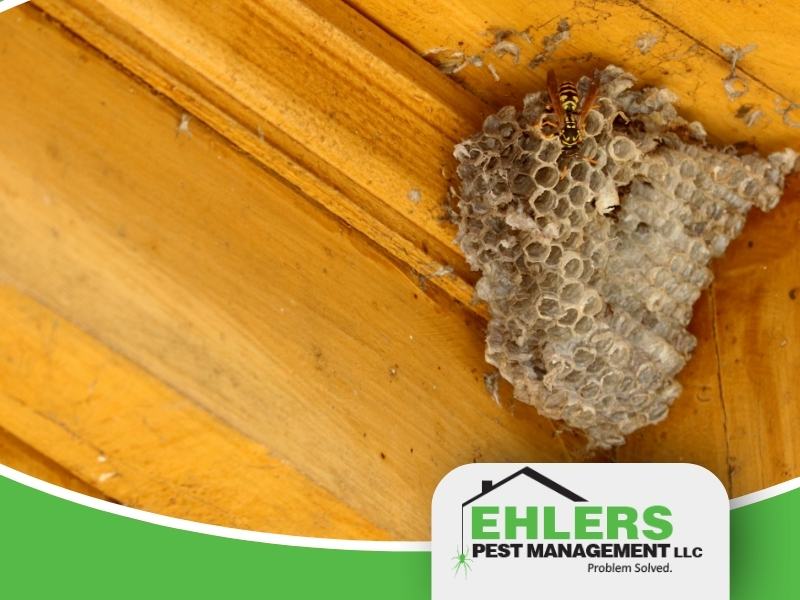
A wasp nest attached to the corner of a yellow wooden ceiling, with a wasp on it—an all-too-common sight that highlights the need for professional wasp nest removal Milwaukee services. The Ehlers Pest Management LLC logo is visible in the lower right corner.

If you’re looking for wasp nest removal in Milwaukee right now, you’ve hit the worst month of the year to have a nest on your house, and that isn’t bad luck. September is when wasp and hornet colonies reach their maximum size. A yellow jacket nest that started with a single queen in April can hold close to a thousand workers by Labor Day. Those workers are running short on food, they’re far more aggressive than they were in July, and they’ll defend the nest over almost nothing. If there’s a nest on your property, this is the month it turns into a real problem.

Here’s what’s actually happening in that nest, how to tell what you’re dealing with, and when it’s worth calling someone.

Why are wasps more aggressive in September?

It comes down to colony math and a food supply that runs out.

A yellow jacket colony starts every spring with one queen. She builds a small nest, raises the first workers herself, and from there the workers take over. All summer the colony grows. By late August or early September it’s at peak population, which for yellow jackets in southeastern Wisconsin often means several hundred to a thousand insects in one nest.

At the same time, the queen stops laying. The larvae she’d been raising were feeding the adult workers a sugary secretion, and once that supply dries up, the workers go looking for sugar somewhere else. That’s why they suddenly show up at your grill, your garbage can, your kids’ juice box, and the last inch of soda you left on the deck rail.

So you’ve got the most wasps you’ll see all year, they’re hungry, and they’re spending their time exactly where people are. Sting calls spike in September for that reason. The wasps didn’t change. Their situation did.

What does a wasp nest look like at full size?

That depends on what’s living in it, and the differences matter more than people expect.

Paper wasps build the open, umbrella-shaped nest you can see hanging under a soffit, an eave, a deck rail, or a porch ceiling. The cells are visible from below. These nests stay relatively small and they’re usually easy to spot.

Bald-faced hornets build the enclosed gray nest people describe as football-shaped or basketball-shaped, usually in a tree, on a wall, or tucked into a corner of a roof line. By September these can get genuinely large.

Yellow jackets are the ones you often can’t see at all. They nest inside wall voids, under decks and porches, in gaps behind siding, and in holes in the ground. The nest itself is hidden, so what you notice instead is traffic: a steady stream of wasps going in and out of one specific spot, over and over, all day. If you’re watching insects disappear into a gap in your siding or a hole in the lawn, that’s a yellow jacket nest, and it’s bigger than it looks.

Is it paper wasps or yellow jackets, and does it change the treatment?

It changes it quite a bit.

Paper wasps build visible external nests and they keep building all season. If your house tends to collect them under the soffits every year, ongoing service works better than one-off calls, because a technician knocks the nests down before they get established.

Yellow jackets go into voids and ground holes, and they’re typically handled on a one-time, as-needed basis. When we treat one, we’re treating a specific nest in a specific location, not doing a general perimeter spray and hoping.

Two honest limits worth knowing before you call anyone. Our technicians don’t treat yellow jacket nests above eight feet, because that puts someone on an extension ladder with a thousand agitated insects, and we’re not going to ask that of our people. And yellow jacket colonies die off naturally at the end of the season, so if you’ve got a high nest in a spot nobody walks past, waiting it out is a legitimate option.

One more thing that comes up every fall. If what you’re seeing is honeybees, we’ll tell you to call a beekeeper. We treat paper wasps, yellow jackets, and hornets. We don’t kill honeybees, and any pest control company that offers to should give you pause.

Can you remove a wasp nest yourself?

Sometimes, and September is the month when the odds get worse.

A small paper wasp nest, visible, reachable from the ground, early in the season, is something plenty of homeowners handle with a can of spray. That’s a reasonable call.

A mature nest in September is a different situation, for four reasons:

  • The population is at its highest point of the year, so a nest that would have released a dozen wasps in June releases hundreds now.
  • Anything that requires a ladder puts you above the nest with no way to retreat quickly, which is how most serious stinging incidents happen.
  • Ground nests don’t take spray the way exposed nests do, and the colony comes out at you rather than staying put.
  • Knocking a nest inside a wall void scatters the colony into the wall cavity, and from there they find their way into living space. We get called for this every year, and it’s a harder job than the original nest would have been.

If anyone in the house has a sting allergy, skip the deliberation entirely and let a technician handle it.

How fast can you get wasp nest removal in Milwaukee?

Usually same day, depending on where you are and what the schedule looks like when you call.

When we come out, the person who shows up is a certified, licensed, and insured technician. They inspect the situation, tell you what you’ve got, and do the work on that visit. There’s no salesperson stopping by first and a different crew showing up next week. The person looking at your nest is the person treating it, and they know southeastern Wisconsin homes well enough to find the nest you couldn’t.

That matters more in September than any other month, because a hidden nest that gets found in the first week costs you a phone call. The same nest found in October, after the colony has worked its way behind your siding, costs you considerably more than that.

What to do right now

Walk the perimeter of your house once and look at the roof line, the soffits, the deck, and the corners of the porch. Then stand still for a minute and watch for traffic going into siding gaps, foundation cracks, or holes in the lawn. Those two checks catch most nests.

If you find one, call us at (414) 303-6926, or schedule an inspection online. A technician can tell you over the phone whether it’s something to watch or something to treat, and if it needs treating, we’ll get out there.