

Most people start looking into flea control in Milwaukee in October, after weeks of assuming the problem was handled. The pet got its treatment, the scratching slowed down, and then the bites showed up on someone’s ankles anyway. That pattern isn’t a failed product. It’s what happens when the part of the infestation living in your floor gets ignored.
Here’s why fall is the worst for fleas in southeastern Wisconsin, how to confirm what you’re dealing with, and what actually ends it.
Flea control in Milwaukee is a fall priority because populations peak in late summer and early fall, then move indoors with pets. Treating the pet alone rarely finishes the problem, since adult fleas on the animal are a small share of the population. The rest sits in carpet, bedding, and floor cracks.
Why do fleas get worse in fall?
Outdoor flea populations build through the whole warm season and reach their highest point in late summer and early fall. Every week a pet spends in the yard from June through September is a week of picking up more of them.
Then October happens. Nights get cold, pets spend more time indoors, the furnace comes on, and the house holds a steady temperature for the next six months. Fleas that make it inside at that point have found somewhere the season never changes. A Wisconsin winter ends the outdoor population. It does nothing at all to the one in your living room.
That’s the reason fall is the pivot. Deal with it in October and you’re interrupting a problem before it settles in. Wait until the bites get bad in January and you’re dealing with a population that’s been breeding in your carpet for three months.
Why does treating the pet never seem to finish it?
Because the animal is the visible part of a much larger population, and a relatively small part of it.
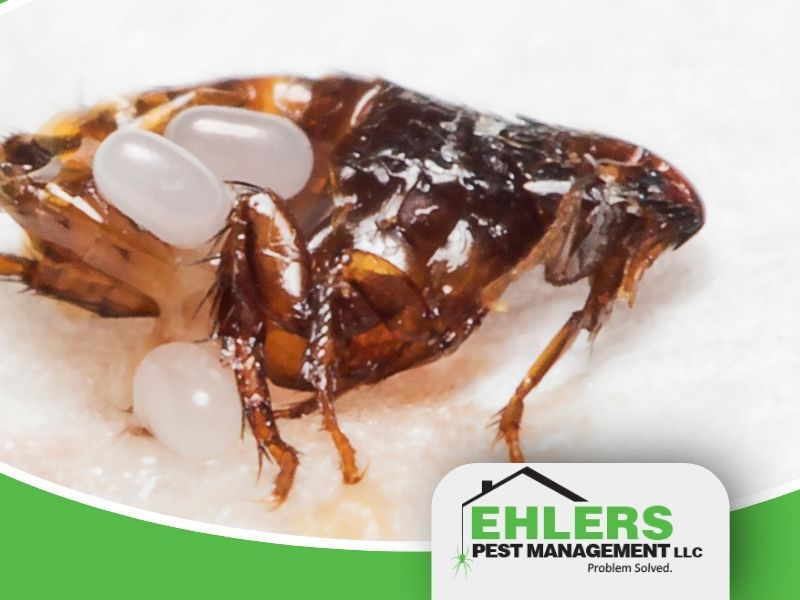
Adult fleas living on your pet are roughly one in twenty of what’s in the house. The other nineteen are in a stage you can’t see. Eggs get laid on the animal, then fall off wherever it sleeps, walks, and lies down. Larvae hatch in the carpet and burrow down toward the base of the fibers, away from light. Pupae spin a sticky cocoon that collects dust and debris and sits protected in the fabric.
So a product that kills fleas on the pet is doing exactly what it says. It just isn’t touching the eggs in the rug, the larvae in the floorboard cracks, or the pupae under the couch. Those keep maturing, and they keep finding the pet.
How do you confirm it’s actually fleas?
Three checks, and you can do all of them in a few minutes.
- Flea dirt. Comb the pet over a sheet of white paper, especially at the base of the tail and along the spine. If the black specks that fall out smear reddish brown when you dab them with a damp paper towel, that’s digested blood, and it confirms fleas.
- Bite pattern. Flea bites on people land on the ankles and lower legs, usually in small clusters, because fleas jump from the floor rather than traveling across the body.
- The white sock test. Put on white socks, walk slowly across suspect carpet for a few minutes, then look at your ankles. Newly emerged fleas jump toward movement and show up clearly against white.
Where are the fleas actually coming from?
Your pet is the obvious answer and it’s often not the whole one, particularly in older Milwaukee neighborhoods.
Wildlife is the source people miss. Squirrels, raccoons, opossums, and outdoor cats nest under decks, porches, sheds, and in crawl spaces, and they bring fleas with them. When that animal moves on or dies, the fleas it left behind start looking for the next warm-blooded thing in the area, and the nearest one is inside your house. We see this every fall on properties with an open deck or a crawl space that something has been getting under.
Two other routes worth knowing about. Moving into a home where the previous residents had pets can set off a wave of hatching, because dormant pupae respond to footsteps and body heat after sitting empty for weeks. And secondhand upholstered furniture brings them in the same way it brings in other things.
What does flea control in Milwaukee involve?
An inspection first, to confirm the species, find where the population is concentrated, and figure out whether something outside is feeding it.
Interior work targets the places the immature stages actually live: carpet and rugs, the pet’s resting areas, upholstered furniture, and the cracks where flooring meets baseboard. Exterior work matters when wildlife is involved, and that means treating the shaded harborage under decks and porches and along the foundation, plus dealing with the access that let the animal under there in the first place.
The piece that has to happen alongside all of it is the pet. Premises treatment without a veterinary product on the animal fails, and the product on the animal without premises treatment fails. Your vet handles that side. We handle the building. Both have to be running at once, and this is the most common reason a flea job stalls out.
Why do fleas come back two weeks after a treatment?
Because of the pupae, and this catches almost everyone off guard.
The pupal stage is protected inside a cocoon that treatments have a hard time penetrating. A pupa can sit dormant for weeks or months, waiting. What wakes it up is vibration, warmth, and the carbon dioxide of something breathing nearby. In other words, footsteps.
So after a treatment, pupae keep hatching on their own schedule, and you see adult fleas again a week or two later. That isn’t the treatment failing. Those new adults are emerging onto treated surfaces, which is exactly where you want them, and it’s why flea work takes more than one visit and a few weeks rather than an afternoon.
Vacuuming helps for the same reason. The vibration triggers hatching, which pulls the pupae out of their protected stage and into contact with the treatment. Vacuuming daily for two to three weeks after a treatment does more than most people expect.
What should you do before and after treatment?
Preparation makes a real difference on this one.
- Vacuum thoroughly beforehand, including under furniture, along baseboards, and anywhere the pet sleeps. Empty the canister or bag outside immediately.
- Wash all pet bedding and any washable throws in hot water.
- Pick up items off the floor so the treatment can reach the carpet and the edges of the room.
- Keep vacuuming every day or two for two to three weeks afterward, and keep the pet on whatever your veterinarian prescribed.
One thing to avoid: don’t shampoo or steam clean carpets right after a treatment. That removes the material you just paid to have applied, right when the pupae are starting to hatch into it.
What to do next
If you’re seeing bites around your ankles, catching the pet scratching at the base of the tail, or finding flea dirt in the bedding, this is worth dealing with now rather than in February. The population is at its annual high right now and your house is about to hold a steady temperature until spring.
Talk to Ehler’s Pest Management’s experienced team at (414) 303-6926 to schedule service. A certified technician will inspect the property, confirm what you have, check whether something under the deck or in the crawl space is feeding the problem, and lay out what the treatment sequence looks like. We’ll also tell you plainly what needs to happen on the veterinary side, because the work only holds if both halves happen together.