
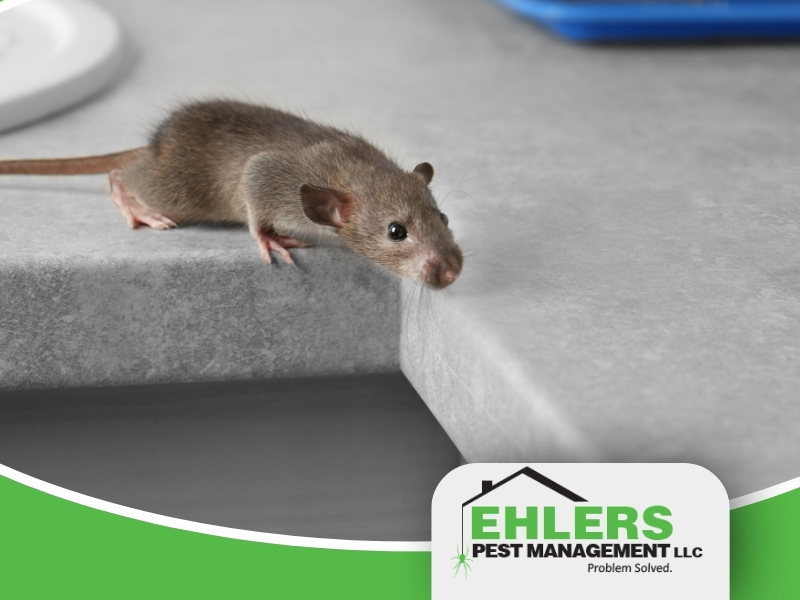

Commercial rodent control in Milwaukee is a fall decision that shows up as a winter outcome. Rodents move toward heated buildings as the ground cools in September and October, and a commercial property has far more ways in than a house does: dock doors, deliveries, floor drains, roof penetrations, and a trash area that stays busy all day. The buildings that get sealed and monitored now stay quiet. The ones that don’t tend to surface in January, often during an inspection.
Here’s what to have handled before the first freeze, broken out by the three property types where this goes wrong most often.
Why does fall decide how your winter goes?
Because rodent pressure is seasonal and building vulnerability isn’t.
A gap under a dock door is a gap in July too. What changes in fall is the number of rodents actively looking for it. Once they’re inside a heated commercial building with a food source, they stop being a perimeter problem and become an interior one, and interior populations in a warehouse or a school are considerably harder and more disruptive to resolve than exterior pressure is.
There’s a documentation angle too. If a finding turns up on an inspection in February, what protects you is a record showing you had a program running and acted on what it found. That record has to have been created before the inspection, which means the work happens now.
What should a restaurant have done before October?
For a restaurant, the back of house is where these problems start, and most of it is operational rather than chemical.
- Back and dock doors. Propping them open during deliveries and shift changes is the single most common way rodents get into a restaurant. Door sweeps get worn down fast in a commercial kitchen and need checking, not assuming.
- Dumpster and grease container placement, distance from the building, lid discipline, and the condition of the pad underneath. A dumpster area is a food source with an address.
- Floor drains and grease traps, which are both an entry route and a harborage.
- Dry storage held off the floor and away from walls, with enough clearance to actually inspect behind and under the shelving.
- Employee areas and lockers, where food gets stored and forgotten.
- The base of walk-in coolers and the utility penetrations behind equipment, which are warm, dark, and rarely looked at.
On the compliance side, evidence of rodent activity is a serious finding on a health inspection, and what an inspector wants alongside the absence of evidence is a documented program with service records. Having the records and not needing them is the goal.
What’s different about a warehouse?
For a warehouse, rodent vulnerability comes from scale, dock doors, and the fact that rodents arrive on the truck.
Dock doors and dock levelers are the largest recurring opening in almost any warehouse, and the gaps at the corners of a leveler pit are a standing invitation. Brush seals and dock shelters wear out on a schedule nobody tracks, and fall is the right time to walk them.
Incoming freight is the other route. Rodents travel in on pallets and in packaging, which means an interior population can establish in a building whose exterior is sealed well. Receiving inspection catches this and almost nobody does it consistently.
Inside, the practical problem is racking against walls. Product stored tight to the perimeter blocks the aisle a technician needs to inspect and monitor, and it creates protected harborage the length of the building. Keeping a clear perimeter aisle is worth more than any product you can apply.
The cost side isn’t just contamination. Chewed packaging writes off inventory, and rodents gnawing wiring in a racking system or a mechanical room is a fire exposure that most operations don’t price in until it happens.
What do schools need to account for?
For schools, it’s two things: the summer gap, and Wisconsin’s posting requirements.
Summer break is when populations establish without anyone noticing. Buildings sit quiet, kitchens are idle, custodial routines change, and by the time staff return in late August a small problem has had ten weeks to grow. Fall reopening is when it gets discovered, which is exactly the wrong time.
The places to check first are the kitchen and cafeteria, dry storage, custodial closets, boiler rooms and tunnels, classroom areas where food or classroom pets are kept, and any storage holding food, seed, or plant material.
On the regulatory side, Wisconsin governs pesticide use in schools under Wis. Stat. 94.715, with the detail in ATCP 29. Notice of each pesticide application has to be posted for 72 hours from the time of application, with signs placed where people would see them before entering the treated area, and different signage for indoor and perimeter applications versus lawn and field applications.
Here’s the part worth knowing if you manage a school facility. Mechanical rodent traps are exempt from those posting requirements. That means a rodent program built on exclusion, monitoring, and mechanical trapping can run without triggering the notification and posting burden that comes with pesticide applications. It’s a practical reason that approach fits schools well, on top of being the approach that actually resolves rodent problems.
What does commercial rodent control in Milwaukee actually include?
An inspection first, then a program built around what the inspection found rather than a standard route.
On the exterior, that means mapped monitoring and bait stations placed where the pressure actually is, exclusion work on the openings a building has, and honest recommendations about sanitation and storage that sit outside what a pest control company can fix. On the interior, it means monitoring devices and mechanical trapping in the areas where product, food, or people make other approaches inappropriate.
Service is typically monthly for commercial accounts, and rodent work in particular is year-round rather than seasonal, because commercial buildings don’t stop having doors. Every visit should produce a service report that names what was found, what was done, and what still needs attention from your side.
Rodent control is the majority of the work we do, across commercial buildings, homes, and smaller multi-unit properties. It’s the thing we’re set up for.
What does an inspector or an auditor actually want to see?
Five things, and most programs have the first four.
- A current service agreement.
- A site map showing device locations and numbering.
- Service reports for every visit, with findings recorded rather than a checkbox.
- Applicator licensing and product documentation on site.
- Evidence that findings got acted on.
The last one is where programs fail. A log showing the same finding at the same device for six consecutive months, with no corrective action recorded, is worse than no log at all, because it documents that you knew. A good program closes items out and shows the trend going the right direction.
Who we work with, and who we don’t
We work with independently owned local businesses. Offices, warehouses and shops, banks and credit unions, small pubs and independent restaurants, and schools.
We’re not a fit for national chains that need centralized billing across multiple regions, and we’ll tell you that rather than take the account and underperform. We don’t service 24-hour operations, because we’re not staffed to work a kitchen at two in the morning and pretending otherwise wouldn’t serve you. For restaurants, we work best with operations that close at least one day a week. General pest control doesn’t require you to be closed, though specialty work does. And we don’t take general maintenance contracts at large apartment complexes.
What to do next
Walk your dock doors, your back doors, and your trash area this week, and look at the gaps rather than the doors. That’s a fifteen-minute exercise that tells you most of what you need to know about how your winter is going to go.
If you want a professional look at it, call Ehlers Pest Management at (414) 303-6926 to schedule a commercial inspection. A certified technician will walk the building, tell you what they found and where, and give you a program built around your property and your operation.