

If you’ve been finding centipedes in Wisconsin basements this fall, you’ve probably also found a few other things down there. Millipedes curled up on the floor, crickets that hop instead of chirp, and something silver that darts under the water heater when the light comes on. Those four show up together for the same reason, and once you know what that reason is, the answer to all of them is mostly the same.
Here’s what each one actually is, which of them can do damage, and what finding them repeatedly is telling you about the building.
Centipedes in Wisconsin basements usually turn up alongside millipedes, camel crickets, and silverfish. All four are drawn to moisture, and three of them wander in from outside and die there. Finding them repeatedly points at a damp basement or crawl space rather than an infestation.
What are these things in my basement?
Four species account for almost every call we get about basement bugs in southeastern Wisconsin.
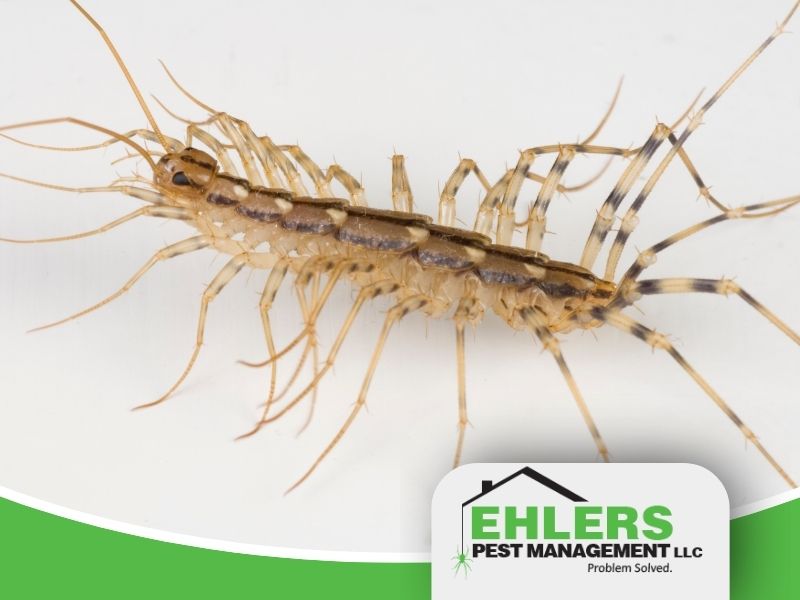
House centipedes are the fast ones with the long legs, grayish yellow with dark stripes down the back, roughly an inch of body and a lot more leg. They move in quick bursts and stop dead. People find them genuinely alarming and they’re the most harmless thing on this list.
Millipedes are rounded, dark, slow, and segmented, with two pairs of tiny legs on each segment. When they’re disturbed or dying they curl into a tight spiral, which is how most people find them, motionless on the floor near a wall.
Camel crickets, sometimes called cave crickets, are the humpbacked, long-legged, wingless crickets that live in damp basements and crawl spaces. They don’t chirp, and they jump toward you when startled rather than away, which is why they have a reputation. The crickets you hear chirping in October are field crickets, a different insect that comes in from outside.
Silverfish are teardrop shaped, silver gray, with three bristles trailing off the back end. They move with a wriggle that looks like a fish swimming, they’re nocturnal, and they run for cover the moment a light goes on.
Are house centipedes in Wisconsin dangerous?
No, and they’re arguably working for you.
House centipedes are predators. What they eat is spiders, silverfish, small roaches, firebrats, and other soft-bodied insects living in the same damp spaces. They have venom for subduing prey, but their mouthparts struggle to break human skin, and bites are rare and comparable to a mild sting when they happen. They don’t damage the building, they don’t get into food, and they don’t carry disease.
Here’s the part worth acting on though. Unlike most things in this article, house centipedes can live indoors for years, and they only stay where there’s food. A basement with a persistent centipede population is a basement with a steady supply of other insects in it. The centipede is a symptom worth reading rather than the problem itself.
Which of these actually damage anything?
Two of the four, and it’s not the ones people worry about.
Silverfish eat starch. That means paper, cardboard, book bindings, wallpaper paste, photographs, and the glue in box seams, along with dried goods in a pantry. Boxes of stored documents, photo albums, and anything on a basement shelf are what they go after, and the damage is slow enough that people usually find it long after it started.
Camel crickets chew too. Fabric, paper, cardboard, and stored clothing are all fair game, and a large population in a crawl space can do noticeable damage to anything boxed up down there.
Millipedes and centipedes damage nothing. Millipedes do release a defensive fluid that can stain and has an unpleasant smell, which is a reason not to squash them on a light-colored floor.
Why do they all show up in fall?
Because the moisture outside changes, and moisture is the only thing all four of them care about.
Millipedes and field crickets live outdoors in leaf litter, mulch, and damp soil. When fall brings the first cold nights, or when a heavy rain floods their harborage, they move. A foundation wall is warm and the gaps along it lead somewhere sheltered, so they end up in the basement by accident. Most of them die within a few days, because there’s nothing down there for them to eat and the air is too dry to survive in for long.
Centipedes, silverfish, and camel crickets are a different case. They were probably already there. What changes in October is that the furnace comes on and dries out the upstairs, which concentrates them in whatever damp space is left. That’s usually the basement, the crawl space, or the bathroom, and it’s also where you’ve started going more often to pull out storage bins.
What does it mean if you keep finding them?
That the building has more moisture in it than it should.
One millipede on the floor in October is normal in Wisconsin and means nothing. Finding them every few days through the fall means something along the foundation is staying wet. Same with silverfish. Same with camel crickets.
The usual culprits are a downspout dumping against the foundation, grading that slopes toward the house rather than away, mulch or leaf litter piled against the siding, a crawl space with no vapor barrier, a dehumidifier that quit, or a slow plumbing leak nobody has found yet. That last one is worth ruling out, because an unexplained silverfish population in one corner of a basement has more than once turned out to be a leaking supply line inside a wall.
What actually reduces them?
Drying the space out does more than any product, so start there.
- Run a dehumidifier in the basement or crawl space and keep it running through fall. Getting relative humidity down is the single most effective thing available.
- Extend downspouts well away from the foundation, and check that grading carries water away from the house rather than toward it.
- Pull mulch, leaf litter, and stacked firewood back off the siding and foundation. That’s where millipedes and crickets live before they come inside.
- Get stored items off the floor and out of cardboard. Plastic bins with lids remove both the food source and the harborage for silverfish.
Sealing helps too, and it’s the same list of gaps that keeps mice out: the sill plate, utility penetrations, basement window frames, and the gaps around a bulkhead or garage door.
When is it worth calling someone?
When the moisture work is done and they’re still there, or when the population is clearly established rather than wandering in.
A perimeter treatment around the foundation reduces the wanderers, since millipedes and crickets have to cross treated ground to reach the building. Silverfish and camel crickets need interior work, because they breed indoors and drying the space alone takes a long time to catch up with an established population.
One honest note on centipedes. Treating for centipedes specifically accomplishes very little. They’re there because other insects are there, so the work that matters is reducing the population they’re feeding on and taking the moisture away. Handle those and the centipedes leave on their own.
What to do next
Go down to the basement and look at the floor along the walls rather than in the middle of the room. That’s where you’ll find them, and the corner they’re concentrated in usually points straight at the moisture source. Check what’s directly outside that corner while you’re at it, because the answer is often a downspout.
Ehlers Pest Management works across southeastern Wisconsin, and you can reach our experienced team at (414) 303-6926 to schedule service. A certified technician will identify what you actually have, look at the moisture conditions feeding it, and tell you whether this needs a treatment or a dehumidifier and a downspout extension. Sometimes it’s the second one, and we’ll say so.