
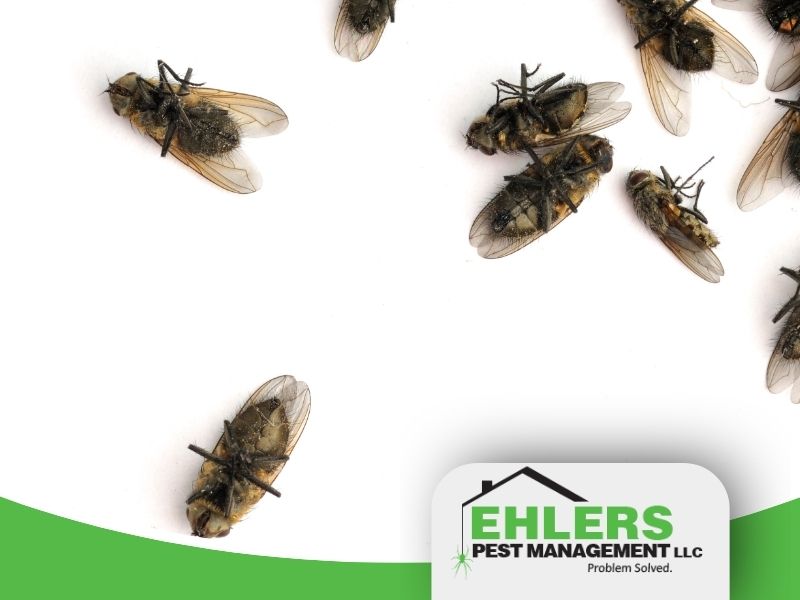

Cluster flies in Wisconsin show up the same way every year. A warm October afternoon, a dozen slow flies bumping around an upstairs window, and no obvious reason for them. There’s no garbage nearby, nothing rotting, and the house is clean. People find it unsettling for exactly that reason, because the usual explanation doesn’t fit.
It doesn’t fit because these flies have nothing to do with sanitation. Here’s where they actually come from, how to tell them apart from the flies that do mean something, and what reduces them.
Cluster flies in Wisconsin gather on sunny walls in fall and work their way into attics and wall voids to overwinter. They come from earthworms in the soil rather than garbage or drains, so finding them says nothing about how clean a house is.
What are cluster flies?
They’re a group of flies that spend their larval stage inside earthworms.
The adult female lays her eggs in soil. The larvae that hatch out find an earthworm, enter it, and develop inside it over a few weeks. Several generations run through that cycle over a Wisconsin summer, entirely outdoors and entirely out of sight.
So the population building up around your house all season has been living in your lawn, your garden beds, and the field behind you. Properties with a lot of turf, open ground, or pasture nearby get the heaviest pressure, which is why this is more common in the suburbs and out toward the county lines than it is downtown.
Why are there flies at my window in October?
Because the last generation of the year is looking for somewhere to spend the winter, and your house is the warmest thing in the neighborhood.
On sunny fall afternoons they gather on south and west facing walls, the same warm surfaces that collect box elder bugs and Asian lady beetles. From there they work into gaps around window and door frames, under siding, at soffit and fascia joints, and through attic and gable vents. What they’re aiming for is an unheated but protected space, so attics, wall voids, and rooms nobody uses are where they settle.
Then they go quiet. What brings them back out is a warm spell, which in Wisconsin can be a sunny January afternoon as easily as an October one. The warmth wakes them, they move toward light, and they end up at the nearest window, which is usually upstairs. That’s why this problem tends to announce itself in a spare bedroom or a bathroom on the top floor.
They’re slow and clumsy when they emerge, which is a useful tell. A fly you can catch with a cup is not a house fly.
Are they a sign the house is dirty?
No, and this is the part worth saying plainly, because it’s the first thing most people assume.
They don’t breed in garbage, they don’t come up from drains, and they don’t feed on waste. They can’t reproduce indoors at all, because their entire life cycle requires soil and earthworms. A house with cluster flies in the attic has good soil outside it and gaps in the building envelope. That’s the whole story.
We’ve found them in immaculate homes, brand new construction, and houses that had been deep cleaned the week before. It’s a building and landscape situation rather than a housekeeping one.
How do you tell them from house flies and blow flies?
This matters more than it sounds, because one of the three means something is genuinely wrong.
Cluster flies are slightly larger than a house fly, dark gray, and sluggish. The reliable marks are short golden or yellowish hairs on the thorax, just behind the head, and wings that overlap across the back when they’re at rest. They show up in groups, at windows, on warm days.
House flies are smaller, faster, and hold their wings apart in a V shape when resting. If you’re seeing quick flies around a kitchen, a trash can, or a drain, that’s a different problem with a different cause.
Blow flies are the ones to pay attention to. They’re metallic, shiny blue or emerald, and unmistakable once you’ve seen one. A sudden appearance of blow flies indoors usually means something died in a wall void, a chimney, or an attic, most often a mouse or a bird. If the flies at your window are shiny and metallic rather than dull gray, the fly isn’t the problem you need to solve.
Do they cause any harm?
Very little directly, and a bit indirectly.
They don’t bite, they don’t damage the structure, and they don’t carry the contamination risk that flies breeding in waste do. What they do leave behind is small dark spots on walls, window frames, and curtains, and a greasy smear if you swat one against a painted surface.
The indirect problem is the same one that comes with box elder bugs. A large number of flies dying inside a wall void or attic becomes a food source for carpet beetles and larder beetles, and those do damage wool, stored fabric, and dry goods. That’s the real argument for keeping them out rather than letting them in and vacuuming the survivors every spring.
What reduces cluster flies in Wisconsin homes?
An exterior treatment applied before they get in, and sealing after they’re gone.
The window for exterior work is late summer into early fall, while the flies are still massing on the outside walls. A treatment on the siding, eaves, soffits, and around window and door frames reduces how many make it into the structure. Once they’re inside a wall void or an attic, that opportunity has passed for the year, because spraying doesn’t reach them in there and treating a cavity full of insects creates the dead-insect problem described above.
Sealing is the durable half. Soffit and fascia gaps, siding seams and corners, the openings around vents and utility penetrations, gaps at window and door frames, and attic or gable vents with damaged screening. That’s the same list that keeps mice and box elder bugs out, so one pass handles several problems.
Being straight about the result: even a well-timed exterior treatment on a property with heavy pressure won’t get you to zero. It reduces the number substantially. Any company promising a fly-free attic is setting you up to be disappointed.
What should you do with the ones already inside?
Vacuum them, and use something you can empty outside.
Don’t swat them against walls or window trim, because of the spotting. And don’t spray insecticide along interior window sills for this, since it accomplishes very little against insects that are emerging from a wall cavity a few at a time over several months.
If you want to know where they’re coming from, pay attention to which room and which window. Flies concentrating at one upstairs window on warm days point at the wall or attic space right behind it, and that’s the information a technician needs to find the entry point outside.
What to do next
If you’re seeing them now, note the room and the wall, then walk outside and look at that same section of the house for gaps at the soffit, the siding seams, and around the window frames. The exterior window for treatment is open in early fall and it closes once they’ve moved into the walls.
Ehlers Pest Management serves southeastern Wisconsin, and you can reach our experienced team at (414) 303-6926 to schedule service. A certified technician will confirm what kind of fly you actually have, which matters more than people expect, find where they’re getting in, and treat the exterior. If it turns out you have blow flies rather than cluster flies, we’ll tell you that too, because that’s a different job entirely.