
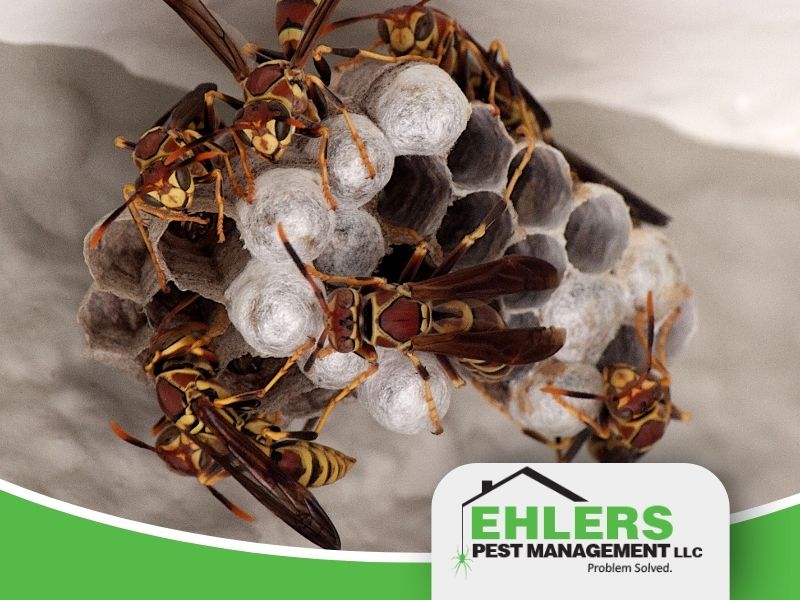
Every fall, once the leaves come down, people find the wasp nest that was hidden in the tree or under the eave all summer and want to know what to do with it. The useful answer is that a wasp nest in winter is already empty, it will never be used again, and whether to take it down is mostly a question of how it looks.
Here’s what actually happened inside it, why the wasps won’t be back, and what is genuinely worth doing before spring.
A wasp nest in winter is empty. Yellow jacket and hornet colonies die off completely in Wisconsin, and only newly mated queens survive by sheltering elsewhere. No wasp species here reuses an old nest, so last year’s nest will never be occupied again.
Is the nest still alive?
By late fall in Wisconsin, no.
A yellow jacket or bald-faced hornet colony runs for a single season. It starts with one queen in spring, builds all summer, peaks in late August and September, and then produces the next generation of queens and males. Once that’s done the colony has finished its purpose. The workers die, the old queen dies, and the nest is finished by the time you’ve had a few hard freezes.
The only survivors are the newly mated queens, and they don’t stay in the nest. They leave and find somewhere protected to overwinter on their own, which is usually under loose bark, in leaf litter, or inside a structure.
Do wasps come back to the same nest?
No. None of the species in Wisconsin reuse an old nest.
Each spring a surviving queen starts over from scratch, building a small nest alone and raising the first workers herself. She doesn’t return to where she was born and she doesn’t repair an existing nest. The papery structure hanging in your tree is a finished object, not a dormant one.
Left alone outdoors, an old nest breaks down over the winter and spring. Rain, wind, and freeze-thaw cycles take it apart, and birds pull it apart further for nesting material.
Why do wasps keep nesting in the same spot then?
Because the location is good, not because the nest is there.
This is the part that confuses people, and it’s a real pattern rather than a coincidence. If the same soffit corner, porch ceiling, or shed eave gets a paper wasp nest every single year, that spot has the combination wasps look for: sheltered from rain, warm in the afternoon, protected from wind, and near a food supply.
A queen scouting in April evaluates the same conditions the last one did and reaches the same conclusion. Removing the old nest changes nothing about that. Changing the conditions or blocking access does.
Should you remove a wasp nest in winter?
Sometimes, and the reasons have nothing to do with preventing next year’s wasps.
Worth removing: a nest that looks bad somewhere visible, a nest pressed against siding or trim where it traps moisture, and any large nest inside a structure. That last one matters most, because the dead brood and comb left in a wall void or attic becomes a food source for carpet beetles and larder beetles, and those go on to damage wool and stored fabric.
Fine to leave: an exterior nest high in a tree or on a garage gable where nobody sees it or walks under it. It’ll come apart on its own, and taking it down means getting a ladder out in cold weather for an aesthetic result.
How do you know it’s actually finished?
Watch it before you touch it, and pick your day carefully.
Wait until you’ve had several hard freezes, not just one cold night. A stretch of warm weather in late October can bring stragglers back out, and a nest that seems dead on a forty-degree morning can have activity at two in the afternoon.
Then stand well back on a sunny afternoon, which is when any survivors would be moving, and watch the entrance for several minutes. No traffic in or out over that window generally means it’s done.
Two cautions regardless. Don’t take on a nest that requires an extension ladder, which is our own rule for yellow jacket nests above eight feet, and don’t handle any of this if someone in the household has a sting allergy.
What about the queens that survived?
They’re the part of this worth paying attention to, because they’re the ones that come back.
A large yellow jacket colony can produce a substantial number of new queens before it breaks up, and every one of them needs somewhere to spend the winter. Some find bark, leaf litter, or a rotting log. The rest look for a building, and they settle into attics, wall voids, gaps behind siding, and the folds of insulation.
That’s why people find wasps at an upstairs window during a January thaw. Those insects aren’t from the nest you can see. They’re queens that moved into the structure in September and got woken up by a warm spell.
It also means the number of nests around your property next summer depends partly on how many queens got into your building this fall, which is a thing you can affect.
What about a nest inside a wall?
Different situation, and the timing runs the other way.
A colony inside a wall void or attic is dead by winter like any other, but the material stays there. Comb, dead brood, and dead insects sit in the cavity and attract the scavenger beetles described above, and in a large nest there can be a lot of it.
The practical approach is to seal the exterior entry point over the winter, once activity has stopped, and deal with the cavity itself only if there’s a reason to open it up. Sealing while a colony is active is the mistake, because it traps them and their only remaining exit is into your living space.
What’s actually worth doing this winter?
Closing the openings, which is the thing that affects next year.
Winter is the right window because activity has stopped and the queens haven’t started new nests yet. The list is short: soffit and fascia gaps, siding seams and corners, the openings around vents and utility penetrations, gaps at window and door frames, and attic or gable vents with torn screening.
That’s the same list that keeps mice and box elder bugs out, so one pass covers several problems. And a queen that can’t get into a wall void in April never becomes a thousand-insect colony in September, which is a much easier problem to have prevented than to solve.
What to do next
If the nest is outdoors and out of the way, you can leave it and it will take care of itself. If it’s somewhere visible, wait for a solid cold stretch, confirm there’s no traffic on a warm afternoon, and take it down from the ground or leave it to someone with the right equipment.
The more valuable job is finding where they got in. Ehlers Pest Management works throughout southeastern Wisconsin, and you can reach our experienced team at (414) 303-6926 to schedule service. A certified technician can identify the entry points on your building, tell you which ones matter, and handle the sealing over the winter so the same spot isn’t producing a nest again next August.

John Ehlers is the owner of Ehlers Pest Management. Ehlers Pest Management is a veteran-owned family pest control company with the mission to provide responsible pest management solutions that protect people and the environment throughout every community with exceptional quality service. We service Milwaukee, Oak Creek, Shorewood, River Hills, Fox Point, Whitefish Bay, Racine and beyond.