Categories Cockroaches, Pest Treatment & Services

Cockroach Exterminator Milwaukee: Why They Show Up Indoors in Fall

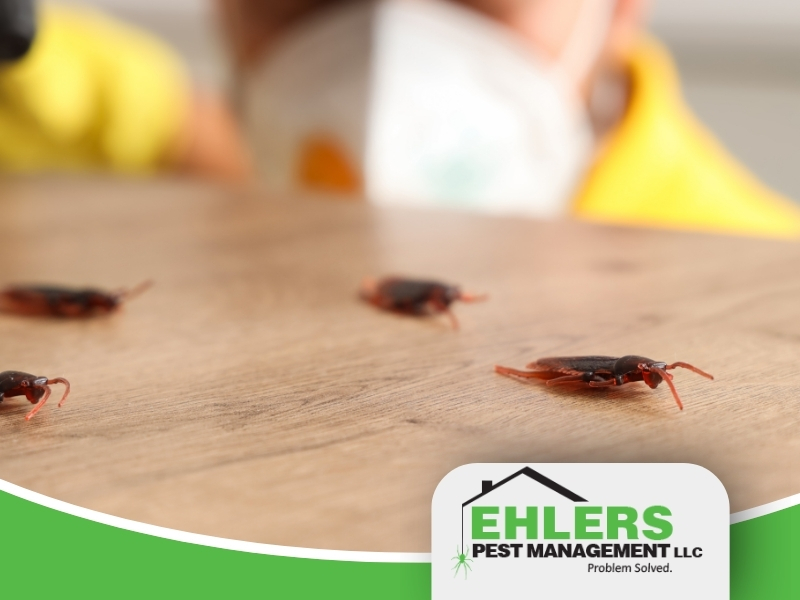
A gloved hand shines a flashlight on a gray sofa, revealing cockroaches inside. The Ehlers Pest Management LLC logo appears in the bottom right corner, highlighting their expert pest control services.

People start looking for a cockroach exterminator in Milwaukee in the fall for two different reasons, depending on which species they have. Some roaches are moving in from drains, sewers, and outdoor harborage as the ground cools. Others were already inside and simply became easier to notice once the furnace kicked on and the house got quiet at night. Either way, seeing one is worth acting on, because roaches are the pest where waiting costs you the most.

Here’s what you’re probably dealing with, why the store-bought approach usually backfires, and what real treatment looks like.

Cockroaches turn up indoors in fall for two reasons. Oriental and American roaches move in from drains and sewers as the ground cools. German cockroaches were already inside and get more active once heating raises indoor temperatures. German cockroaches are the species that produces a true infestation.

Why am I suddenly seeing cockroaches?

Because fall pushes two separate situations to the surface at the same time.

Oriental and American cockroaches live in sewers, storm drains, basements, and damp outdoor spaces. As soil temperatures drop, they follow warmth and moisture into buildings through floor drains, sump pits, utility penetrations, and gaps around basement pipes. In older Milwaukee housing stock with original drain work, this is common every fall and it’s often a small number of individuals rather than a colony.

German cockroaches are a different problem entirely. They live indoors year-round and never came from outside at all. What changes in fall is that heating raises interior temperatures, which speeds up their development, and people spend more evenings at home, which is when roaches are active. The population didn’t arrive. It got bigger and you got more chances to see it.

Which cockroach do you have, and does it matter?

It matters a great deal, because the treatment is different and so is the seriousness.

German cockroaches are small, about half an inch, light brown, with two dark parallel stripes running back from the head. They stay near food and moisture, so kitchens and bathrooms, and they hide in cabinet hinges, under appliances, behind wall plates, and inside the motor housing of a dishwasher or a microwave. This is the species that produces a genuine infestation, and it’s the one that requires specialty work.

American cockroaches are the big ones, an inch and a half or more, reddish brown, with a yellowish figure-eight pattern behind the head. People call them water bugs. They’re usually associated with drains and sewer lines rather than kitchens.

Oriental cockroaches are dark brown to nearly black, slower moving, and strongly tied to damp spaces. Basements, crawl spaces, floor drains, and window wells.

There are also wood roaches, which wander in from outside, don’t establish indoors, and mostly turn up in early summer. If you found one large roach in a basement in September, the honest answer is that it might be nothing. If you’re finding small striped ones in a kitchen, that’s not nothing.

Does one cockroach mean an infestation?

With German cockroaches, effectively yes.

They’re nocturnal and they avoid open space, so at any given moment the large majority of the population is hidden inside a void, a hinge, or an appliance. Seeing one in daylight generally means the harborage is crowded enough to push individuals out into places they’d normally avoid.

The reproduction math is the reason speed matters. A female German cockroach carries an egg case holding roughly thirty to forty eggs, produces several over her life, and the young reach breeding age in a couple of months. A small problem in September is a substantially larger one by the holidays. There isn’t a version of this that stays the same size.

With a single large American or Oriental roach in a basement, it’s reasonable to check your floor drains and watch for a week before doing anything drastic.

Is it because of how clean the house is?

No, and this is worth saying plainly because it stops people from calling.

German cockroaches get into buildings by being carried in. Grocery bags and cardboard boxes, a used appliance, secondhand furniture, a delivery, a suitcase, or a moving truck. In a duplex, a four-family, or any building with shared walls, they travel between units through plumbing chases, electrical runs, and shared voids without any regard for whose apartment is spotless.

We’ve treated immaculate homes and we’ve treated cluttered ones. Cleanliness affects how fast a population grows once it’s established, and it has very little to do with how it started. The technician who comes to your house has seen this many times and isn’t there to form an opinion about your housekeeping.

Do store-bought roach treatments work?

Gel baits, used carefully and placed well, can help. Most of the rest of it makes things worse.

Total-release foggers, the ones people call bug bombs, are the clearest example. The material settles on open surfaces and doesn’t penetrate the voids where roaches actually live, and the repellent effect drives the population deeper into walls and out into adjoining rooms or neighboring units. We’re regularly called to homes that had a contained kitchen problem before someone set off foggers and a building-wide problem afterward.

Aerosol sprays along baseboards have the same scattering effect on a smaller scale. And spraying insecticide over gel bait placements ruins the bait, so the two common approaches actively cancel each other out.

The underlying issue is reach. You can’t treat what you can’t get to, and most of the population is somewhere you can’t get to.

What does a cockroach exterminator in Milwaukee actually do?

For German cockroaches, this is specialty work with a defined protocol, and it looks different from general pest control.

It starts with an inspection to confirm the species and find the harborage, because treating for the wrong roach wastes everyone’s time. From there, treatments run on a schedule of roughly every two weeks, which is set by the life cycle rather than by convenience. Egg cases are protected, so you need applications timed to catch the nymphs as they emerge.

Preparation matters as much as the treatment does. Kitchen cabinets get emptied, clutter gets cleared so the technician can reach the harborage, and the space is vacated during the visit. Incomplete preparation is the single most common reason a roach job has to start over, and it’s worth doing exactly as it’s written.

In a duplex or a multi-unit building, adjacent units get monitored and often treated. Treating one unit while the neighbors go untreated produces a temporary drop and a full recovery.

How long does it take?

Longer than people want, and it should have an ending.

The standard we work to is eight weeks with zero activity before a job is considered resolved. That’s after the treatment sequence, not instead of it, so a German cockroach job is a commitment of a couple of months from start to confirmed finish.

The reason we work that way is that it’s supposed to end. Solve the problem and the work dries up, which is the opposite of the ongoing-maintenance-forever model. If a company is treating your kitchen every month indefinitely and calling that roach control, they’re managing a complaint rather than finishing a job.

What to do next

If you’re finding small striped roaches in a kitchen or bathroom, don’t wait and don’t set off a fogger. Both make the eventual job bigger.

Call Ehlers Pest Management at (414) 303-6926. A certified technician will come out, confirm what species you have, find where they’re living, and tell you what the treatment sequence looks like for your situation. In a multi-unit building we’ll tell you honestly if the neighbors need to be part of it.

Categories Pest Identification & Prevention

How to Prepare Your Milwaukee Home for Fall Pest Season: A Room-by-Room Checklist

Close-up of a yellow spray nozzle releasing mist, with green grass in the background and an Ehlers Pest Management LLC logo in the lower right corner, highlighting professional pest management solutions.

Fall pest control in Milwaukee isn’t something most homeowners think about in August — but that’s exactly when the preparation window opens. By the time October arrives and you’re finding mice in your kitchen or box elder bugs on your walls, the seasonal push has already been underway for weeks. Getting ahead of it now, while the outdoor population is still largely outside, is the most effective and least disruptive approach to fall pest management in a Wisconsin home.

Why Fall Pest Preparation Starts in August in Wisconsin

Wisconsin’s fall pest pressure doesn’t wait for leaves to change. Mice begin scouting for indoor entry points as overnight temperatures start dropping in late August. Box elder bugs begin aggregating on sun-warmed exterior walls in early September. Stink bugs and Asian lady beetles follow a similar pattern, clustering on south and west-facing walls before pushing through gaps into wall voids and attic spaces.

Each of these pests responds to the same environmental trigger — declining overnight temperatures — and acts on it weeks before the first frost. Homeowners who address vulnerabilities in August and early September intercept this movement at the most effective point: before the bulk of the population has made it inside.

What Should You Check Around the Exterior of Your Home?

The exterior of your home is where fall pest control in Milwaukee starts. A thorough walk-around in August identifies the vulnerabilities that mice, box elder bugs, and other fall invaders will exploit over the next two months:

  • Foundation gaps and cracks. Even hairline cracks in foundation mortar are sufficient for mice. Look particularly around utility penetrations, where pipes and conduit enter the building.
  • Door and window weatherstripping. Compressed, torn, or missing weatherstripping along the bottom of exterior doors is one of the most common mouse entry points in Milwaukee homes. Replace anything that’s degraded.
  • Soffit and fascia gaps. Gaps where soffit meets the roofline are entry points for mice, squirrels, and overwintering insects. Check for separations, rot, or missing sections.
  • Dryer vents and HVAC penetrations. These should be screened with appropriate mesh to prevent entry. Check that existing screens are intact and properly seated.

Move wood piles, dense ground cover, and debris away from the foundation. These provide harborage for mice and cover for travel routes directly to your home’s entry points.

A Room-by-Room Fall Pest Control Checklist for Milwaukee Homes

Kitchen

  • Inspect cabinet interiors for gaps around plumbing penetrations and seal with steel wool or caulk
  • Check behind and under the refrigerator, stove, and dishwasher for gaps at floor level
  • Store dry goods in sealed containers rather than original packaging
  • Fix any dripping faucets or slow drains that create standing moisture

Basement and Utility Areas

  • Inspect the sill plate and rim joist area for gaps where the foundation meets the framing
  • Check around the water heater, furnace, and utility connections for gaps and penetrations
  • Ensure floor drains have functional covers
  • Reduce clutter that provides harborage, particularly stored cardboard boxes

Attic and Upper Floors

  • Inspect attic access points for gaps around the hatch frame
  • Check that attic vents are screened and screens are intact
  • Look for evidence of existing activity including droppings, nesting material, or gnaw marks on wood framing

Garage

  • Check the bottom seal of the garage door for gaps or deterioration
  • Inspect where the garage walls meet the foundation for gaps
  • Store birdseed, pet food, and other attractants in sealed metal or heavy plastic containers

When Should You Schedule Professional Fall Pest Control in Milwaukee?

DIY exclusion work and eliminating attractants are meaningful steps, but they work best alongside professional treatment rather than as a complete replacement for it. A professional pest control Milwaukee provider can identify entry points that aren’t obvious to the untrained eye, treat the exterior perimeter with a residual product timed to intercept fall pests before they enter, and assess whether any activity is already present inside the home that needs to be addressed simultaneously.

August and September are the highest-value months for scheduling a fall perimeter treatment in Milwaukee. Treatment applied before large numbers of box elder bugs aggregate on your exterior walls, and before the seasonal mouse push peaks, is significantly more effective than reactive treatment after the fall invasion is already underway.

Ehlers Pest Management provides fall pest control across Milwaukee and Southeastern Wisconsin. To schedule service or talk to our experienced team about getting ahead of this fall’s pest pressure, contact us today.

Frequently Asked Questions

When should I schedule fall pest control in Milwaukee?

August is the ideal window for fall pest preparation in Milwaukee. Scheduling a professional perimeter treatment and completing exclusion work before September gives you the best chance of intercepting the seasonal mouse scouting push and the box elder bug aggregation before they reach your home’s exterior and begin finding entry points.

What pests should Milwaukee homeowners prepare for in fall?

The three highest-priority fall pests in Southeastern Wisconsin are mice, which begin scouting for indoor entry points in late August; box elder bugs, which aggregate on exterior walls in September before pushing inside; and Asian lady beetles and stink bugs, which follow a similar pattern. Squirrels seeking attic access also become more active in fall as they prepare for winter.

Can I do fall pest preparation myself or do I need a professional?

Homeowners can meaningfully reduce fall pest risk through DIY exclusion work: sealing foundation gaps, replacing weatherstripping, moving wood piles away from the foundation, and storing attractants properly. Professional treatment adds a residual perimeter barrier and a trained eye for entry points that aren’t obvious from a surface inspection. For homes with a history of fall pest problems, combining both approaches delivers the most reliable results.

How do I keep box elder bugs out of my Milwaukee home this fall?

Box elder bug prevention combines exterior perimeter treatment applied in late August or early September before aggregation peaks, and sealing gaps in the building envelope that allow them to enter wall voids. Once large numbers have aggregated on your exterior walls, treatment is less effective and the focus shifts to preventing entry rather than eliminating the outdoor population.

Categories Rodents

Mouse Control in Milwaukee: Why the Problem Is Never Just One Mouse

A black rat is near a chewed, exposed electrical wire on a wooden floor, highlighting the importance of professional pest management. The Ehlers Pest Management LLC logo is displayed at the bottom right corner.

Mouse control in Milwaukee starts with understanding something most homeowners don’t want to hear: if you’ve seen one mouse, you almost certainly have more. This isn’t alarmist. It’s behavioral biology. Mice are nocturnal, they avoid open spaces, and they stay hidden during the day. By the time one is visible, the conditions that produced it have been in place long enough to support a larger population than what you’re seeing.

Why Does One Mouse Almost Always Mean More?

House mice operate as colony animals. A dominant female establishes a territory, breeds rapidly, and her offspring remain nearby, establishing their own nesting sites within the same structure. A mouse that entered your home in early fall and found food, water, and a safe nesting location will have produced multiple litters before winter ends.

The math compounds quickly. A single female house mouse can produce five to ten litters per year with five to six pups each. Those offspring reach reproductive maturity in about six weeks. A mouse problem that seems minor in October can be a well-established indoor colony by January — all while remaining largely invisible because the population is concentrated in wall voids, behind appliances, and inside insulation.

This is why professional mouse control in Milwaukee focuses on the full scope of the problem rather than just the individual mice you’ve observed. Trapping the mice you can see without addressing the entry points and the broader population almost always produces temporary results.

What Does One Mouse Tell You About Your Home?

A mouse visible inside your home is carrying specific information about your property that’s worth understanding:

  • An entry point exists. Mice don’t materialize indoors. Every mouse you see came in through a gap, crack, or penetration somewhere in your home’s envelope. That entry point is almost certainly being used by more than one mouse.
  • A food or moisture source has been located. Mice don’t explore randomly. Scouts that find food return and reinforce the route. A mouse in your kitchen has identified something worth coming back for.
  • The outdoor population is actively scouting. In Milwaukee, late summer and fall trigger mouse scouting behavior as outdoor populations peak and overnight temperatures begin dropping. One mouse indoors in August or September means the seasonal push is underway.

Why Is Mouse Control in Milwaukee Different From DIY Trapping?

Snap traps catch individual mice and are a useful supplemental tool, but they don’t address the three things that make a mouse problem persist: the entry points allowing continuous access, the conditions attracting mice to the property, and the broader indoor population that exists beyond the mice you’re catching.

Professional rodent control in Milwaukee addresses all three. A trained technician identifies and maps active entry points, assesses the extent of indoor activity, implements targeted population control using tamper-resistant bait stations placed along active travel routes, and provides specific exclusion recommendations for the gaps and penetrations that are allowing access.

The difference in outcome is significant. Trapping alone typically produces a cycle of catching mice while new ones continue entering through unaddressed gaps. A professional program that combines population control with exclusion breaks that cycle rather than just managing it.

When Should You Call a Mouse Control Professional in Milwaukee?

A few situations make professional mouse control the clear choice over continued DIY attempts:

  • You’ve set traps and are catching mice consistently but the activity isn’t decreasing after two weeks.
  • You’re finding evidence of activity in multiple areas of the home, which indicates a larger established population rather than a single scout.
  • You’ve heard scratching inside walls or ceilings, which suggests nesting activity beyond the areas you can access with traps.
  • You’ve had mouse problems in previous fall or winter seasons, which strongly suggests entry points were never fully sealed.

Ehlers Pest Management provides mouse control across Milwaukee and Southeastern Wisconsin. To schedule service or talk to our experienced team about what you’re seeing in your home, contact us today.

Frequently Asked Questions

How do I know if I have just one mouse or a bigger problem?

Evidence in multiple locations is the clearest indicator of a larger population. Finding droppings in more than one area of the home, hearing scratching in walls or ceilings, or catching multiple mice in the same trap location over several days all suggest a population beyond a single scout. A professional inspection can assess the full extent of activity more accurately than what’s visible from the surface.

What is the fastest way to get rid of mice in a Milwaukee home?

The fastest route to a fully resolved mouse problem combines professional population control with entry point exclusion. Population control alone reduces the current population but allows new mice to enter through unaddressed gaps. Exclusion alone traps any mice already inside. Done together by a professional rodent control provider in Milwaukee, the problem is addressed at every level simultaneously rather than one layer at a time.

Do mice come back after professional treatment?

Reinfestation is possible if entry points weren’t fully sealed during treatment, or if new gaps develop over time as a home’s building envelope continues to age. A professional treatment that includes thorough exclusion work significantly reduces the chance of recurrence. For homes that have had recurring mouse problems across multiple seasons, a seasonal inspection in late summer before the fall scouting period begins is the most effective preventative approach.

Are mice dangerous in a Milwaukee home?

Yes. Beyond the nuisance, mice gnaw on electrical wiring, a documented cause of house fires. They contaminate food storage areas, countertops, and insulation with droppings and urine that can carry pathogens including salmonella. Established mouse populations also attract secondary pests. The structural and health risks from an untreated mouse infestation are significant enough that professional rodent control in Milwaukee is worth addressing early rather than waiting to see how the problem develops.

Categories Pest Treatment & Services

Pest Control for Schools and Universities in Milwaukee: What Facilities Managers Need to Know

A pest control worker in uniform sprays near a wall in a hallway with blue lockers, holding a sprayer connected to a backpack tank. The Ehlers Pest Management LLC logo appears in the bottom right corner, highlighting their professional pest solutions.

School pest control in Milwaukee is a health, safety, and operational concern that carries specific regulatory weight. It requires a pest control provider who understands how educational environments work. With the fall semester approaching, August is the right time for facilities managers to assess their current pest control program and make sure the right protocols are in place before students and staff return.

Why School Buildings Are High-Risk Pest Environments

Educational facilities create conditions that attract and sustain pest activity in ways that differ from most commercial properties. Cafeterias and food service areas generate food debris and moisture daily. Locker rooms and storage areas provide harborage for a range of pests. High foot traffic brings pests in on clothing, backpacks, and equipment. And the sheer size and complexity of most school buildings means pest activity in one area can go unnoticed until it’s well established.

The pests most commonly affecting Milwaukee schools and universities include:

  • Rodents — mice and rats follow food sources into cafeterias, kitchens, and maintenance areas. Fall is the highest-pressure season as outdoor populations begin moving indoors.
  • Cockroaches — kitchen and food service areas in older school buildings are particularly vulnerable to German cockroach infestations, which spread rapidly through shared plumbing and utility spaces.
  • Ants — cafeteria and food prep areas attract ant activity throughout the warmer months, with pavement ants and odorous house ants being the most frequent species in Milwaukee school environments.
  • Stinging insects — wasps and yellow jackets building nests near building entrances, in landscaping, or under exterior overhangs create safety concerns for students and staff throughout late summer and early fall.

What Are Wisconsin’s Pest Control Requirements for Schools?

Wisconsin’s pesticide regulations include specific requirements for pesticide applications in schools and day care facilities. Facilities managers need to be aware of several key obligations:

  • Prior notification requirements. Wisconsin Administrative Code requires that parents, guardians, and staff be notified before pesticide applications in school buildings, with specific timing requirements depending on the type of application and the pesticide used.
  • Record-keeping obligations. Schools must maintain records of all pesticide applications including the product used, application date, location, and the name of the licensed applicator. These records must be available for inspection.
  • Licensed applicator requirement. All pesticide applications in Wisconsin schools must be performed by a licensed commercial pesticide applicator. Self-application by facilities staff using retail products in a school setting creates compliance risk.

A professional commercial pest control provider in Milwaukee with experience in educational facilities will be familiar with these requirements and will handle notification, documentation, and record-keeping as part of the service program.

How Should School Pest Control Be Scheduled?

Scheduling is one of the most operationally important aspects of school pest control in Milwaukee. Treatment during occupied building hours creates exposure concerns and operational disruption. Most effective school pest control programs are built around the academic calendar:

  • Summer treatment windows are the most operationally ideal for comprehensive interior treatments, particularly in cafeterias, kitchens, and high-activity areas. August, before the semester begins, is the highest-value treatment window of the year.
  • After-hours scheduling during the school year allows ongoing monitoring and targeted treatments in specific areas without disrupting classes or creating notification challenges during the school day.
  • Scheduled perimeter treatments during non-occupancy periods address exterior pest pressure, particularly for stinging insects in late summer and rodents heading into fall.

What Should Facilities Managers Look for in a School Pest Control Provider?

Not every commercial pest control company in Milwaukee has the operational experience or regulatory familiarity to serve educational facilities well. A few criteria matter specifically for this environment:

  • Familiarity with Wisconsin school pesticide notification requirements. Your provider should handle this proactively, not leave it to your facilities staff to manage.
  • Scheduling flexibility around the academic calendar. A provider unwilling to schedule after-hours or during school breaks isn’t a practical fit for an educational facility.
  • Written service documentation after every visit. This is your compliance record. It needs to be thorough, accurate, and delivered consistently.
  • An IPM-based approach. Integrated Pest Management minimizes product use by targeting treatment precisely where it’s needed. This is both the most effective and the most appropriate approach for environments with children present.

Ehlers Pest Management provides school pest control in Milwaukee and across Southeastern Wisconsin. To schedule service or talk to our experienced commercial team about your facility’s specific needs before the fall semester begins, contact us today.

Frequently Asked Questions

When is the best time to schedule school pest control in Milwaukee?

August is the highest-value treatment window for most Milwaukee schools and universities. The building is unoccupied or minimally occupied, comprehensive interior treatments can be completed without scheduling constraints, and the timing addresses both the late-summer stinging insect peak and the beginning of fall rodent pressure before students return.

Do Milwaukee schools have to notify parents before pest control treatments?

Yes. Wisconsin pesticide regulations require prior notification to parents, guardians, and staff before pesticide applications in school buildings. The specific notification requirements depend on the type of application and the products being used. A licensed commercial pest control provider experienced with educational facilities will manage this notification process as part of the service program.

Can school facilities staff apply pest control products themselves?

Using retail pesticide products in a Wisconsin school building without a commercial pesticide applicator license creates compliance risk under state regulations. All pesticide applications in educational facilities should be performed by a licensed commercial applicator who can document the application correctly and meet the state’s record-keeping requirements.

What pests are most common in Milwaukee schools heading into fall?

Rodents are the highest-priority concern heading into fall as outdoor mouse populations begin moving toward warm structures in August and September. Stinging insects near building entrances and exterior spaces are the most immediate safety concern through late August. Cockroaches in food service areas and ants in cafeterias are ongoing concerns that benefit from proactive treatment during the summer window before the semester begins.

Categories Ants

Carpenter Ants in Milwaukee: What Makes Them Different and Why Treatment Can’t Wait

Close-up of several ants crawling on a wall, with the Ehlers Pest Management LLC logo and slogan Problem Solved. visible in the lower right corner, showcasing professional local pest management services.

Seeing large black ants in your Milwaukee home isn’t the same as seeing small ants trailing across your kitchen counter — and calling a carpenter ant exterminator in Milwaukee is a meaningfully different service than general ant control. Carpenter ants are a structural pest. They excavate wood to build their nests, and a colony that’s been established inside a home’s framing, window frames, or roof structure for more than one season can cause damage that goes well beyond what most homeowners expect from an ant problem.

What Makes Carpenter Ants a Structural Pest?

Carpenter ants don’t eat wood the way termites do. They excavate it, chewing through soft or moisture-damaged wood to create smooth-walled galleries where the colony nests. The sawdust-like material they push out of their galleries, called frass, is often the first visible evidence that an infestation is present inside a wall or structural member.

The damage accumulates over time. A small satellite colony established in a window frame or wall void grows gradually, expanding its galleries through adjacent wood as the population increases. A colony that’s been present for two or three seasons in a Milwaukee home can hollow out a surprising amount of structural material before the signs become obvious from the outside.

This is what separates carpenter ant control in Milwaukee from general ant treatment. The goal isn’t just eliminating the foragers visible indoors — it’s locating and treating both the satellite colony inside the structure and the parent colony, which is often in a tree, stump, or wood pile outside the home.

Why Are Carpenter Ants So Common in Milwaukee Homes?

Southeastern Wisconsin’s combination of older housing stock, mature tree canopy, and seasonal moisture makes it particularly hospitable to carpenter ant activity. A few conditions consistently correlate with carpenter ant infestations in Milwaukee homes:

  • Moisture-damaged wood. Carpenter ants strongly prefer wood that’s been softened by moisture — leaking roofs, poorly flashed windows, water intrusion around foundations, and condensation inside wall voids all create ideal nesting conditions.
  • Mature trees and stumps near the home. Parent colonies are frequently established in dead or dying trees, stumps, or wood piles close to the home’s exterior. Foragers from these outdoor colonies enter the home and establish satellite colonies inside the structure.
  • Older construction. Homes with aging wood elements, original sill plates, and decades of minor water intrusion events have more moisture-compromised wood available for carpenter ant excavation than newer construction.

How Do You Know If You Have Carpenter Ants?

Several signs distinguish a carpenter ant problem from a general ant infestation:

  • Size. Carpenter ants are noticeably large — a quarter to half an inch — compared to the small dark ants of most common household species. Worker ants are typically black, though some species have reddish coloring on the thorax.
  • Frass near baseboards or window frames. The sawdust-like material carpenter ants push from their galleries often accumulates in small piles near the nest site.
  • Hollow or soft-sounding wood. Tapping on wood framing near areas of suspected activity sometimes reveals a hollow sound where galleries have been excavated.
  • Indoor activity at night. Carpenter ants are most active after dark. Seeing large ants inside the home in the evening, particularly near moisture sources or wooden structural elements, is a strong indicator.

Why Can’t Carpenter Ant Treatment Wait?

Carpenter ant colonies grow slowly compared to some household pests, but the damage they cause accumulates continuously as long as the colony is present. A satellite colony established this summer will be larger next summer, occupying more gallery space in your home’s structure.

Summer is also the most active foraging period for carpenter ants in Wisconsin, which means it’s the easiest time to track forager activity back to the nest location. A carpenter ant exterminator in Milwaukee working during the active season has a significantly better chance of locating and treating both the satellite and parent colony than attempting treatment in late fall when activity has slowed.

Ehlers Pest Management provides carpenter ant control across Milwaukee and Southeastern Wisconsin. To schedule service or talk to our experienced team about what you’re seeing in your home, contact us today.

Frequently Asked Questions

How do I know if I have carpenter ants or termites in my Milwaukee home?

Carpenter ants and termites are frequently confused but look and behave differently. Carpenter ants are large, clearly segmented, and black or bicolored — they’re visible and recognizable. Termites are pale, soft-bodied, and rarely seen directly since they avoid light. Carpenter ant frass is coarse and sawdust-like. Termite frass and mud tubes are finer and more clay-like. If you’re unsure, a professional inspection will identify which pest you’re dealing with quickly and accurately.

Can I treat carpenter ants myself in Milwaukee?

Over-the-counter ant products kill carpenter ant foragers on contact but don’t reach the satellite colony inside the structure or the parent colony outside. Because carpenter ant treatment requires locating and treating both colonies with appropriate professional-grade products, DIY approaches rarely resolve an established infestation. They may temporarily reduce visible activity while the colony continues to expand inside the wood.

How long does carpenter ant treatment take to work?

Professional carpenter ant control in Milwaukee typically involves an initial treatment targeting identified nest locations and entry points, with follow-up to confirm the colony has been eliminated. Results are usually visible within one to two weeks as forager activity decreases. A follow-up inspection confirms that both the satellite and parent colonies have been addressed.

What attracts carpenter ants to Milwaukee homes?

Moisture-damaged wood is the primary attractant. Leaking roofs, improperly flashed windows, water intrusion near the foundation, and condensation inside wall voids all create the soft wood carpenter ants prefer for excavation. Mature trees, stumps, and wood piles near the home also provide parent colony habitat that puts foragers in proximity to your structure. Addressing moisture problems alongside pest treatment is the most effective long-term approach.