
Office building pest control usually becomes a priority about four hours after somebody sees a mouse in the break room. Before that, it’s a line item. After that, it’s three people standing in a doorway with their phones out.
That’s a predictable pattern, and it’s worth getting ahead of. Here’s what drives pest problems in an office and what ongoing service actually covers.
Office building pest control is mostly winter rodent work, driven by break room food, trash, and gaps around utility lines and delivery doors. Most accounts run on monthly service with bait stations inside and outside. Ants, cockroaches, and spiders get treated at the moisture or food source rather than where they were seen.
Why do offices see more mice in the winter?
Because an office building in November has everything a mouse spent the summer looking for.
There’s warmth, which is the whole reason they come in. There’s food, from stored snacks and drawer candy to break room trash and crumbs under a toaster oven. There are quiet voids to nest in: drop ceilings, wall cavities, spaces behind cabinets, and the undisturbed back corners of storage rooms.
Getting in is the easy part. Gaps around pipes and utility penetrations, worn weatherstripping on exterior doors, and loading or delivery entrances that stay propped during a drop-off all work as doorways. Older buildings tend to have more of these, and buildings that have been renovated in pieces over the years often have the worst of them, because every trade that ran a line through a wall left something behind.
Once mice are established inside a heated building, they breed year-round. The population doesn’t pause for winter the way outdoor activity does.
What does office building pest control cover?
An inspection, a plan that fits the building, and then ongoing visits that mostly look boring when they’re working.
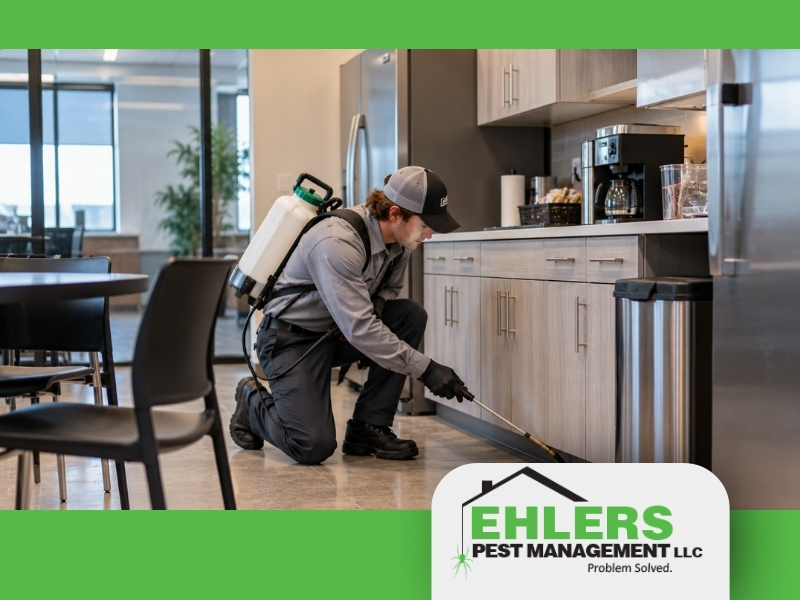
A certified technician walks the interior and the exterior: break rooms, restrooms, janitorial and storage closets, mechanical and electrical rooms, drop ceilings where accessible, the loading area, and the perimeter of the building. The goal is to find the source and the entry points rather than to treat where the sighting happened.
Most office accounts then run on monthly service. The technician checks and maintains bait stations inside and outside, documents activity, and shifts placement as the pattern changes. Insect work gets folded into the same visit when it’s needed.
Timing is worked around your operation. Plenty of office service happens during business hours without anyone noticing, and the work that needs an empty space gets scheduled for one.
Which pests show up in an office besides mice?
Four come up constantly in Southeastern Wisconsin:
- Ants. Usually following a water source or a sugar source, which in an office means a dishwasher, a coffee station, or a soda machine drip tray. Odorous house ants are the common one here.
- Cockroaches. Almost always tied to moisture plus food, so break room sinks, dishwashers, floor drains, and the underside of appliances. German cockroaches also move between tenant suites through shared plumbing chases.
- Spiders. Mostly a sign of other insect activity, since they go where there’s something to catch. Window wells, stairwells, and storage rooms are the usual spots.
- Fruit flies and drain flies. A recycling bin that doesn’t get rinsed or a rarely used floor drain will produce them steadily, and treating the air does nothing. The breeding site has to be cleaned out.
Why does the break room matter so much?
Because it concentrates every condition pests need into about eighty square feet.
Water, food, warmth, and cover all sit in one room, often with appliances that nobody pulls out and cleans behind. The space under a refrigerator and the gap behind a dishwasher are the two most productive places to look in most offices, and they’re the two places least likely to have been looked at.
It’s also where sightings happen, because it’s the one room everybody visits. A mouse living in a storage closet might go unnoticed for months. The same mouse crossing the break room floor at 9:15 generates a work order within the hour.
If you fix nothing else in the building, a daily trash pull and a quarterly pull-and-clean behind the appliances will change what a technician finds on the next visit.
What can building staff do between visits?
More than you’d expect, and none of it requires a license:
- Take break room and desk-side trash out daily, especially anything with food in it
- Move stored snacks into sealed containers rather than leaving open boxes in cabinets
- Keep the loading or delivery door closed when a delivery isn’t actively happening
- Report sightings with a location and a time instead of just the fact of it, since that’s what narrows a search
- Clear storage rooms off the floor so activity is visible rather than buried in boxes
Does this work for a tenant in a leased suite?
Yes, though the building’s situation shapes what’s possible.
A tenant can absolutely have service inside their own space, and for most problems that’s enough. Where it gets complicated is with pests that move through shared structure, since cockroaches and mice travel through plumbing chases, shared walls, and drop ceilings between suites. Treating one suite in a building with an untreated problem next door means pressure keeps coming back.
When that’s the situation, the useful move is documenting what’s being found and bringing it to building management, because the fix is building-wide. A technician’s inspection notes make that conversation a lot shorter.
What should you do next?
If somebody has reported a mouse, if ants have shown up twice in the same break room, or if your building has gaps around its utility lines that have been there for years, the cheapest version of this problem is the one you handle in November instead of February.
Ehlers Pest Management works with offices, mixed office and shop sites, and multi-tenant buildings across Milwaukee, Waukesha, and Racine counties. You can talk to our experienced team at (414) 303-6926 or schedule service online, and a certified technician will inspect the building and recommend what it actually needs rather than a standard package.
Frequently asked questions
Can service happen after business hours?
Usually, and for some treatments it’s preferable. Routine bait station checks and perimeter work are typically done during the day with no disruption, while anything that calls for an empty room gets scheduled around your hours. Tell us your constraints up front and the schedule gets built around them.
Will employees notice anything after a treatment?
For most office work, no. Bait stations are enclosed and placed out of walkways, and interior insect treatment is targeted at cracks, voids, and the areas behind appliances rather than applied across open floor. If a product calls for a reentry window, you’ll be told the specific timing before the visit.
How long does it take to get an ant problem under control in an office?
Often two to four weeks, because the goal is eliminating the colony rather than the ants you can see. Odorous house ants in particular take a few visits of baiting to carry material back to the nest. Spraying what’s visible kills those ants and leaves the colony intact.
We only see one mouse now and then. Is that worth a call?
Yes, and the timing works in your favor. A single sighting in a commercial building almost never means a single mouse, but it often means an early population. Catching it before droppings turn up in three separate rooms is a much smaller job than catching it after.
Do older buildings always have more problems?
Not always, though they usually have more entry points. What matters more is how a building has been maintained and how many trades have run lines through its walls over the years. A well-sealed 1940s building can outperform a 2015 building with sloppy utility penetrations and a propped delivery door.

John Ehlers is the owner of Ehlers Pest Management. Ehlers Pest Management is a veteran-owned family pest control company with the mission to provide responsible pest management solutions that protect people and the environment throughout every community with exceptional quality service. We service Milwaukee, Oak Creek, Shorewood, River Hills, Fox Point, Whitefish Bay, Racine and beyond.