Last Updated on November 16, 2026
The spiders in Wisconsin that people describe on the phone and the ones that actually turn up in Wisconsin basements are rarely the same animal. Almost every call starts with a question about whether it’s dangerous.
Here’s what’s actually living in Wisconsin houses, what the risk really is, and what a lot of spiders usually tells you.
Most spiders in Wisconsin are harmless, and the two species people worry about are either rare here or not established at all. A sudden increase in spiders usually means an increase in the insects they eat, so the useful question is what’s drawing their prey indoors.
Which spiders in Wisconsin actually live in houses?
Five, and none of them are the ones people are afraid of.
- Cellar spiders. Long, thin legs, loose untidy webs in basement corners and ceiling joints. These are the ones most people mean by daddy long legs. Harmless, and they eat other spiders.
- Common house spiders. Small, brown or grey, messy webs in corners, closets, and behind furniture. The most frequently encountered indoor spider in the state.
- Wolf spiders. Large, fast, hairy, and they don’t build webs. They hunt on the ground, which is why they show up running across a basement floor and startle people badly. Not aggressive, and their size does most of the work on people’s nerves.
- Orb weavers. The ones that build the big round webs on porches and around outdoor lights in late summer. Outdoor spiders that wander in occasionally and don’t establish indoors.
Jumping spiders round out the list. Small, stout, often with visible markings, and they move in quick hops. They have excellent vision and will turn to look at you, which people find either charming or deeply unsettling with no middle ground.
Are there dangerous spiders in Wisconsin?
Very few, and the two most people ask about are the two least likely to be in your house.
The brown recluse isn’t considered established in Wisconsin. Occasional specimens turn up, generally believed to arrive in shipments or belongings from states where the species does live, but a reproducing population here isn’t recognized. The overwhelming majority of spiders identified as brown recluse by homeowners turn out to be something else, and that pattern holds across the upper Midwest.
Black widows are also not a common Wisconsin animal. The northern black widow’s range touches the region, and encounters here are rare enough that most pest control careers in this state don’t include one.
What this means practically is that a bite from a Wisconsin house spider is unlikely to be medically significant, and that most skin lesions attributed to spider bites turn out to have other causes. If a bite becomes painful, spreads, or develops a wound, that’s a question for a physician rather than a pest control company, and it’s worth taking seriously regardless of what caused it. If you’ve got the spider, keep it, because identification changes the conversation.
Why am I suddenly seeing so many spiders?
Because something else increased first. Spiders are predators, and their numbers follow their food.
A house with a lot of spiders is usually a house with a lot of insects, and the insects are the part worth investigating. Three common drivers in Wisconsin:
- Exterior lighting. A porch or garage light draws flying insects all night, and the spiders set up where the food is. Switching to warmer-toned bulbs or relocating a fixture away from a doorway often does more than any treatment.
- Fall insect pressure. When box elder bugs, lady beetles, and cluster flies move toward buildings in autumn, the spiders that eat them concentrate in the same places.
- Moisture. A damp basement or crawlspace supports the insects that live in damp conditions, which supports the spiders that eat them. The fix is sometimes a dehumidifier and a regraded downspout rather than anything from a pest control company.
This is why treating the spiders alone tends to disappoint. Remove the predators and the prey population they were feeding on is still there, which means new spiders find the same conditions within weeks.
When is spider treatment actually worth it?
When the numbers are high enough to be a real nuisance, or when the webbing itself is the problem.
Three situations where it makes sense. A house with persistent heavy webbing on the exterior, around soffits, eaves, and entryways, where knocking it down manually isn’t keeping up. A basement or garage where wolf spiders are frequent enough that people won’t use the space. And a commercial building where visible webbing is a presentation issue regardless of whether the spiders matter.
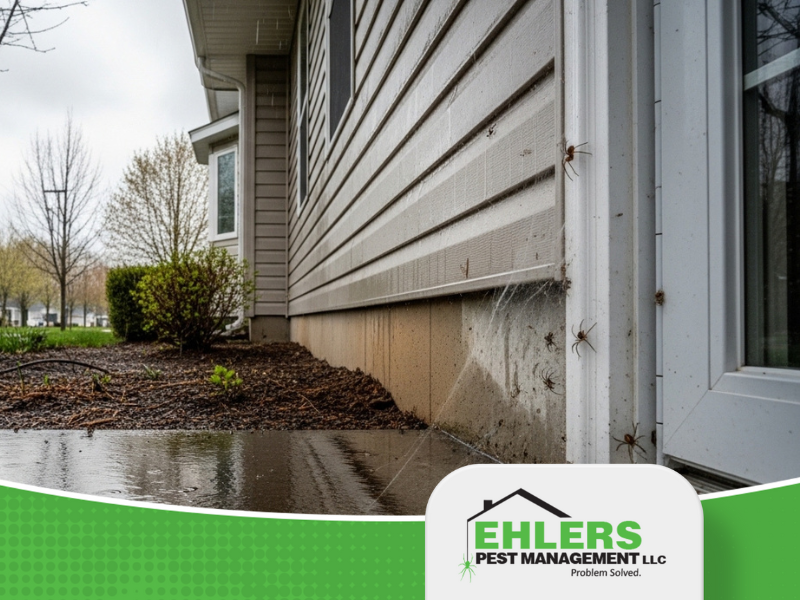
Treatment focuses on the exterior, because that’s where they come from. Web removal, attention to entry points, and targeted work around the foundation, window frames, soffits, and light fixtures. Interior work is usually limited and secondary, since a spider on a basement wall came from outside.
Two situations where it isn’t worth paying for. A handful of cellar spiders in basement corners, which are doing you a small favor. And a single large wolf spider, which is one animal that wandered in and can be escorted out with a cup and a piece of card.
How do you keep spiders out without treating?
Mostly by making the outside of the building less attractive and the openings smaller.
The things that work: moving or changing exterior lighting near doors, trimming vegetation back off the siding, clearing webs from soffits and eaves each season so they don’t accumulate, repairing window screens, fitting door sweeps, and keeping firewood off the ground and away from the wall. Indoors, reducing clutter in basements and closets removes the undisturbed spots webs get built in.
The thing that doesn’t work, despite being everywhere online, is scattering chestnuts or dousing baseboards in essential oils. Neither has held up under testing, and the time spent on them is time not spent on the door sweep.
What should you do next?
If you’re seeing more spiders than you’d like, the question worth asking first is what they’re eating, because that’s usually the actual problem and it’s often something simple like a light fixture by the back door.
If you want help identifying what you’ve got, our pest identification guide covers the species common in Wisconsin homes. Ehlers Pest Management handles spider control across Milwaukee, Waukesha, and Racine counties, and you can talk to our experienced team at (414) 303-6926 or schedule an inspection online. A certified technician will tell you what you have, and if what you have is a few harmless cellar spiders, you’ll hear that instead of a proposal.
Frequently asked questions
How can I tell a wolf spider from something dangerous?
Wolf spiders are large, hairy, brown or grey with mottled markings, and they run rather than build webs. The giveaway is behavior: they’re hunters, so finding one sprinting across a floor in the open is normal for the species. They’re not considered medically significant, and their reputation comes from their size and speed rather than from any real risk.
Do spiders come inside in winter?
Some are already inside and have been all along. Cellar spiders and common house spiders live indoors year round and don’t migrate seasonally. What changes in autumn is that outdoor species wander in while looking for shelter, and the insects they eat move toward buildings at the same time, so sightings tend to rise in fall rather than midwinter.
Should I knock down webs or leave them?
Knock them down. It discourages the spider from rebuilding in that spot, and on the exterior it keeps webbing from accumulating season after season into something that needs real work to remove. The one argument for leaving a web is inside a basement where the spider is quietly eating other insects, which is a reasonable trade if the web isn’t somewhere you have to look at it.
Does one spider mean there are hundreds?
No, and spiders are different from roaches this way. They’re territorial, often cannibalistic, and don’t live in colonies, so a single spider is frequently just a single spider. What does suggest a larger issue is consistent webbing in multiple rooms or a lot of spiders of the same kind in one area, since that usually points at a food source nearby.
Are spiders a sign of a dirty house?
Not really. Clutter gives them undisturbed places to build, so a crowded basement will hold more webs than an empty one, but the thing that actually drives spider numbers is the insect population they feed on. A spotless house with a bright porch light and a damp basement will have more spiders than a messy one without those conditions.