If you’ve noticed yellow jackets becoming more aggressive around your Milwaukee home or yard this time of year, there’s a specific biological reason for it — and August is when calling a yellow jacket exterminator in Milwaukee shifts from a convenience to a genuine safety consideration. Yellow jacket colonies that started with a single queen in spring have been building all summer, and by August they’ve reached a size and temperament that makes accidental encounters significantly more dangerous than earlier in the season.
Yellow jackets are most aggressive in August in Wisconsin because colonies reach their peak population of several hundred to several thousand workers. The colony is also under nutritional stress as summer food sources decline, making foragers more defensive and more likely to sting without direct provocation. This combination of maximum population and heightened aggression makes August the highest-risk month for yellow jacket encounters in Southeastern Wisconsin.
Why Are Yellow Jackets So Much Worse in August?
Yellow jacket colonies follow a predictable growth cycle that reaches its peak in late summer. A queen that founded a colony in April or May with just a handful of workers has spent the entire summer building a population. By August, a single colony can contain anywhere from several hundred to several thousand workers depending on the nest location and the season’s food availability.
Two things happen simultaneously at peak population that make August yellow jackets more dangerous than any other time of year. First, the sheer number of workers means more foragers in more locations, which increases the chance of accidental encounters in yards, near trash cans, around outdoor dining areas, and along the foundation of your home. Second, late-summer food competition intensifies as natural protein sources decline, making yellow jackets more aggressive in defending both the nest and any food source they’ve found.
The result is a stinging insect that is actively more defensive, present in higher numbers, and foraging more aggressively than at any other point in the season. For anyone with a known venom allergy, a yellow jacket nest on the property in August is a medical risk, not just a nuisance.
Where Do Yellow Jackets Nest in Milwaukee Homes and Yards?
Yellow jackets nest differently from paper wasps and bald-faced hornets, which build visible aerial nests. Yellow jackets almost always nest in concealed locations, which is part of what makes accidental disturbance so common:
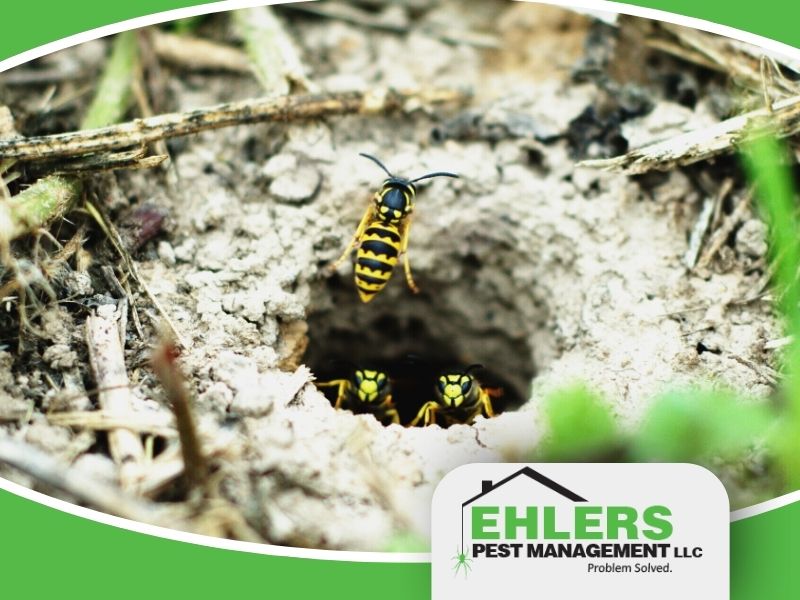
- Ground nests are the most frequently encountered in Milwaukee yards, built in abandoned rodent burrows, under landscaping timbers, or in loose soil near foundations. A mower or foot traffic can disturb a ground nest with no warning.
- Wall voids inside homes, garages, and outbuildings are a common nesting site in older Milwaukee construction, with colonies entering through small gaps in siding, soffits, or foundation gaps.
- Hollow trees and stumps near homes provide ideal protected nesting space and are often discovered only when a colony is well established.
The hidden nature of yellow jacket nests means they’re frequently discovered only after accidental disturbance, which is exactly the worst way to find out one exists.
What Should You Do If You Find a Yellow Jacket Nest?
The most important thing is to not disturb it. Yellow jackets respond to vibration, sudden movement, and perceived threats with rapid, coordinated stinging. A disturbed ground nest can send dozens of workers to the surface within seconds.
If you’ve discovered a nest, keep people and pets away from the area, mark it clearly so it isn’t accidentally disturbed again, and contact a professional for assessment. Ground nests and wall void nests in particular require treatment approaches and protective equipment that go well beyond what a retail aerosol product can safely deliver.
Yellow jacket nests located above eight feet are not treated by Ehlers. Nests at that height require ladder work in close proximity to an aggressive colony, which creates a liability and safety risk we don’t take on. Those nests will die off naturally with the first hard frost. Everything below eight feet and accessible from the ground is within scope for professional treatment.
Why Is August the Best Time to Call a Yellow Jacket Exterminator in Milwaukee?
It might seem counterintuitive to call a yellow jacket exterminator in Milwaukee when the colony is at its largest and most aggressive. But August treatment is actually more important, not less, for two reasons.
First, the nest isn’t going to get smaller from here. Colony growth peaks in August and the population stays at or near maximum through September before beginning to decline with cooler temperatures. Waiting doesn’t reduce risk — it extends it through the most active foraging period of the season.
Second, stinging insect control in Milwaukee is most effective when the full colony is present and active. Treatment applied to a peak-population nest eliminates the entire colony rather than a partial population, which reduces the chance of the nest being rebuilt by surviving workers.
Ehlers Pest Management handles yellow jacket removal across Milwaukee and Southeastern Wisconsin. To schedule service or talk to our experienced team about a nest on your property, contact us today.
Frequently Asked Questions
How do I know if I have yellow jackets or paper wasps?
Yellow jackets are stockier, more brightly banded in yellow and black, and almost always nest in the ground or inside wall voids rather than in visible aerial nests. Paper wasps are slender, brownish, and build the open umbrella-shaped nests you can see on eaves and railings. If you see insects going in and out of a hole in the ground or a gap in your siding, it’s almost certainly yellow jackets.
Are yellow jackets more dangerous than bees in Wisconsin?
Yellow jackets are generally considered more dangerous in practical encounter terms because they can sting repeatedly (unlike honeybees, which sting once), they’re highly aggressive when a nest is disturbed, and their ground-nesting habit makes accidental disturbance much more common. For individuals with a known venom allergy, both are medically serious, but yellow jacket encounters are statistically more frequent in Wisconsin residential settings.
Will yellow jackets go away on their own in Wisconsin?
Yes, eventually. Yellow jacket colonies die off naturally with the first hard frost in Wisconsin, typically in October or November. Worker yellow jackets don’t survive winter. However, waiting through August and September means living with a peak-population, highly aggressive colony through the most active outdoor months of the year. If the nest is in a location that creates regular human contact, professional treatment before the season ends is the practical choice.
Can I treat a yellow jacket ground nest myself?
DIY treatment of a yellow jacket ground nest carries significant risk. Approaching the nest opening, applying product, and retreating quickly while avoiding the defensive response of potentially thousands of workers requires protective equipment and product application methods that aren’t available in retail formats. For any ground nest in an area where people or pets are regularly present, professional treatment is strongly recommended.