Categories Commercial Pest Control

Office Building Pest Control: Why It Starts in the Break Room

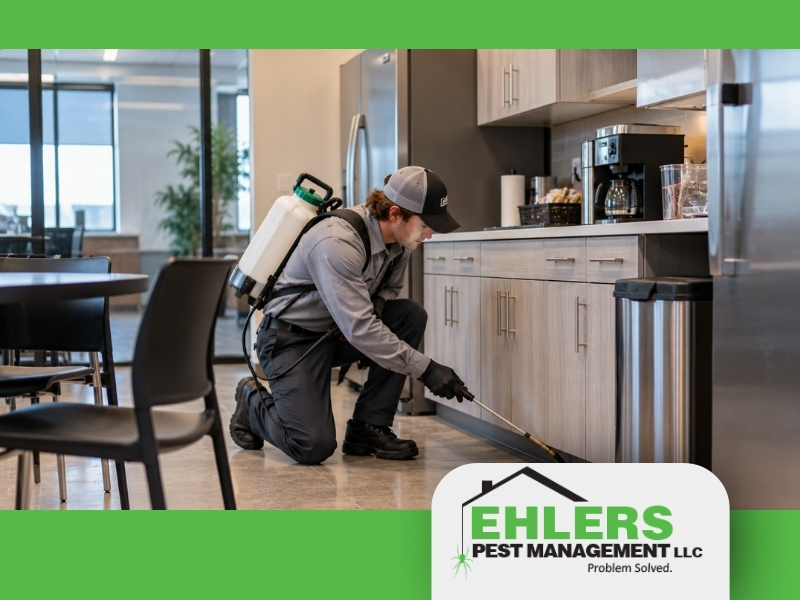
An Ehlers Pest Management technician kneels to spray the base of kitchen cabinets during office building pest control services.

Office building pest control usually becomes a priority about four hours after somebody sees a mouse in the break room. Before that, it’s a line item. After that, it’s three people standing in a doorway with their phones out.

That’s a predictable pattern, and it’s worth getting ahead of. Here’s what drives pest problems in an office and what ongoing service actually covers.

Why do offices see more mice in the winter?

Because an office building in November has everything a mouse spent the summer looking for.

There’s warmth, which is the whole reason they come in. There’s food, from stored snacks and drawer candy to break room trash and crumbs under a toaster oven. There are quiet voids to nest in: drop ceilings, wall cavities, spaces behind cabinets, and the undisturbed back corners of storage rooms.

Getting in is the easy part. Gaps around pipes and utility penetrations, worn weatherstripping on exterior doors, and loading or delivery entrances that stay propped during a drop-off all work as doorways. Older buildings tend to have more of these, and buildings that have been renovated in pieces over the years often have the worst of them, because every trade that ran a line through a wall left something behind.

Once mice are established inside a heated building, they breed year-round. The population doesn’t pause for winter the way outdoor activity does.

What does office building pest control cover?

An inspection, a plan that fits the building, and then ongoing visits that mostly look boring when they’re working.

A certified technician walks the interior and the exterior: break rooms, restrooms, janitorial and storage closets, mechanical and electrical rooms, drop ceilings where accessible, the loading area, and the perimeter of the building. The goal is to find the source and the entry points rather than to treat where the sighting happened.

Most office accounts then run on monthly service. The technician checks and maintains bait stations inside and outside, documents activity, and shifts placement as the pattern changes. Insect work gets folded into the same visit when it’s needed.

Timing is worked around your operation. Plenty of office service happens during business hours without anyone noticing, and the work that needs an empty space gets scheduled for one.

Which pests show up in an office besides mice?

Four come up constantly in Southeastern Wisconsin:

  • Ants. Usually following a water source or a sugar source, which in an office means a dishwasher, a coffee station, or a soda machine drip tray. Odorous house ants are the common one here.
  • Cockroaches. Almost always tied to moisture plus food, so break room sinks, dishwashers, floor drains, and the underside of appliances. German cockroaches also move between tenant suites through shared plumbing chases.
  • Spiders. Mostly a sign of other insect activity, since they go where there’s something to catch. Window wells, stairwells, and storage rooms are the usual spots.
  • Fruit flies and drain flies. A recycling bin that doesn’t get rinsed or a rarely used floor drain will produce them steadily, and treating the air does nothing. The breeding site has to be cleaned out.

Why does the break room matter so much?

Because it concentrates every condition pests need into about eighty square feet.

Water, food, warmth, and cover all sit in one room, often with appliances that nobody pulls out and cleans behind. The space under a refrigerator and the gap behind a dishwasher are the two most productive places to look in most offices, and they’re the two places least likely to have been looked at.

It’s also where sightings happen, because it’s the one room everybody visits. A mouse living in a storage closet might go unnoticed for months. The same mouse crossing the break room floor at 9:15 generates a work order within the hour.

If you fix nothing else in the building, a daily trash pull and a quarterly pull-and-clean behind the appliances will change what a technician finds on the next visit.

What can building staff do between visits?

More than you’d expect, and none of it requires a license:

  • Take break room and desk-side trash out daily, especially anything with food in it
  • Move stored snacks into sealed containers rather than leaving open boxes in cabinets
  • Keep the loading or delivery door closed when a delivery isn’t actively happening
  • Report sightings with a location and a time instead of just the fact of it, since that’s what narrows a search
  • Clear storage rooms off the floor so activity is visible rather than buried in boxes

Does this work for a tenant in a leased suite?

Yes, though the building’s situation shapes what’s possible.

A tenant can absolutely have service inside their own space, and for most problems that’s enough. Where it gets complicated is with pests that move through shared structure, since cockroaches and mice travel through plumbing chases, shared walls, and drop ceilings between suites. Treating one suite in a building with an untreated problem next door means pressure keeps coming back.

When that’s the situation, the useful move is documenting what’s being found and bringing it to building management, because the fix is building-wide. A technician’s inspection notes make that conversation a lot shorter.

What should you do next?

If somebody has reported a mouse, if ants have shown up twice in the same break room, or if your building has gaps around its utility lines that have been there for years, the cheapest version of this problem is the one you handle in November instead of February.

Ehlers Pest Management works with offices, mixed office and shop sites, and multi-tenant buildings across Milwaukee, Waukesha, and Racine counties. You can talk to our experienced team at (414) 303-6926 or schedule service online, and a certified technician will inspect the building and recommend what it actually needs rather than a standard package.

Frequently asked questions

Can service happen after business hours?

Usually, and for some treatments it’s preferable. Routine bait station checks and perimeter work are typically done during the day with no disruption, while anything that calls for an empty room gets scheduled around your hours. Tell us your constraints up front and the schedule gets built around them.

Will employees notice anything after a treatment?

For most office work, no. Bait stations are enclosed and placed out of walkways, and interior insect treatment is targeted at cracks, voids, and the areas behind appliances rather than applied across open floor. If a product calls for a reentry window, you’ll be told the specific timing before the visit.

How long does it take to get an ant problem under control in an office?

Often two to four weeks, because the goal is eliminating the colony rather than the ants you can see. Odorous house ants in particular take a few visits of baiting to carry material back to the nest. Spraying what’s visible kills those ants and leaves the colony intact.

We only see one mouse now and then. Is that worth a call?

Yes, and the timing works in your favor. A single sighting in a commercial building almost never means a single mouse, but it often means an early population. Catching it before droppings turn up in three separate rooms is a much smaller job than catching it after.

Do older buildings always have more problems?

Not always, though they usually have more entry points. What matters more is how a building has been maintained and how many trades have run lines through its walls over the years. A well-sealed 1940s building can outperform a 2015 building with sloppy utility penetrations and a propped delivery door.


Categories Rodents

Why Mice Keep Coming Back After Treatment in Milwaukee Homes

Three mice climb over a pile of corn kernels, highlighting why mice keep coming back, with the Ehlers Pest Management logo in the corner.

If mice keep coming back a few weeks after someone treated your house, the usual explanation isn’t that the treatment failed. Trapping and baiting remove the animals that are in the building. Neither one closes the gap they used to get in, and a quarter-inch opening is still a quarter-inch opening the day after the last mouse is carried out.

Here’s what’s actually happening in that gap between quiet and not quiet again.

Why do mice keep coming back after a treatment?

Because the reason they were there was the opening, and the opening is still there.

A mouse doesn’t choose your house for any complicated reason. It’s warm, it has food somewhere in it, and there’s a way in. Remove the mice and every one of those three conditions is unchanged. The building is still warm, the food is still in the pantry and the garage, and the gap at the sill plate is exactly where it was.

Mice also don’t leave on their own and they don’t relocate seasonally once they’re established inside. What ends the cycle is changing the building, not removing the current occupants.

How fast do new mice move in?

Weeks, not months, and in fall it can be days.

When a population is removed, the space it occupied becomes unoccupied territory with no competition, and neighboring mice find it quickly. They’re already traveling the same routes along your foundation, the same utility lines, the same fence line. A cleared building sitting on an established route is the most attractive real estate in the neighborhood.

October through December is the fastest window, because outdoor rodent pressure is at its annual peak and everything within range is actively looking for somewhere warm. A house cleared in November and left unsealed can be occupied again before the first snow.

Is it the bait, the traps, or something else?

Rarely the product, and usually one of four other things.

  • Placement. Mice travel with one side against a wall and follow the same runs night after night. Devices set in the middle of a floor or in a tidy row along an open basement catch far less than devices set on the actual runs.
  • Count. Three traps for a population of thirty produces a slow trickle and a false sense that the problem is small.
  • Reach. Most of the population is inside a wall void, under insulation, or behind an appliance. Whatever can’t get to those places isn’t working on the majority of the mice.
  • Caution from a bad first attempt. A mouse that escapes a poorly set trap avoids that type of device, and a household that spent a month on hardware-store traps often hands a technician a wary population.

So a second round that looks identical to the first tends to produce identical results. What changes the outcome is changing the approach rather than repeating it.

Does the scent they leave behind matter?

More than almost anyone realizes, and it’s one of the reasons a cleared house refills so predictably.

Mice deposit urine and droppings continuously as they travel, and those deposits work as chemical markers. Other mice read them, follow them, and use the same routes and the same entry points. A building that held mice for a season has those trails running through it, and they stay readable after the animals are gone.

Nesting material left in a wall void does the same thing in a different way. It makes the cavity obviously usable to the next animal that finds it. Cleaning the runs and removing the nesting material is part of the job, not housekeeping after the fact.

Does this mean the company did a bad job?

Not necessarily, and the useful question is a different one.

A trapping and baiting service does what it says it does. If that’s what was sold and that’s what happened, the work was performed. What matters is whether anybody looked at the building, and whether closing the openings was ever discussed as part of the plan.

The question worth asking any company, including us, is this: did someone inspect the structure and tell you where they’re getting in? If the answer is no, you bought removal rather than a solution, and removal is a service that needs repeating.

What makes the result actually hold?

Closing the openings, where the building allows it.

That starts with an inspection of the structure, inside and out, including the basement joist bays and the attic. A technician identifies the openings, where activity is concentrated, and the attractants keeping pressure on the property. From there the work is sealing what can be sealed, with materials a rodent can’t chew, along with trapping down whatever population is already inside.

Here’s the honest part. Sealing isn’t the right answer for every building. Some houses have enough deterioration at the foundation, the sill, or the roof line that closing them up properly isn’t realistic as a single piece of work, and some situations need ongoing management instead. Rodent exclusion is a separate service and we only recommend it when the structure is in good enough shape for it to hold. If your house isn’t a candidate, you should hear that rather than pay for work that won’t last.

What should you do next?

If you’ve been through one round already, don’t repeat it. Get the building looked at before anyone sets another device, because the second identical attempt produces the second identical result.

Ehlers Pest Management works across Milwaukee, Waukesha, and Racine counties, and you can reach our experienced team at (414) 303-6926 to schedule service. A certified technician will inspect the structure, show you where the activity is and where it’s getting in, and tell you whether your building is a good candidate for sealing or whether ongoing management makes more sense for it.

Frequently asked questions

How many mice are in the house if I caught three?

Probably more than three, though nobody can give you a reliable number from a catch count. Mice are nocturnal and spend most of their time in voids, so what gets caught in the first few nights is the bold portion of the population rather than the whole of it. A better indicator is how widely the droppings are spread and how many separate areas show activity.

Do ultrasonic repellers work?

No. They’ve been tested repeatedly and mice habituate to the sound within days where they respond to it at all. Every fall we’re called to homes where someone ran them for a month while the population kept growing. The money is better spent on sealing.

Will a cat solve a mouse problem?

A cat may catch the occasional mouse in the open, and some cats deter activity in the rooms they patrol. Neither effect reaches a population living in wall voids and attics, which is where most of them are. Cats also don’t close entry points, so the same replacement cycle continues.

Should I use snap traps or bait?

For an interior problem in a home, traps are usually the better choice, because you recover the animal instead of having it die inside a wall. Bait has its place, particularly in exterior stations where carcass location matters less. A technician will pick based on where the activity is, whether there are pets and children in the house, and what the building allows.

How long should I keep trapping after the catches stop?

Give it at least two weeks of zero activity before assuming it’s finished, and keep monitoring devices in place after that. Mice reproduce fast enough that a few survivors rebuild quickly, so an early stop is one of the common reasons a problem appears to return.

Categories Rodents

Rats or Mice? How to Tell What’s in Your Milwaukee House

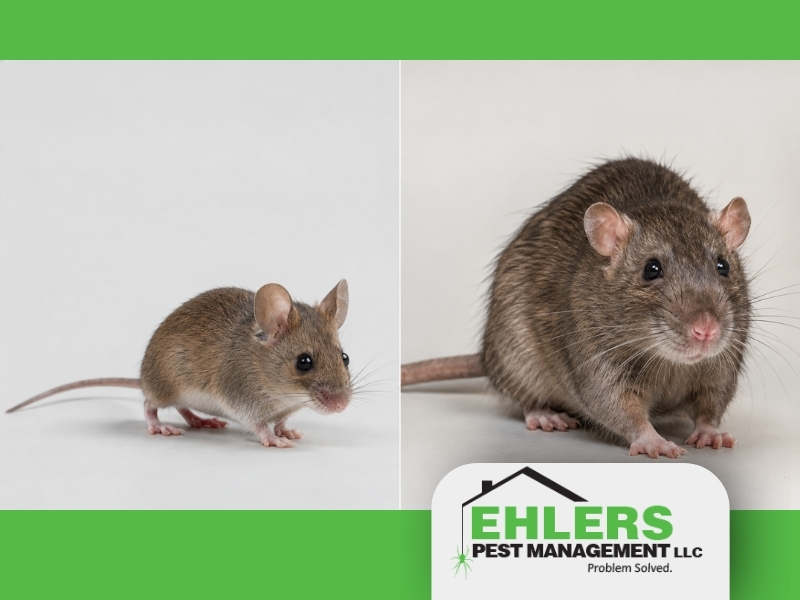
A side-by-side comparison of a mouse on the left and a larger rat on the right with the Ehlers Pest Management logo in the corner, illustrating the differences in a rat vs. mouse rodent infestation.

Figuring out whether you have rats or mice matters more than it sounds, because the two animals behave differently, nest in different places, and need different work. Most people in southeastern Wisconsin have mice. Rats exist here, concentrated near older sewer infrastructure, alleys, and commercial corridors, and they turn up in homes much less often.

Here’s how to read the evidence you already have without ever seeing the animal.

What do the droppings tell you?

Droppings are the fastest and most reliable answer, and you can tell the two apart at a glance once you know the size.

Mouse droppings are about the size of a grain of rice, a quarter inch or less, dark, with pointed ends. You find them scattered, often dozens in one area, because a mouse produces a great many in a day and leaves them as it travels.

Rat droppings are considerably larger, half an inch to three-quarters, and thicker, closer to an olive pit or a raisin in bulk. Norway rat droppings have blunt ends. You find fewer of them, and they tend to be grouped rather than scattered along a route.

If you can hold a ruler next to what you found, that one measurement settles it.

What about gnaw marks and holes?

The opening tells you as much as the droppings do.

A mouse hole is small and surprisingly tidy, roughly the diameter of a dime, with clean edges. Mice only need a gap about a quarter inch wide to start with, so they’re often enlarging something that already existed.

A rat hole is bigger, two inches or more, and the edges look torn rather than cut. Rats are powerful chewers and they leave rough, ragged openings in wood, drywall, and even soft concrete or lead sheathing.

Gnaw marks follow the same pattern. Fine paired scratches on a box corner or a baseboard point to mice. Deep, coarse grooves point to rats.

Where in the house are you finding evidence?

Location narrows it down quickly, because the two species prefer different elevations.

Mice are climbers and they nest high as readily as low. Attics, wall voids, the backs of cabinets, inside appliance housings, and the insulation above a ceiling are all normal. If you’re hearing activity overhead, that’s usually mice.

Norway rats, the species common in this region, are burrowers. They stay low: basements, crawl spaces, under slabs and stoops, along foundation walls, and in burrows outside near the building. Activity concentrated at ground level or below, especially near a floor drain or a sewer line, raises the odds of rats.

Does the sound tell you anything?

It does, and people often notice sound before they find anything else.

Mice make light, quick scratching and scurrying, usually described as something small moving fast. It starts around dusk and again before dawn, in short bursts.

Rats are heavier and you hear it. Thumping, dragging, and gnawing that sounds like it’s coming from a bigger animal, often with longer pauses between bouts of activity. If a homeowner tells us it sounds too big to be a mouse, they’re frequently right.

Why does it matter whether you have rats or mice?

Because treatment, entry points, and timelines all differ.

Mice need a quarter-inch gap, so sealing a house against them means finding and closing a long list of small openings, many of them above ground level. Mice are also curious and investigate new objects quickly, which makes them relatively easy to catch once you set the right placements.

Rats need larger openings but they’ll create them, and they tend to come from a burrow outside rather than living entirely indoors. That shifts the work toward the exterior, the foundation line, and sometimes the sewer connection. Rats are also neophobic, meaning they avoid new objects for days, so a rat job takes longer and a device that sits untouched for a week is normal rather than a failure.

Getting this wrong wastes a month. Placements sized and sited for mice won’t catch rats, and a homeowner who assumed mice and bought traps accordingly often concludes nothing works.

What should you do first?

Three things, before anyone treats anything.

  • Measure a dropping and photograph it next to something for scale. That single piece of evidence answers the species question most of the time.
  • Note where the evidence is and at what height. Ground level and below leans rat; overhead leans mouse.
  • Walk the exterior and look for burrow openings near the foundation, under stoops, and along fence lines. Burrows outside point to rats, and you won’t find them from indoors.

Hold off on buying traps until you know which animal you have, because sizing and placement strategies differ, and the wrong setup can teach the population to avoid the right one later.

What should you do next?

If you’ve found droppings, gnaw marks, or you’re hearing something in the walls, the species question is worth settling before any money gets spent. Ehlers Pest Management works throughout Milwaukee, Waukesha, and Racine counties, and you can reach our experienced team at (414) 303-6926 to schedule service. A certified technician will confirm what you have, find where it’s getting in, and tell you what the work involves for your specific animal.

If the building is a good candidate for sealing the entry points, that’s a separate piece of work we’ll assess during the inspection and explain before scheduling anything.

Frequently asked questions

Can mice and rats live in the same house at once?

It happens, though it isn’t common. Rats are territorial and will drive mice out of shared space, so an established rat population usually means fewer mice. Finding clear evidence of both generally means a large building, separate floors, or a recent shift in which species is dominant.

Do rats in Milwaukee come from the sewers?

Norway rats are strongly associated with sewer systems, storm drains, and alleys in older parts of the city. They move along those routes and enter buildings at ground level or below, through floor drains, broken sewer laterals, and gaps at the foundation. That’s why rat work usually involves the exterior and the plumbing side, not just interior trapping.

Is one mouse really a sign of more?

Almost always. House mice are social and breed quickly, with a female producing several litters a year and the young reaching breeding age in about six weeks. Spotting a single mouse in daylight generally means the population is large enough to push individuals into the open.

How long does it take to get rid of rats compared to mice?

Rats take longer, often by weeks. Mice investigate new objects within hours, so trapping produces results quickly. Rats avoid anything unfamiliar for several days, so devices sit untouched at first and the job moves more slowly. That delay is normal and not a sign the work is failing.

Will the cold weather drive them out?

No. Both species move toward heated buildings as temperatures drop and stay active all winter indoors. Cold weather increases indoor rodent pressure in Wisconsin rather than reducing it, which is why fall and early winter are the heaviest months for these calls.