
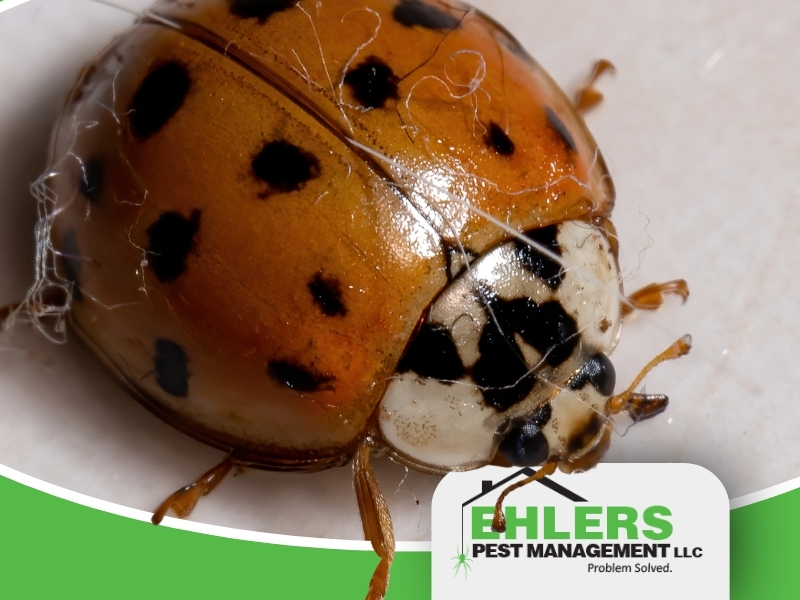

If you’re looking into box elder bug pest control right now, you’re probably standing in the yard looking at a wall covered in insects. In southeastern Wisconsin that usually starts in the second or third week of September, and it’s almost always one of three species: box elder bugs, Asian lady beetles, or brown marmorated stink bugs. They show up together, they behave the same way, and they’re all doing the same thing. They’re looking for somewhere to spend the winter, and your south-facing wall is the warmest surface in the neighborhood.
Here’s how to tell them apart, whether they’ll actually hurt anything, and why the timing of treatment matters more than the treatment itself.
Box elder bug pest control works as an exterior treatment applied in September, before the insects move into wall voids. Box elder bugs, Asian lady beetles, and stink bugs all cluster on warm south and west walls in fall. Once they’re inside the structure, the options narrow considerably.
Why are hundreds of bugs on the side of my house?
Two things happen at once in mid-September. Daylight shortens, which tells these insects that the season is ending, and overnight temperatures start dropping into the forties. Both are cues to find shelter.
On a sunny afternoon, the south and west walls of a house can run twenty or thirty degrees warmer than the air. The insects land on that warm surface, and once a few arrive, more follow. Some of them are following the ones already there, and the aggregation builds on itself through the afternoon.
Then they start looking for a gap. Behind the siding, around a window frame, under a soffit, through a gap in the sill plate. They’re not trying to get into your living room. They’re trying to get into a wall void or an attic, which is a much better winter shelter than anything outside. Ending up in your kitchen in February is an accident on their part, and it usually means a warm spell woke them up and they crawled the wrong direction.
This is also why light-colored houses get hit harder than dark ones, and why the wall facing the afternoon sun collects almost all of them.
Is it box elder bugs, lady beetles, or stink bugs?
All three cluster the same way, so people describe them interchangeably. They’re easy to tell apart up close.
Box elder bugs are flat, narrow, and about half an inch long, black with thin red or orange lines outlining the wings and running along the edges. They feed on box elder, maple, and ash seeds, so properties with those trees nearby get the heaviest pressure. If you have a female box elder tree in the yard, that’s your source.
Asian lady beetles are round and domed, orange to deep red, with a spot count that varies wildly from none to nineteen. The reliable marking is behind the head: a black shape on the white area that reads like an M or a W depending on which way you’re looking at it.
Brown marmorated stink bugs are the shield-shaped ones, mottled brown, roughly the size of a thumbnail. The identifying marks are the alternating light and dark bands on the antennae and along the outer edge of the abdomen.
Are Asian lady beetles the same as ladybugs?
No, and this is the distinction that matters most, because the two behave very differently indoors.
Native ladybugs are the ones people grew up liking. They overwinter outdoors under leaf litter and bark, they don’t gather on houses, and they leave you alone.
Asian lady beetles were introduced to North America for aphid control in agriculture and have spread widely since. They aggregate on structures in fall, they overwinter inside walls and attics, and they do three things native ladybugs don’t. They nip, which most people describe as a pinch rather than a bite. They release a yellow defensive fluid when handled or squashed, and that fluid stains fabric, carpet, and painted trim. And in some households they trigger allergy or asthma symptoms once a large population is overwintering in the structure.
So if the beetles on your siding are leaving yellow marks on the window sills, they’re Asian lady beetles.
Do any of them damage your house or hurt you?
Structurally, no. None of the three chew wood, damage insulation, or eat anything in your home. They don’t reproduce indoors either, so a population inside your walls in January is the same population that got in during September. It won’t grow.
What they do cause is mess and aggravation. Box elder bugs leave dark fecal spots on siding, curtains, and light-colored surfaces. Lady beetles stain with that defensive fluid. Stink bugs release their odor when they’re crushed or feel threatened, which is why the standard advice is to vacuum rather than swat.
There’s one secondary problem worth knowing about. A large number of insects dying inside a wall void becomes a food source for carpet beetles, and those do damage wool, silk, and stored fabric. That’s the argument for keeping them out rather than letting them in and dealing with it later.
Should you cut down the box elder tree?
Probably not, and it usually doesn’t fix the problem anyway.
Box elder bugs feed on the seeds of female box elder trees, and they’ll also use maple and ash. Removing a tree in your own yard reduces the local population somewhat, and if the tree is right against the house it can make a noticeable difference. But these insects fly, and they’ll come from a neighbor’s tree or from a stand two lots over without much trouble. We’ve seen properties with no box elder anywhere on the parcel get covered every year.
If the tree is healthy and you like it, keep it and treat the house instead. If it’s a volunteer box elder that seeded itself against the foundation and you were never attached to it, taking it out is reasonable, and you’ll still want the exterior treatment.
When does box elder bug pest control actually work?
Before they get in. That’s the whole answer, and it’s why this is a September conversation rather than a November one.
An exterior treatment applied to the walls, foundation line, eaves, and around window and door frames while the insects are still massing outside is what reduces the number that make it into the structure. Once they’re behind the siding or inside a wall void, spraying doesn’t reach them, and treating a wall cavity full of overwintering insects creates the dead-insect problem described above.
This is exterior work, and it’s separate from general pest control. Seasonal exterior treatments in southeastern Wisconsin run from April through October, with the two treatments that matter most falling in spring and again right now. If you’re also dealing with ants, spiders, or mice inside, that’s a different service, and you’d have both.
Sealing helps too, and it’s the same list of openings that lets mice in. Gaps behind siding, around window and door frames, at the sill plate, and where utilities enter the wall. Work done on those gaps pays off against several problems at once.
What should you do about the ones already inside?
Vacuum them, and use a shop vac or a bagged vacuum you can empty outside right away.
Don’t crush them. Lady beetles stain, stink bugs smell, and box elder bugs leave marks that are hard to get off painted trim. Don’t spray insecticide along interior baseboards for these either, because it accomplishes very little and puts product where you don’t need it.
If they’re coming out of a light fixture, a ceiling vent, or the gap around a window frame on warm winter days, that tells you where the population is sitting. Write it down. That’s useful information for next fall’s exterior work.
Will treatment get rid of all of them?
No, and any company that tells you otherwise is setting you up to be disappointed.
When there are thousands of insects on the outside of a house, some of them are getting in. A well-timed exterior treatment cuts the number substantially, and on a property that gets hit hard every year the difference between treated and untreated is dramatic. It isn’t zero, and we’re not going to tell you it will be.
We’re also not going to promise unlimited return visits to make up the difference. What we’ll do is treat at the right time, tell you honestly what to expect, and come back on a schedule that fits how much pressure your property actually gets.
What to do next
If your siding is covered right now, this is the week to deal with it. The window for exterior work closes once the insects move into the walls, and after that the only real option is a vacuum and a wait until spring.
Call Ehlers Pest Control at (414) 303-6926 and describe what you’re seeing and which wall it’s on. A certified technician will come out, confirm which of the three you’ve got, look at where they’re getting in, and treat the exterior. They know how these houses behave in a Wisconsin fall.