
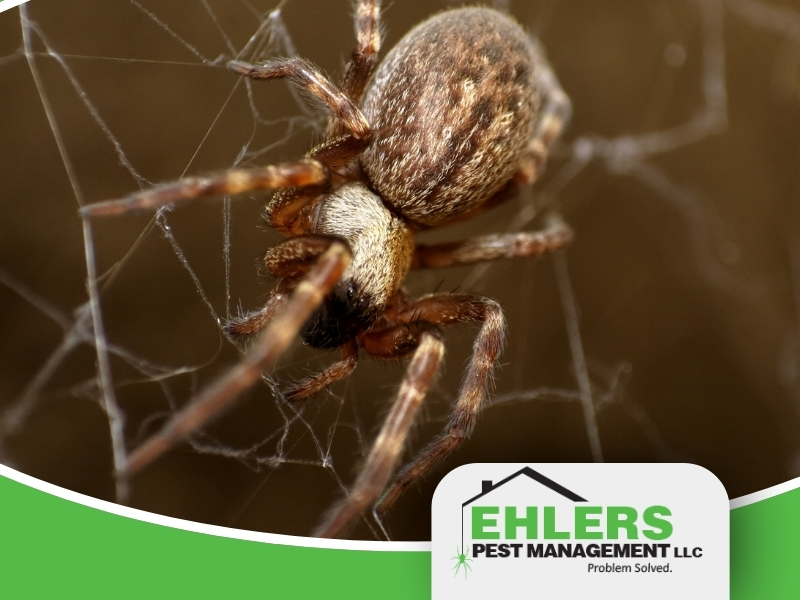

People start looking for a spider exterminator in Milwaukee every September, and the reason isn’t the one most of them assume. Spiders aren’t flooding in from the yard to escape the cold. The house spiders you’re seeing mostly lived in your house all along. What changed is that they finished growing, the males started wandering to find mates, and both of those things happen at the end of summer. You’re seeing the same population you always had, at the point in the year when it’s biggest and most active.
Here’s what’s actually in a Wisconsin home, which ones are worth any concern, and when treatment is the right call.
You see more spiders in fall because house spiders reach full size in late summer and males begin wandering to find mates. Most of them lived in your home all along. Spiders are a secondary pest, so reducing the insects they feed on does more than removing spiders one at a time.
Why are there suddenly more spiders in my house?
Four things stack up at the same time, and only one of them has anything to do with temperature.
The biggest factor is maturity. Common house spiders hatch in spring, grow all summer, and reach full size in late August and September. A spider that was too small to notice in June is now large enough to catch your eye from across the room. Nothing arrived. It just got bigger.
The second is mate-searching. Male spiders that have matured leave their webs and wander looking for females, which is why the spider you find crossing the living room floor at nine at night is almost always a male. Wandering is temporary behavior and it peaks right now.
Third, their food supply moves. Box elder bugs, lady beetles, flies, and other insects push toward the house in fall, and spiders follow the insects. Where you have a lot of one, you get a lot of the other.
Fourth, people are inside more, with the windows shut and the lights on, and simply notice more of what was already there.
Which spiders actually live in Wisconsin homes?
The list is shorter than people expect, and almost all of it is harmless.
Common house spiders build the messy, tangled cobwebs in ceiling corners, basements, and behind furniture. They’re small, tan or gray, and they’re the reason you’re dusting webs down every few weeks.
Cellar spiders are the long-legged ones hanging in loose webs in basements and crawl spaces. People call them daddy longlegs. They eat other spiders, including bigger ones, so a basement full of cellar spiders is doing you a small favor.
Wolf spiders generate more phone calls than anything else on this list. They’re large, hairy, fast, brown or gray, and they don’t build webs. They hunt on the ground, which means you find them running across a basement floor rather than sitting in a corner. They look alarming and they’re not dangerous.
Funnel weavers, sometimes called grass spiders, build the flat sheet webs with a funnel at one end that you see all over lawns, window wells, and shrubs on dewy September mornings.
Orb weavers build the classic wheel-shaped webs outdoors. In September the females are at full size and their webs turn up across doorways and between porch railings overnight. They’re outdoor spiders, they’re harmless, and they’ll be gone with the first hard frost.
Yellow sac spiders are small, pale, and nocturnal, and they wander rather than sit in a web. They’re worth knowing about because they account for a fair share of the bites people actually get in this region.
Are any Wisconsin spiders dangerous?
Very few, and bites are far less common than most people believe.
Most spiders in a Wisconsin home either can’t break human skin or won’t try. Bites generally happen when a spider gets trapped against skin, usually in clothing, a glove, a shoe, or bedding. A yellow sac spider bite can be locally painful and slow to heal. A wolf spider bite is comparable to a bee sting and uncommon.
Northern black widows exist in Wisconsin but are genuinely rare here, concentrated in the southwestern part of the state, and they’re reclusive and non-aggressive. Most people go their whole lives in this state without encountering one.
If you have a bite that’s spreading, worsening, or accompanied by fever, see a doctor. That’s a medical question, not a pest control question, and the answer is frequently something other than a spider.
Is that a brown recluse?
Almost certainly not. Brown recluses aren’t established in Wisconsin.
Their range covers the south-central United States, and the occasional one that turns up here arrived in a shipment or a moving box rather than a local population. Confirmed Wisconsin sightings are rare enough to be notable.
This matters because brown recluse gets blamed for a lot of things it didn’t do. Skin infections, including bacterial ones that need actual treatment, get self-diagnosed as recluse bites, and that delays people getting care they need. The brown spider in your basement in Milwaukee is far more likely to be a wolf spider, a funnel weaver, or a common house spider.
Does killing spiders one at a time help?
Not much, and this is the part worth understanding before you spend money on anything.
Spiders are a secondary pest. They’re in your house because there’s something in your house for them to eat. A property with a heavy spider population almost always has a heavy insect population feeding it, and removing individual spiders doesn’t change that. New ones fill the space.
So the work that actually reduces spiders isn’t spider-specific. It’s cutting down the insects they’re hunting, clearing the webs that mark established territory, and closing up the gaps that let both in.
When is it worth calling a spider exterminator in Milwaukee?
When you’re seeing them consistently rather than occasionally, when webs come back within days of being cleared, or when there’s a bigger insect problem underneath the spider problem.
What treatment actually involves is a perimeter application around the foundation, doors, windows, eaves, and soffits, along with physically removing webs and egg sacs, since a web left in place is an invitation to rebuild. Spiders are covered under general interior and exterior pest control rather than being a standalone service, because handling the insects they feed on is most of the job.
One honest note. Spiders are harder to knock down than most insects, because they walk on the tips of their legs and pick up less material from a treated surface than a crawling insect does. Good results come from the combination of treatment, de-webbing, and reducing what they’re eating, rather than from a single application.
What can you do yourself?
Several things, and they help more here than they do with most pests.
- Clear webs regularly, inside and out, with a vacuum or a web brush. This is the single most effective thing a homeowner can do.
- Change exterior lighting to warm-toned or yellow bulbs, or move fixtures away from doors. White light draws the insects that draw the spiders.
- Move firewood, leaf piles, and mulch back from the foundation, and cut back shrubs touching the siding.
- Seal the same gaps that let mice in: around window and door frames, at the sill plate, and where utilities enter the wall.
- Shake out gloves, boots, and anything stored in the garage or basement before you put it on. That’s how most bites get prevented.
What to do next
If it’s one wolf spider in the basement in September, you’ve got a normal Wisconsin fall and a vacuum will handle it. If webs are back a few days after you clear them, or you’re finding spiders daily, there’s an insect population feeding them and that’s the actual problem to solve.
Talk to our experienced team at (414) 303-6926. A certified technician will inspect the property, tell you what’s driving it, and treat the interior and exterior. They’ve seen how these homes behave in a Wisconsin September.hat’s actually in a Wisconsin home, which ones are worth any concern, and when treatment is the right call.
Why are there suddenly more spiders in my house?
Four things stack up at the same time, and only one of them has anything to do with temperature.
The biggest factor is maturity. Common house spiders hatch in spring, grow all summer, and reach full size in late August and September. A spider that was too small to notice in June is now large enough to catch your eye from across the room. Nothing arrived. It just got bigger.
The second is mate-searching. Male spiders that have matured leave their webs and wander looking for females, which is why the spider you find crossing the living room floor at nine at night is almost always a male. Wandering is temporary behavior and it peaks right now.
Third, their food supply moves. Box elder bugs, lady beetles, flies, and other insects push toward the house in fall, and spiders follow the insects. Where you have a lot of one, you get a lot of the other.
Fourth, people are inside more, with the windows shut and the lights on, and simply notice more of what was already there.
Which spiders actually live in Wisconsin homes?
The list is shorter than people expect, and almost all of it is harmless.
Common house spiders build the messy, tangled cobwebs in ceiling corners, basements, and behind furniture. They’re small, tan or gray, and they’re the reason you’re dusting webs down every few weeks.
Cellar spiders are the long-legged ones hanging in loose webs in basements and crawl spaces. People call them daddy longlegs. They eat other spiders, including bigger ones, so a basement full of cellar spiders is doing you a small favor.
Wolf spiders generate more phone calls than anything else on this list. They’re large, hairy, fast, brown or gray, and they don’t build webs. They hunt on the ground, which means you find them running across a basement floor rather than sitting in a corner. They look alarming and they’re not dangerous.
Funnel weavers, sometimes called grass spiders, build the flat sheet webs with a funnel at one end that you see all over lawns, window wells, and shrubs on dewy September mornings.
Orb weavers build the classic wheel-shaped webs outdoors. In September the females are at full size and their webs turn up across doorways and between porch railings overnight. They’re outdoor spiders, they’re harmless, and they’ll be gone with the first hard frost.
Yellow sac spiders are small, pale, and nocturnal, and they wander rather than sit in a web. They’re worth knowing about because they account for a fair share of the bites people actually get in this region.
Are any Wisconsin spiders dangerous?
Very few, and bites are far less common than most people believe.
Most spiders in a Wisconsin home either can’t break human skin or won’t try. Bites generally happen when a spider gets trapped against skin, usually in clothing, a glove, a shoe, or bedding. A yellow sac spider bite can be locally painful and slow to heal. A wolf spider bite is comparable to a bee sting and uncommon.
Northern black widows exist in Wisconsin but are genuinely rare here, concentrated in the southwestern part of the state, and they’re reclusive and non-aggressive. Most people go their whole lives in this state without encountering one.
If you have a bite that’s spreading, worsening, or accompanied by fever, see a doctor. That’s a medical question, not a pest control question, and the answer is frequently something other than a spider.
Is that a brown recluse?
Almost certainly not. Brown recluses aren’t established in Wisconsin.
Their range covers the south-central United States, and the occasional one that turns up here arrived in a shipment or a moving box rather than a local population. Confirmed Wisconsin sightings are rare enough to be notable.
This matters because brown recluse gets blamed for a lot of things it didn’t do. Skin infections, including bacterial ones that need actual treatment, get self-diagnosed as recluse bites, and that delays people getting care they need. The brown spider in your basement in Milwaukee is far more likely to be a wolf spider, a funnel weaver, or a common house spider.
Does killing spiders one at a time help?
Not much, and this is the part worth understanding before you spend money on anything.
Spiders are a secondary pest. They’re in your house because there’s something in your house for them to eat. A property with a heavy spider population almost always has a heavy insect population feeding it, and removing individual spiders doesn’t change that. New ones fill the space.
So the work that actually reduces spiders isn’t spider-specific. It’s cutting down the insects they’re hunting, clearing the webs that mark established territory, and closing up the gaps that let both in.
When is it worth calling a spider exterminator in Milwaukee?
When you’re seeing them consistently rather than occasionally, when webs come back within days of being cleared, or when there’s a bigger insect problem underneath the spider problem.
What treatment actually involves is a perimeter application around the foundation, doors, windows, eaves, and soffits, along with physically removing webs and egg sacs, since a web left in place is an invitation to rebuild. Spiders are covered under general interior and exterior pest control rather than being a standalone service, because handling the insects they feed on is most of the job.
One honest note. Spiders are harder to knock down than most insects, because they walk on the tips of their legs and pick up less material from a treated surface than a crawling insect does. Good results come from the combination of treatment, de-webbing, and reducing what they’re eating, rather than from a single application.
What can you do yourself?
Several things, and they help more here than they do with most pests.
- Clear webs regularly, inside and out, with a vacuum or a web brush. This is the single most effective thing a homeowner can do.
- Change exterior lighting to warm-toned or yellow bulbs, or move fixtures away from doors. White light draws the insects that draw the spiders.
- Move firewood, leaf piles, and mulch back from the foundation, and cut back shrubs touching the siding.
- Seal the same gaps that let mice in: around window and door frames, at the sill plate, and where utilities enter the wall.
- Shake out gloves, boots, and anything stored in the garage or basement before you put it on. That’s how most bites get prevented.
What to do next
If it’s one wolf spider in the basement in September, you’ve got a normal Wisconsin fall and a vacuum will handle it. If webs are back a few days after you clear them, or you’re finding spiders daily, there’s an insect population feeding them and that’s the actual problem to solve.
Call Ehlers Pest Management at (414) 303-6926. A certified technician will inspect the property, tell you what’s driving it, and treat the interior and exterior. The person who looks at your house is the one who does the work, and they’ve seen how these homes behave in a Wisconsin September.