
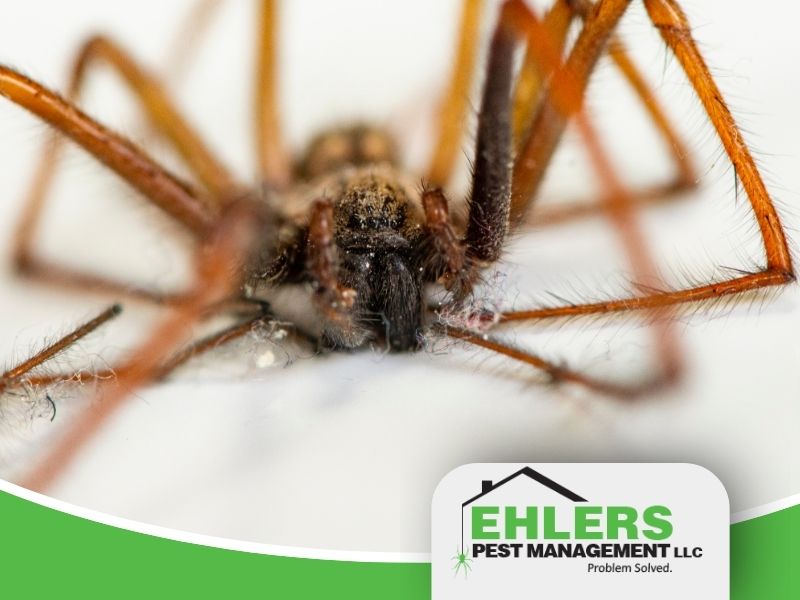
Every October someone asks whether they can pause pest control until spring, on the reasonable theory that a Wisconsin winter takes care of the problem. It’s a fair assumption and it’s mostly wrong. Do bugs die in winter here? A few do. Most have spent a very long time evolving not to, and the ones that cause the most trouble in this state are the ones winter doesn’t touch at all.
Here’s what actually happens to them between November and March, and what that means for the house you’re standing in.
Do bugs die in winter? Most Wisconsin insects don’t. They overwinter as eggs, as adults sheltered in leaf litter and wall voids, or below the frost line. Several pests never slow down at all, because they live indoors year round where the temperature never changes.
Do bugs die in winter, or do they just hide?
Some do. Far fewer than people think, and a hard freeze is not the reset button it gets credit for.
Insects that overwinter in Wisconsin are adapted to Wisconsin. Many species tolerate temperatures well below freezing, and some produce compounds that work like antifreeze, keeping ice crystals from forming inside their cells. A cold snap that feels brutal to you is within the normal operating range for an insect that has been living here since long before the house was.
There’s a detail that surprises people. Snow makes survival easier, not harder. A foot of snow insulates the ground beneath it so effectively that the layer where insects are sheltering stays close to freezing even when the air above is far below zero. A cold winter with deep snow is often gentler on the insect population than a mild one with bare ground and repeated freeze-thaw cycles.
Where do Wisconsin insects spend the winter?
Four strategies cover most of them.
- As eggs. The adults die at frost and leave the next generation behind in egg cases on twigs, in soil, or in leaf litter. Nothing survives the winter except the eggs, and the population rebuilds from scratch in spring.
- As sheltered adults. Box elder bugs, Asian lady beetles, stink bugs, cluster flies, and mated wasp queens go dormant in a protected space and wait. In a wooded lot that means under bark. On your property it often means your wall voids and attic.
- Under insulation outdoors. Leaf litter, mulch, brush piles, and the soil below the frost line all stay survivable. Many spiders and ground beetles do this, and so do ticks, which is why they’re active again on the first warm day in March.
- As larvae or pupae. Some species pass the winter mid-development, underground or inside a host, and finish the job in spring.
Which pests never leave at all?
The ones that matter most in a Wisconsin winter, because they live inside with you and the season is irrelevant to them.
Mice and rats are the obvious case. They move indoors in fall and stay active all winter in a heated building, breeding the whole time. Winter is their busy season, not their off season.
German cockroaches live entirely indoors and never encounter winter. If anything, the furnace helps them, since warmer interior temperatures speed up their development. A small population in October is a considerably larger one by February.
Bed bugs are the same story. They’re in a bedroom at a steady temperature, and the outside weather has no bearing on them whatsoever.
Silverfish, house spiders, and pantry pests round out the list. All of them are indoor residents rather than seasonal visitors.
Does a cold winter mean fewer bugs next year?
Less than the internet suggests, and the relationship is messier than a simple yes.
What actually drives next summer’s populations is spring and summer conditions: moisture, temperature, and how early things warm up. A wet spring will produce more mosquitoes than a cold January prevents. Insects that made it through the winter reproduce fast enough to make up ground quickly once conditions turn.
And as noted above, a cold winter with consistent snow cover can be easier on overwintering insects than a mild one with bare ground, because the snow insulates and the mild winter puts them through repeated freezing and thawing. So the January headline about a deep freeze knocking back the bug population is usually optimistic.
Why do bugs show up indoors in January?
Because they were already in the building and something woke them up.
The insects that moved into your walls and attic in September and October are dormant rather than dead. A stretch of warm weather, a sunny afternoon against a south wall, or heat moving through the structure raises the temperature in that cavity enough to bring them out of dormancy. Then they move toward warmth and light, which leads them into your living space.
That’s why box elder bugs turn up on a window sill in February and why cluster flies appear in an upstairs bedroom during a thaw. Nothing got in that week. They’ve been there since fall, and the thaw just found them.
It’s also why the same thing happens again in March, and why people assume they have a new problem when they have the same one.
Is winter pest control worth anything?
For some things it’s the most important season of the year, and for others there’s genuinely nothing to do.
Rodent work is at its peak value in winter, because that’s when the population is indoors, concentrated, and findable. Roach and bed bug work runs on its own timeline and doesn’t care what month it is. Interior monitoring catches the things emerging from wall voids during thaws.
Exterior work is a different matter. Treating the outside of a house in eight-degree weather with snow against the foundation accomplishes very little, and any company selling a year-round exterior program in Wisconsin is applying a model that was designed somewhere warmer. We’d rather tell you the exterior visit isn’t worth doing in February than take the money for it.
What should you do before it freezes?
The useful work is all happening in the next few weeks.
- Seal the gaps, because every opening you close now is one that isn’t letting something in to overwinter. It’s also the last comfortable window to do foundation work before the ground hardens.
- Get exterior treatment done while it still does something, particularly if your house collects box elder bugs or cluster flies on the sunny walls.
- Clear leaf litter, mulch, and brush back from the foundation, since that’s where the outdoor overwintering population is settling in right now.
- Deal with any rodent activity you already know about, rather than waiting to see whether it gets worse. It will.
What to do next
If you’ve been planning to pause service until spring, the thing worth knowing is which category your actual problem falls into. Mice, roaches, and bed bugs don’t care that it’s January. Box elder bugs and cluster flies are already in the walls and will be at your windows during the first thaw. Neither of those situations improves on its own.
Ehlers Pest Management works across southeastern Wisconsin year round, and you can reach our experienced team at (414) 303-6926 to schedule service. A certified technician will tell you what’s worth doing before the ground freezes, what’s better handled inside once it does, and what genuinely can wait until spring. That last category is real, and we’ll name it.

John Ehlers is the owner of Ehlers Pest Management. Ehlers Pest Management is a veteran-owned family pest control company with the mission to provide responsible pest management solutions that protect people and the environment throughout every community with exceptional quality service. We service Milwaukee, Oak Creek, Shorewood, River Hills, Fox Point, Whitefish Bay, Racine and beyond.