
Identifying a German cockroach correctly changes everything about what happens next, because the species in your kitchen and the species in your floor drain need entirely different work. People describe both as roaches and treat them the same way, which is why so many first attempts fail.
Here’s how to tell which one you have in under a minute.
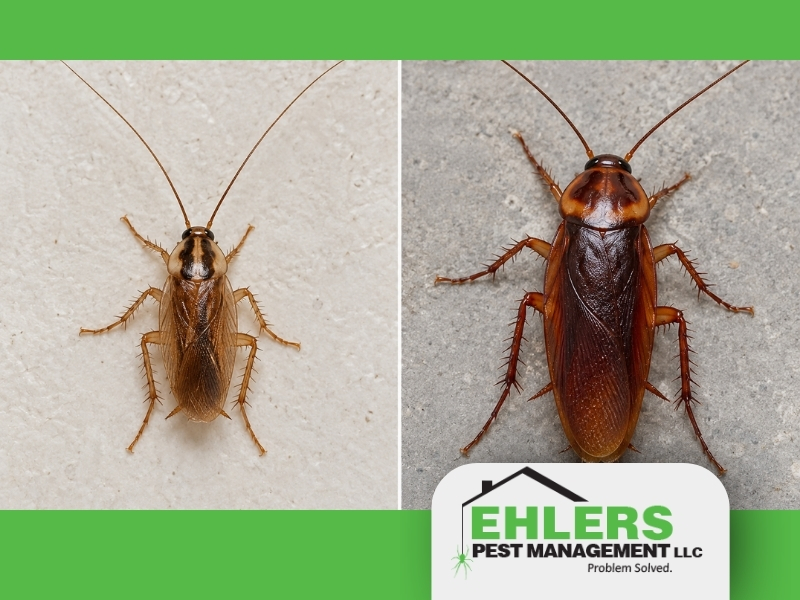
A German cockroach is small, light brown, and has two dark stripes behind the head. It lives indoors year-round and produces real infestations. The large reddish-brown ones people call water bugs come up from drains and sewers and are usually individual wanderers rather than a colony.
What does a German cockroach look like?
Small, light tan or brown, about half an inch long, with two dark parallel stripes running back from the head.
Those stripes are the reliable mark. They sit on the shield behind the head and run lengthwise, and nothing else common in a Wisconsin home has them. Adults have wings but rarely fly. Nymphs are darker, almost black, much smaller, and carry the same stripe pattern, so finding tiny dark roaches alongside tan ones means a breeding population rather than a stray.
They stay close to warmth and moisture, which means kitchens and bathrooms. Cabinet hinges, the underside of countertops, behind and inside appliances, under the sink, and inside the motor housing of a dishwasher or microwave.
What about the big reddish-brown ones?
Those are usually American cockroaches, and they mean something different.
American cockroaches run an inch and a half or longer, are reddish-brown, and have a yellowish figure-eight pattern on the shield behind the head. People call them water bugs. They live in sewers, storm drains, steam tunnels, and damp basements, and they come up through floor drains, sump pits, and gaps around basement plumbing.
Oriental cockroaches are the third one you’ll see here. Darker, nearly black, slower, and strongly tied to damp spaces like crawl spaces and window wells.
Finding one large roach in a basement in November is often a single wanderer from the drain system and may be nothing. Finding small striped ones in a kitchen is not nothing.
Why does the species matter so much?
Because one of them breeds indoors and the other mostly doesn’t.
This species completes its whole life cycle in your building. A female carries an egg case holding roughly thirty to forty eggs and produces several over her life, with the young maturing in a couple of months. That compounding is what turns a few insects into an infestation, and it’s why a small problem in November becomes a much bigger one by the holidays.
American and Oriental cockroaches live outdoors or in the sewer system and wander in. They don’t establish the same way in a dry heated home, and the fix often involves the drain, the sump, or a crawl space moisture problem rather than a kitchen treatment.
Treating a kitchen for a drain problem accomplishes nothing, and treating one unit in a building with shared walls accomplishes very little for long.
How do they get into a clean house?
They’re carried in, and this is worth saying because the embarrassment keeps people from calling.
They arrive in grocery bags and cardboard boxes, in used appliances and secondhand furniture, in a suitcase, or in a delivery. In a duplex or any building with shared walls, they travel between units through plumbing chases, electrical runs, and wall voids without regard for whose apartment is spotless.
Cleanliness affects how fast a population grows once it’s established. It has very little to do with how it started. We’ve treated immaculate homes and we’ve treated cluttered ones.
What does treatment involve for each one?
Different enough that getting the identification wrong wastes a month.
Work on the striped species is specialty work with a defined sequence. Treatments run on a schedule set by the life cycle rather than convenience, because egg cases are protected and applications have to catch the nymphs as they emerge. Preparation matters as much as the treatment: cabinets emptied, clutter cleared so the technician can reach the harborage, and the space vacated during the visit. In a multi-unit building, adjacent units get monitored and often treated, since treating one unit while the neighbors go untreated produces a temporary drop and a full recovery.
For American and Oriental cockroaches, the work usually centers on the entry route and the moisture. Floor drains, sump pits, basement plumbing penetrations, and whatever is keeping a crawl space damp.
What makes a first attempt fail?
Two things, and both are common enough that we see them most weeks.
Foggers are the clearest example. Total-release products settle on open surfaces and don’t penetrate the voids where roaches actually live, and the repellent effect pushes the population deeper into walls and out into adjoining rooms or neighboring units. We get called to homes that had a contained kitchen problem before someone set off foggers and a building-wide problem afterward.
The other is spraying over gel bait. Insecticide applied across a bait placement ruins the bait, so the two most common do-it-yourself approaches cancel each other out.
What should you do next?
If you’re finding small striped roaches in a kitchen or bathroom, don’t wait and don’t set off a fogger, because both make the eventual job larger.
Ehlers Pest Management works across Milwaukee, Waukesha, and Racine counties, and you can reach our experienced team at (414) 303-6926 to schedule service. A certified technician will confirm the species, find where they’re living, and explain what the treatment sequence looks like for your situation. In a duplex or a multi-unit building we’ll tell you honestly whether the neighboring units need to be part of it.
Frequently asked questions
Does seeing one cockroach mean there are more?
With the striped indoor species, effectively yes. They’re nocturnal and avoid open space, so most of the population stays hidden in voids and appliance housings. One in daylight usually means the harborage is crowded enough to push individuals out. With a single large American cockroach in a basement, it may genuinely be one wanderer from the drain.
Can cockroaches survive a Wisconsin winter?
The indoor species never experiences winter, because it lives year-round in heated space and warmth speeds up its development. American and Oriental cockroaches survive in sewers, steam tunnels, and heated basements. Cold weather doesn’t end either problem.
Do cockroaches bite or carry disease?
Bites are very rare. The real health concern is allergens, since cockroach debris is a recognized asthma trigger, especially for children. They also move across contaminated surfaces and then across food-preparation areas, which is the practical reason to resolve them rather than tolerate them.
How long does cockroach treatment take?
Longer than people expect. The protocol runs on a multi-week schedule tied to the egg cycle, followed by a monitoring period with no activity before the job is considered finished. A company treating the same kitchen monthly with no end in sight is managing a complaint rather than finishing a job.
Should I throw out my appliances?
Almost never. Appliances get cleaned and treated rather than replaced, since the harborage is in the motor housing and the warm voids, and a new appliance in an untreated kitchen gets colonized the same way. Replace only if a technician tells you a specific unit can’t be cleared.

John Ehlers is the owner of Ehlers Pest Management. Ehlers Pest Management is a veteran-owned family pest control company with the mission to provide responsible pest management solutions that protect people and the environment throughout every community with exceptional quality service. We service Milwaukee, Oak Creek, Shorewood, River Hills, Fox Point, Whitefish Bay, Racine and beyond.