
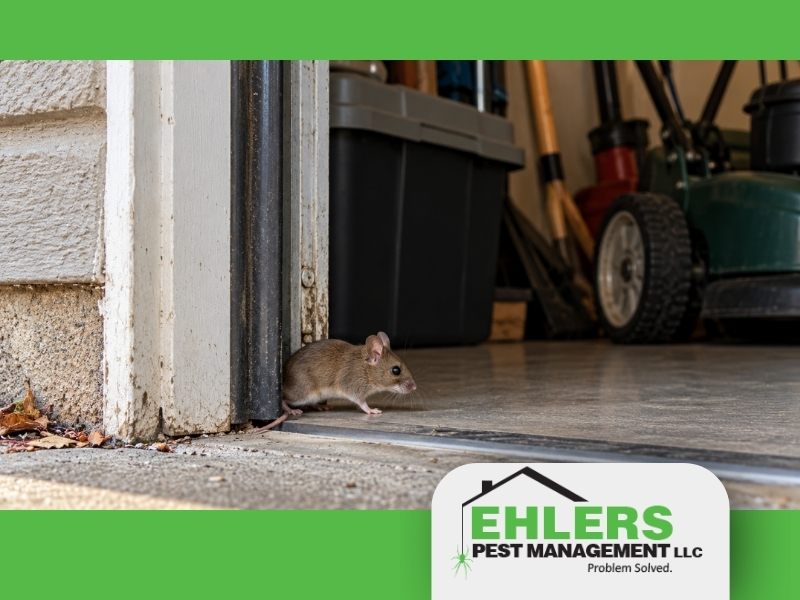
Mice in the garage are how many Milwaukee homes end up with mice in the kitchen. People treat the garage as outside, so they never look at the gap under the door or the worn sweep on the service door. Mice don’t make that distinction. To them, it’s a heated, sheltered room full of food, attached to a bigger one.
Here’s what’s pulling them in and what to close before the ground freezes.
Mice in the garage usually get in under the overhead door, where the seal wears thin in the middle and pulls away at both corners. From there they reach the house through the service door, the utility penetrations, and the gap where the garage wall meets the foundation.
Why do mice go for the garage first?
Because it offers everything they’re looking for with the least effort.
A garage in November is warmer than outside, sheltered from wind and precipitation, quiet for most of the day, and full of cover. It usually contains food too, in forms people don’t think of as food storage: birdseed, pet food, grass seed, fertilizer, garbage waiting for pickup, and the bag of dog treats on a shelf.
It also has the largest openings on the property. Everywhere else on the house, a mouse is hunting for a quarter-inch gap. At the garage, the door corners are often an inch or more.
Where are the mice in the garage actually getting in?
Five places, and the first one accounts for most of it.
- The overhead door seal. The rubber compresses and hardens over the years, wears thin in the middle where the door meets the slab, and pulls away at both corners. Those corners are the single most reliable rodent opening on a house in this area.
- The gap where the concrete slab meets the frame, especially where the slab has settled or heaved.
- Utility penetrations along the back and side walls, where electrical, water lines, and outlets pass through and nobody sealed behind them.
- The service door, where a worn sweep leaves daylight at the bottom and the weatherstripping has flattened.
Stand inside with the lights off in the daytime and look along the base of the overhead door and around the service door. Daylight means an opening, and if you can see light, a mouse enter.
How do they get from the garage into the house?
Through the shared wall, and usually without going outside again.
The door between the garage and the house has a sweep that wears like any other, and it’s frequently the worst-sealed interior door in the building. Beyond that, there’s the wall cavity itself. Mice move up inside a shared wall and come out in the kitchen, the laundry, or a first-floor closet, which is why people find droppings in the pantry and assume the mice came in through the back door.
Plumbing and electrical runs between the garage and the living space are the other route. Anywhere a pipe or a cable passes through that shared wall is a hole that was drilled larger than the thing going through it.
What’s in the garage that’s feeding them?
More than people expect, and this part is free to fix.
Birdseed is the leading offender in southeastern Wisconsin. A paper bag of seed on a garage floor is an open buffet, and the spillage underneath keeps feeding a population long after the bag is gone. Pet food in its original bag is the same problem. Grass seed, fertilizer with grain or bone meal in it, and bags of ice melt all get chewed into.
Then there’s the cardboard. Stacked boxes and stored paper are nesting material and harborage in one, and a mouse living inside a box of holiday decorations is a mouse you won’t find until December.
Move anything edible into hard plastic bins with gasketed lids, get storage off the floor and onto shelving, and replace cardboard with plastic where you can.
Can mice damage a car parked in the garage?
Yes, and the repairs can cost real money.
Modern vehicles use plant-derived compounds in some wire insulation, and rodents chew it. A car that sits through a Wisconsin winter in an attached garage is a stationary, sheltered engine bay, and mice nest in it, in the cabin air filter housing, and under seats. Chewed harnesses produce warning lights, failed sensors, and electrical faults that are expensive to trace.
If you drive the car daily, it’s less attractive. A second vehicle, a project car, or anything parked for the season is the one at risk.
What should you close before the ground freezes?
Four jobs, and most of them are a Saturday with a trip to the hardware store.
- Replace the overhead door bottom seal if it’s hardened, torn, or worn thin, and check how it meets the jamb at both corners.
- Put a proper sweep on the service door and on the door into the house.
- Pack and seal utility penetrations with copper mesh or hardware cloth, then seal over it with sealant rather than foam alone.
- Get food and cardboard off the floor and into sealed containers.
Closing the exterior openings on the rest of the structure is a separate piece of work, and an inspection will assess whether the building is a good candidate. The garage items above are worth doing regardless.
What should you do next?
Check the garage this week, because it’s the fastest payoff available on the whole property and the window for comfortable work is closing.
If you’re already finding droppings on a workbench or along the base of the walls, that population has access to the house whether or not you’ve seen evidence inside yet. Ehlers Pest Management works throughout Milwaukee, Waukesha, and Racine counties, and you can reach our experienced team at (414) 303-6926 to schedule service. A certified technician will look at the garage and the shared wall, tell you what’s getting through and where, and explain what it takes to close it.
Frequently asked questions
Is it normal to have mice in an attached garage?
It’s extremely common in this area, particularly from October onward. That doesn’t make it harmless, because an attached garage shares a wall with living space and mice move through it readily. A detached garage is a lower-stakes version of the same problem.
Will keeping the garage door closed solve it?
No, because the opening is usually the worn seal along the bottom, not the door being left up. A closed door with a hardened or torn seal still has a gap at the slab and at the corners, which is exactly where mice enter.
Do mothballs or peppermint oil keep mice out of a garage?
Neither works. Mothballs are a pesticide being used off-label when scattered loosely, and peppermint oil has no durable effect on a population with a reason to be there. Both are common enough that we see them on nearly every garage visit, usually alongside active droppings.
Should I set traps in the garage?
Traps help with the animals present, and they’re reasonable to run, placed along the walls rather than in open floor. They don’t address the opening, so expect replacements to arrive if the door seal and the penetrations stay open.
What about the cars, should I pop the hood?
Leaving the hood up in storage is a common suggestion and it does make the engine bay less sheltered. It’s a partial measure rather than a fix. Keeping food out of the garage and closing the door openings does considerably more.

John Ehlers is the owner of Ehlers Pest Management. Ehlers Pest Management is a veteran-owned family pest control company with the mission to provide responsible pest management solutions that protect people and the environment throughout every community with exceptional quality service. We service Milwaukee, Oak Creek, Shorewood, River Hills, Fox Point, Whitefish Bay, Racine and beyond.