
Voles in Wisconsin do most of their damage where nobody can see it, under the snow, between December and March. What you find at snowmelt is a lawn crossed with dead brown trails and a young tree with its bark chewed off at the base. By then the damage is done and the tree may not recover. That’s why October is the month voles are worth dealing with.
Here’s how to confirm what you have, what separates them from moles, and what’s worth doing before the ground freezes.
Voles in Wisconsin leave narrow surface runways through the grass and chew bark off the base of young trees and shrubs. They’re often mistaken for moles, which raise tunnels and eat insects instead of plants. Most vole damage happens under winter snow, which makes fall the window to act.
What do voles in Wisconsin actually look like?
Like a mouse that got stockier and lost its tail.
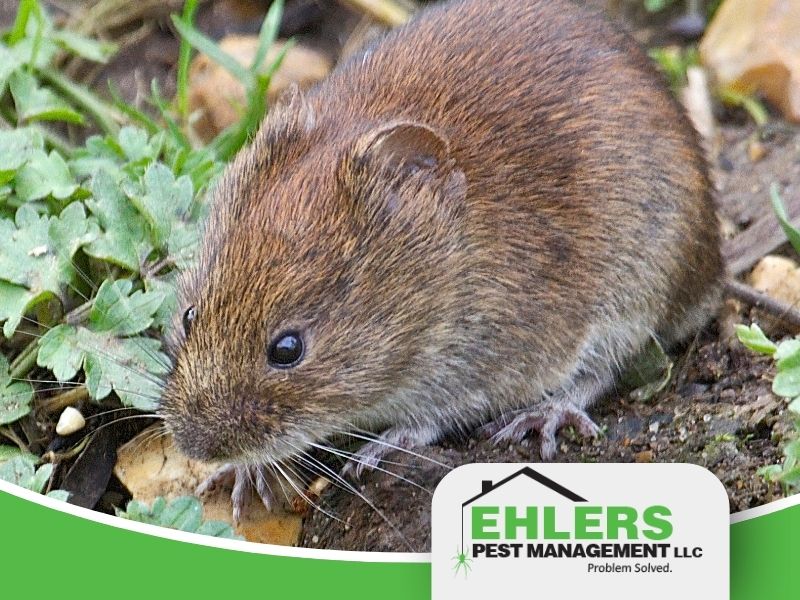
The meadow vole is the common one here. Four to seven inches nose to tail, brown or gray, with a blunt rounded nose, small ears mostly buried in fur, and a short tail roughly the length of its head. That tail is the quickest tell. A house mouse has a long, thin, nearly hairless tail about as long as its body. A vole’s looks stubby by comparison.
They’re herbivores, which matters. Grasses, roots, bulbs, tubers, and tree bark are what they’re after, and they have no interest in your pantry. They’re active around the clock all year and they don’t hibernate.
Is it voles or moles?
This is the most common mix-up in Wisconsin yards, and the two need completely different work.
Voles leave surface runways. Narrow paths, an inch or two wide, worn through the grass at ground level, with clipped vegetation and small droppings along them. You see them best in early spring or after mowing a neglected area. They’re paths, not tunnels.
Moles leave raised ridges and volcano-shaped mounds of soil. They’re pushing dirt because they’re digging, and they’re digging because they eat grubs and earthworms. Moles do not eat plants. If something chewed the bark off your burning bush, that was not a mole.
There’s a useful shortcut here. Damage to the plant itself means voles. Damage to the soil surface means moles. Plenty of people spend a season treating for the wrong animal because nobody told them that.
What damage do they actually do?
Two kinds, and the second one is expensive.
The first is turf. Runways and feeding trails leave the lawn crossed with dead brown lines, most of it revealed at snowmelt. It’s ugly and it usually grows back with some raking and overseeding.
The second is girdling, and it’s the one that kills things. Voles chew the bark off the base of young trees and shrubs, working under snow cover where they feel protected. If the chewing goes all the way around the trunk, the plant loses its ability to move water and nutrients, and it dies even though it looks fine until it leafs out in spring and then doesn’t. Young fruit trees, crabapples, arborvitae, burning bush, and newly planted ornamentals are the usual casualties.
Bulbs get eaten too, which is why a tulip bed planted in October sometimes produces nothing in April.
Why does fall matter more than any other season?
Because of the snow, and because of the timing of everything you’d want to do about it.
Vole populations peak in fall after a full breeding season. As the weather turns, they move toward cover and start feeding on woody material. Then the snow comes, and they tunnel through the layer between the snowpack and the ground, where they’re hidden from hawks, owls, and foxes, and insulated from the cold. That protected space is where they do their worst work on your trees and shrubs.
Everything that helps has to happen before that. You can see the runways now and you won’t be able to in January. Tree guards go on before snow, not after. Habitat work needs open ground. Once there’s a foot of snow on the lawn, you’re a spectator until March.
Do voles get into houses?
Rarely, and if something is in your house it’s almost certainly not a vole.
Voles are outdoor animals built for runways and burrows in vegetation. They occasionally turn up in an attached garage or a walkout basement, but they don’t establish indoors the way mice do, and they aren’t looking for your kitchen.
If you’re hearing activity in a wall or finding droppings in a cabinet, that’s a mouse, and it’s a different job with a different approach. Getting the identification right saves you from paying for the wrong service.
What reduces them?
Habitat first, protection second, and treatment where it’s warranted.
- Mow late into the season and cut back tall grass, weeds, and ground cover, especially along fence lines and foundation beds. Voles need cover and won’t cross open ground willingly.
- Pull mulch back several inches from tree trunks and shrub bases. A mulch volcano piled against a trunk is ideal vole habitat placed exactly where the damage hurts most.
- Put hardware cloth cylinders around young trees and valuable shrubs, pushed an inch or two into the soil and tall enough to clear the expected snow depth. This is the single most effective thing you can do in October.
- Clear brush piles, stacked wood, and leaf litter away from the lawn and the foundation.
Beyond that, bait placement and trapping in active runways are what a technician handles, and both are far more effective when the habitat work has already been done.
Does anything eat voles?
Plenty of things, and it’s part of why habitat work matters more than people assume.
Hawks, owls, foxes, coyotes, and snakes all hunt voles, and an outdoor cat will take a few. None of that solves a vole problem on its own, because a single female can produce several litters in a season and the reproduction outruns the predation. What predators do is punish exposure. A vole crossing open, short grass is in real danger. A vole running a covered runway under tall grass, ground cover, or a mulch bed is not.
That’s the practical argument for mowing late and pulling mulch back. You’re not just removing shelter, you’re handing the population over to the owls. It’s the cheapest control available and it costs an afternoon.
Can you actually get rid of voles?
Not permanently, and it’s worth being straight about that before anyone spends money.
Voles are a landscape animal. If your property backs onto a field, a prairie restoration, a retention pond, a wooded lot, or any unmowed ground, new ones will move in from there no matter what happens on your side of the line. What’s realistic is keeping the population down and protecting the plants that matter, on a recurring basis rather than as a one-time fix.
On a tight suburban lot surrounded by other mowed lawns, results hold much better. Knowing which situation you’re in changes what’s worth spending.
What to do next
Walk the lawn this week, particularly along fence lines, garden beds, and anywhere the grass has gotten long, and look for narrow worn paths at ground level. Then check the base of every young tree and shrub you’d be unhappy to lose. If you find runways near plantings you care about, get guards on those trunks before the first lasting snow.
Ehlers Pest Management works across southeastern Wisconsin, and you can reach our experienced team at (414) 303-6926 to schedule service. A certified technician will confirm whether you have voles or moles, which changes everything about the approach, look at what’s giving them cover, and tell you what’s realistic for your property given what surrounds it.

John Ehlers is the owner of Ehlers Pest Management. Ehlers Pest Management is a veteran-owned family pest control company with the mission to provide responsible pest management solutions that protect people and the environment throughout every community with exceptional quality service. We service Milwaukee, Oak Creek, Shorewood, River Hills, Fox Point, Whitefish Bay, Racine and beyond.