
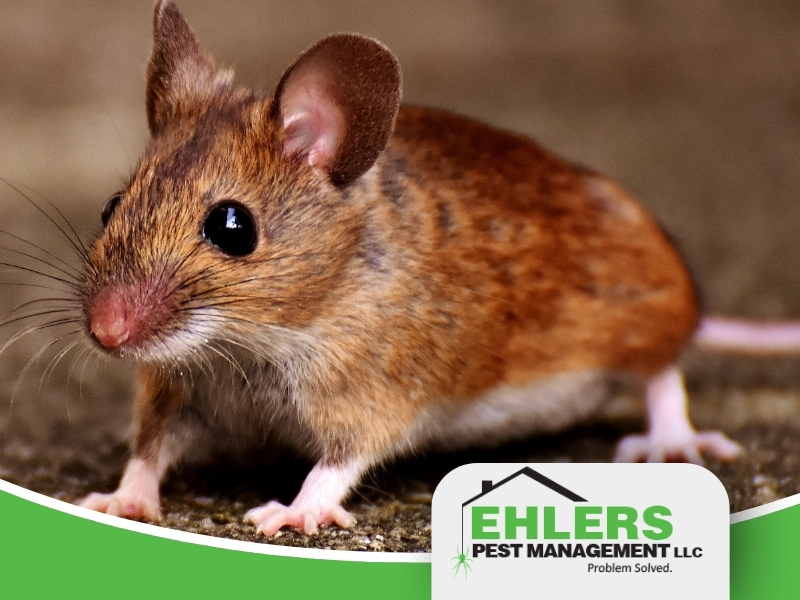
Mouse damage is easy to underestimate because the part you see is a few droppings behind the toaster. The part you don’t see is in the attic, inside the wall cavities, and along the wiring runs, and it accumulates quietly for months before anything obvious happens.
Here’s what mice actually do to a house in southeastern Wisconsin, roughly in order of how much it costs to fix.
Mouse damage shows up in three places: insulation they nest in and contaminate, wiring they gnaw to keep their teeth worn down, and stored items in attics and basements. The wiring is the one that matters most, because chewed insulation on a live wire is a documented fire risk.
What does mouse damage actually look like?
Four things, and only one of them is the thing people picture.
- Insulation, which they nest in, tunnel through, and contaminate.
- Wiring, which they gnaw constantly, including the low-voltage runs for thermostats, doorbells, and networking.
- Stored belongings, particularly anything in cardboard boxes in an attic or basement.
- Ductwork and the surfaces around it, which spreads the contamination through the house.
Droppings on a counter are a symptom of all of that. They’re the least expensive part of the problem.
What happens to attic insulation?
It stops working, and it doesn’t recover.
Mice tunnel through blown-in cellulose and fiberglass to build nests, which compresses the material and destroys the air pockets that make it insulate in the first place. Compressed insulation loses a meaningful share of its R-value, and in a Wisconsin winter you pay for that every month.
Then there’s the contamination. Mice urinate as they travel rather than in one spot, so an active population soils a wide area over a season. Soiled insulation holds odor, and in an attic that odor moves into the house whenever air pressure shifts. Once it’s bad enough, the fix is removal and replacement of the affected area rather than cleaning, which is the single most expensive thing on this list.
Is chewed wiring really a fire risk?
Yes, and it’s the reason we push people to deal with rodents rather than tolerate them.
Mouse incisors grow continuously, so they gnaw whether they’re hungry or not, and wire insulation is exactly the right hardness for the job. What that leaves is exposed conductor inside a wall cavity or an attic, often surrounded by nesting material. That combination is how rodent activity turns into an arc fault, and it’s a recognized cause of structure fires.
The low-voltage damage is more common and shows up sooner. Thermostat wire, doorbell wire, alarm and camera runs, and network cable are all thin and easy to chew. If your furnace started behaving strangely or a hardwired smoke detector began chirping for no reason, rodents are worth ruling out before you call an electrician.
You generally can’t inspect this yourself, because the damage is where the mice travel and that’s inside the structure. What you can do is take the activity seriously early, before there’s been time for much of it.
What about cars parked in the garage?
Worth knowing about, because it surprises people every fall.
Modern vehicles use soy-based and other plant-derived compounds in wire insulation, and rodents will chew it. A car that sits in an attached garage through a Wisconsin winter is a warm, sheltered place with a stationary engine bay, and mice nest in it. The repairs run into real money and they’re frequently not covered the way people assume.
If your garage has mouse activity, that isn’t only a garage problem. It’s the staging area for the house and a risk to whatever is parked in it.
What should you know before cleaning up droppings?
One thing, and it matters more than the cleaning method.
Don’t sweep or dry-vacuum droppings and nesting material. That puts particles into the air you’re breathing. The standard practice is to ventilate the space first, spray the area with a disinfectant solution and let it sit, then wipe it up with paper towels while wearing gloves and bag it.
The realistic health concern in a Wisconsin home is allergens and asthma triggers rather than anything exotic, along with bacteria on surfaces where food is handled. That’s reason enough to handle it properly without treating it as a crisis.
Does homeowners insurance cover it?
Usually not, and this catches people at the worst possible moment.
Rodent damage is commonly excluded from homeowners policies, on the reasoning that it develops gradually and is preventable with maintenance. Insulation replacement, chewed wiring, and damaged stored goods frequently fall outside coverage. Fire that results from rodent-chewed wiring is a more complicated question and depends on the policy.
Worth ten minutes with your actual policy rather than an assumption, because the answer changes how much the prevention is worth to you.
How long does it take for the damage to add up?
Faster than the timeline most people have in their head.
A pair of mice that gets in during October has produced multiple generations by February, because a female can have several litters a year and the young breed at around six weeks. That population is nesting, chewing, and contaminating the entire time, in spaces nobody looks at until spring.
There’s a secondary problem too. Mice that die inside a wall or attic become a food source for blow flies, carpet beetles, and larder beetles. A sudden appearance of shiny metallic flies at an upstairs window in midwinter usually means exactly that.
What are the early signs, before the damage adds up?
Five things, and most of them show up weeks before anyone sees an actual mouse.
- Rub marks. Mice follow the same routes and leave a faint greasy smudge along joists, pipes, and the base of walls. On a light-colored surface it reads as a dirty line that wasn’t there last year.
- Gnaw marks on specific materials. Look at the corners of cardboard boxes, the edge of a plastic storage bin lid, and the soft wood at the bottom of a door frame or a stair stringer.
- Sound with a schedule. Scratching or scrabbling in a wall or ceiling that starts around dusk and again before dawn, rather than randomly through the day.
- Pet behavior. A dog or cat that fixates on one section of wall, one cabinet, or one spot on the floor for days is usually right.
The other one worth checking is smell. A persistent musky odor in a closet, a basement corner, or near a floor vent, particularly one that gets stronger when the furnace runs, generally means there’s a nest in the vicinity or something died in the cavity.
Any of those is worth acting on. All of them are cheaper to deal with in October than in March.
What to do next
If you’ve seen a mouse, heard activity in a wall, or found droppings anywhere, treat that as the start rather than the whole of it. Get someone into the attic and the basement joist bays, which is where the expensive damage happens and where you’re not going to notice it on your own.
Ehlers Pest Management works across southeastern Wisconsin, and you can reach our experienced team at (414) 303-6926 to schedule service. A certified technician will inspect the property, tell you what’s actually going on and how long it’s likely been happening, and lay out what it takes to close the building up before winter.

John Ehlers is the owner of Ehlers Pest Management. Ehlers Pest Management is a veteran-owned family pest control company with the mission to provide responsible pest management solutions that protect people and the environment throughout every community with exceptional quality service. We service Milwaukee, Oak Creek, Shorewood, River Hills, Fox Point, Whitefish Bay, Racine and beyond.