
Bugs in firewood come into Wisconsin houses every October, usually about twenty minutes after someone brings an armload in and sets it next to the stove. The wood warms up, whatever was dormant in it wakes up, and suddenly there are beetles on the hearth rug.
It’s less alarming than it looks. Here’s what’s actually living in the pile, the short list of things worth caring about, and how to stack wood so this mostly stops happening.
Bugs in firewood are common and mostly harmless indoors. Carpenter ants, bark beetles, wood borers, spiders, and sowbugs all overwinter in a wood pile and wake up when the wood warms. Almost none of them can infest the dry, finished lumber in a house.
What bugs in firewood are you actually looking at?
A wood pile is a habitat, and by October it’s full.
Carpenter ants are the ones worth knowing by name. They excavate galleries in damp or decaying wood, and a split log can contain an entire overwintering colony that becomes active in a warm room.
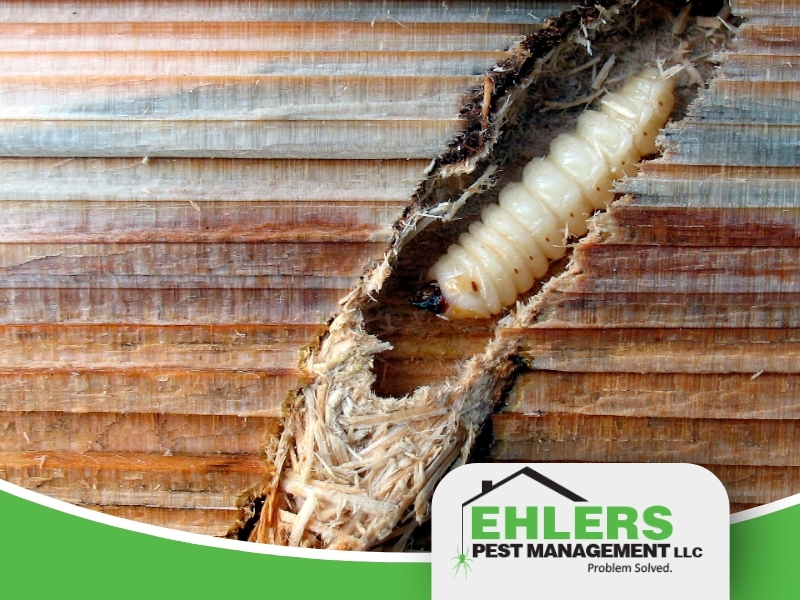
Wood borers and bark beetles are the most common and the most startling. Longhorned beetles and metallic wood borers develop under the bark and in the sapwood of dead trees, and the adults emerge when the wood warms. Some of them are large and they fly, which is how you end up with an inch-long beetle circling a lamp in February.
Then there’s everything using the pile as shelter rather than food: spiders, centipedes, sowbugs and pillbugs, wood roaches, overwintering wasps and lady beetles tucked into bark crevices, and occasionally a mouse nest in the middle of the stack.
Will any of it infest my house?
Almost none of it, and this is the reassurance most people are looking for.
Wood borers and bark beetles need unseasoned wood with bark and moisture still in it. The framing lumber, flooring, and trim in your house are dry, finished, and years past the condition those insects require. They emerge, fly around, and die without reproducing. They’re a nuisance, not a threat to the structure.
Wood roaches are the same story. They’re an outdoor insect that can’t establish indoors and doesn’t behave like a German cockroach.
Carpenter ants are the exception worth watching. They don’t eat wood, but they do excavate it, and they need moisture to do it. A house with a chronic damp spot, a leaking window, or a wet sill plate can support them. A dry house generally can’t, and the ones that ride in on firewood usually just die.
Why do they come out indoors?
Because your living room is a false spring.
These insects go dormant as temperatures drop and they take their cue to become active from warmth. A log that’s been at twenty degrees in the yard and then sits at seventy next to a wood stove gets a signal that winter has ended. The insects inside it respond accordingly and come out looking for a world that isn’t there.
That’s the entire mechanism, and it’s why this happens with wood brought in and stacked indoors rather than wood carried straight to the fire.
How should you stack firewood?
Four rules, and the first one prevents most of the problem.
- Never store firewood inside the house or in an attached garage. Bring in only what you’ll burn that day, and put it on the fire rather than in a rack by the hearth for a week.
- Stack outdoors, off the ground on a rack or pallets, so the bottom row isn’t sitting in soil and moisture.
- Keep the pile well away from the house rather than against the siding or foundation. A pile against the wall is shelter for mice, voles, spiders, and anything else looking for a way in, positioned exactly where they can find one.
- Cover the top to shed rain and snow, and leave the sides open so air moves through and the wood keeps drying.
Burning the oldest wood first helps too, since a stack that sits for three seasons becomes considerably more populated than one that turns over each winter.
Should you spray firewood?
No, and this is the one piece of advice in here that matters for a different reason.
Firewood is going to be burned, and whatever you apply to it goes up the chimney and into the air, some of it into the room. Insecticides are not manufactured or labeled for that, and applying them to something you intend to set on fire is genuinely a bad idea rather than a cautious one.
Knocking logs together outside before carrying them in does more than any product would, and it costs nothing.
Does it matter where the wood came from?
Yes, and Wisconsin has rules about it.
Moving firewood is one of the main ways invasive tree pests spread, emerald ash borer being the obvious example, and Wisconsin restricts how far firewood can travel, particularly onto state land. The general principle is to buy wood close to where you’ll burn it, or buy certified heat-treated wood, rather than hauling a load across the state. Rules change, so it’s worth checking current Wisconsin DNR guidance if you’re transporting any distance.
This one isn’t really about your house. It’s about not moving something into a stand of trees that hasn’t got it yet.
What about the pile that’s already against the house?
Move it, and do it before the ground freezes.
A wood pile stacked against siding or a foundation is one of the more reliable ways to end up with mice in a wall. It gives them cover right at the point where they’d be looking for a gap, it holds moisture against the building, and it hides the foundation line you’d otherwise be inspecting.
The same pile is also prime habitat for voles chewing at nearby shrubs and for the millipedes and centipedes that end up in the basement. Moving it twenty feet out solves a surprising amount at once.
What to do next
If bugs come out of the wood next to your stove, sweep or vacuum them up and don’t worry much about it. They came in on the log and they’re not going anywhere in your walls.
What’s worth doing this month is relocating the pile off the house and getting the foundation line clear before the ground hardens. If you’re finding carpenter ants indoors repeatedly, or you’re seeing activity that doesn’t line up with the firewood, that’s worth an actual look. Ehlers Pest Management serves southeastern Wisconsin, and you can reach our experienced team at (414) 303-6926 to schedule service. A certified technician can tell you whether what you’re seeing came in on the wood or is living in the building, which are two very different conversations.

John Ehlers is the owner of Ehlers Pest Management. Ehlers Pest Management is a veteran-owned family pest control company with the mission to provide responsible pest management solutions that protect people and the environment throughout every community with exceptional quality service. We service Milwaukee, Oak Creek, Shorewood, River Hills, Fox Point, Whitefish Bay, Racine and beyond.