Author: John

John Ehlers is the owner of Ehlers Pest Management. Ehlers Pest Management is a veteran-owned family pest control company with the mission to provide responsible pest management solutions that protect people and the environment throughout every community with exceptional quality service. We service Milwaukee, Oak Creek, Shorewood, River Hills, Fox Point, Whitefish Bay, Racine and beyond.

Categories Rodents

Signs of Mice in Your Walls: What Wisconsin Homeowners Need to Know

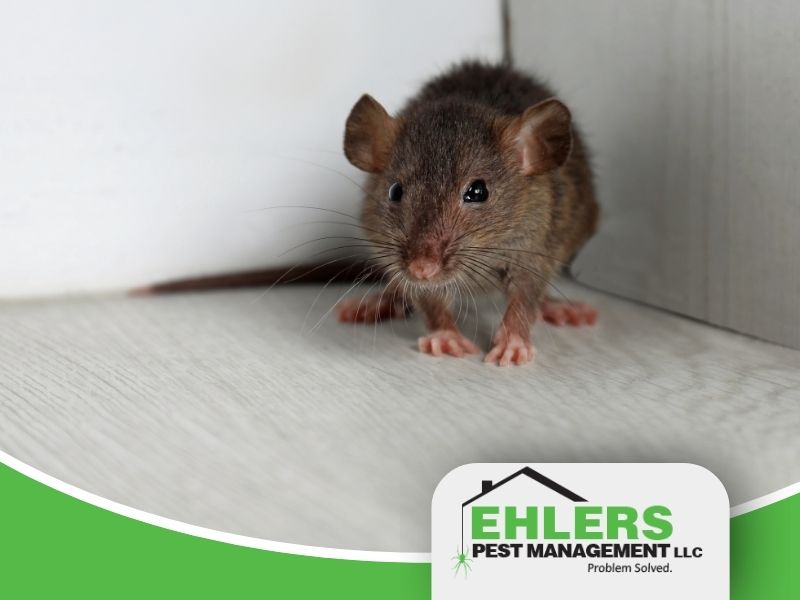
A brown mouse stands in the corner of a white room. The Ehlers Pest Management LLC logo appears in the lower right corner, representing expert pest control solutions.

If you’re hearing scratching sounds coming from inside your walls, there’s a good chance you already know what’s causing it — you just don’t want it to be true. Recognizing the signs of mice in walls early is one of the most important things a Wisconsin homeowner can do before a small problem becomes a serious one.

Here’s what to look for, what it means, and when to act.

Why Mice Head Indoors in Wisconsin

Wisconsin winters push mice to seek warmth, shelter, and food — and your home offers all three. Mice can squeeze through a gap as small as a dime, and once one finds a way in, others follow. House mice and deer mice are the most common species in Southeastern Wisconsin homes, and both are capable of nesting inside wall cavities, insulation, and crawl spaces where they’re almost never seen directly.

That’s what makes them tricky. By the time most homeowners realize they have a problem, a small entry has already become an established route — and a pair of mice has already become a lot more.

Signs of Mice in Your Walls

You’re unlikely to see mice directly, especially during the day. What you’ll notice are the signals they leave behind:

  • Scratching or scurrying sounds — Most active at night, mice move through wall cavities, across ceilings, and behind baseboards. If you hear it after the house settles down for the evening, take it seriously.
  • Droppings near baseboards or in cabinets — Small, dark, and pellet-shaped. Fresh droppings are soft; older ones dry out and crumble. Either way, they indicate active or recent activity.
  • Gnaw marks on wood, drywall, or food packaging — Mice gnaw constantly to keep their teeth worn down. Look for chewed corners on boxes, baseboards, or structural wood near the floor.
  • Grease marks along walls — Mice travel the same routes repeatedly and leave oily smudge marks along baseboards and walls from the oils in their fur.
  • A musty, ammonia-like odor — Mouse urine has a distinctive smell that becomes more noticeable in enclosed spaces like cabinets, closets, or utility rooms.
  • Pet behavior changes — Dogs and cats often detect rodents before humans do. If your pet is fixating on a wall, cabinet, or corner of the room for no obvious reason, trust their instincts.

Why One Mouse Means More

This is the part most homeowners underestimate. Mice reproduce rapidly — a single female can produce 5 to 10 litters per year, with 5 to 6 pups per litter. A couple of mice that find their way into your home in October can become dozens by spring.

Mice also rarely travel alone. If one has found a reliable food source and a safe nesting spot, others will follow the same scent trails. Seeing or hearing one mouse is almost never the whole picture.

The Risks Beyond the Nuisance

Mice aren’t just unpleasant to think about — they create real problems inside your home:

  • Structural damage from gnawing on insulation, wood framing, and electrical wiring (a leading cause of house fires)
  • Contamination of food, countertops, and stored items through droppings and urine
  • Health risks from pathogens carried in droppings, including salmonella and hantavirus

This is why rodent control in Milwaukee homes is something we take seriously — and why waiting to see if the problem resolves on its own is rarely a good strategy.

What to Do If You’re Seeing the Signs

If you’ve noticed one or more of the signs above, here’s what to do:

  • Don’t ignore it. Activity doesn’t stop on its own once mice are established indoors.
  • Avoid using poison bait yourself. Rodenticide placed incorrectly can harm pets and children, and mice often die inside walls — creating odor and secondary pest problems.
  • Seal obvious entry points around pipes, dryer vents, and foundation gaps — but understand this alone won’t address mice already inside.
  • Call a professional. A trained technician can identify entry points, assess the extent of the infestation, and implement a targeted treatment plan.

Don’t Wait Until Spring to Deal With It

Mice don’t slow down once they’re inside. They nest, breed, and cause damage year-round in the warmth of your walls and attic spaces. The earlier you address it, the less damage gets done — and the simpler and less costly the solution.

If you’re hearing scratching in your walls or seeing any of the signs above, Ehlers Pest Management can help. We provide rodent control in Milwaukee and across Southeastern Wisconsin — straightforward, effective, and without the runaround.

Schedule your inspection today.


Frequently Asked Questions

How do I know if the scratching in my walls is mice or something else?

Mice are most active at night and produce light, rapid scratching or scurrying sounds. Squirrels are more likely to be heard during the day and in the attic. If you’re hearing sounds at night near baseboards or inside lower wall cavities, mice are the most likely culprit in a Wisconsin home.

Can mice in walls go away on their own?

Rarely. Once mice establish a nesting site and food source inside your home, they stay. Without intervention — sealing entry points and removing the existing population — the problem typically grows.

How long does it take to get rid of mice in walls?

It depends on the size of the infestation and the treatment method. A professional treatment plan typically produces noticeable results within one to two weeks, with follow-up to confirm the problem is fully resolved.

Is it dangerous to have mice in my walls?

Yes. Beyond the nuisance, mice chew through electrical wiring, contaminate surfaces with droppings and urine, and can carry pathogens that pose health risks to your family.

Categories Uncategorized

What May Pest Activity Tells You About Summer Problems Ahead

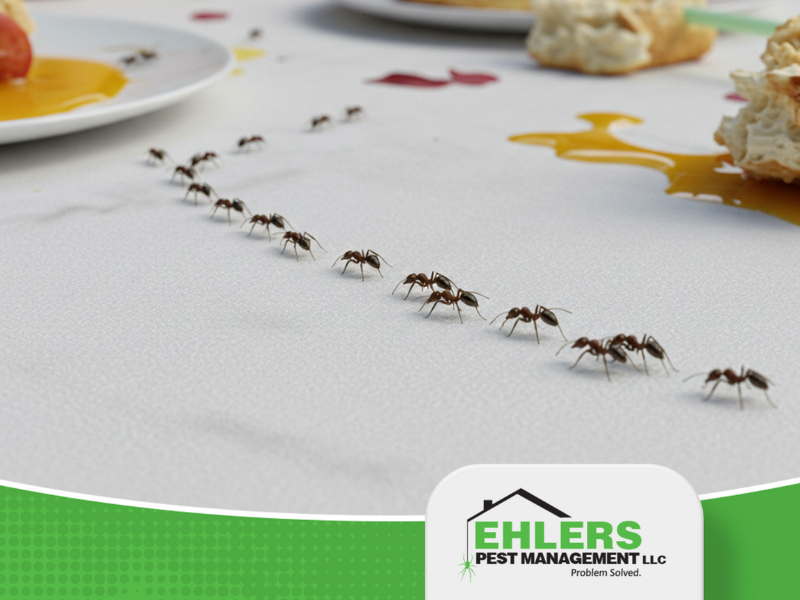
A line of ants marches across a white surface with food and spills, with the Ehlers Pest Management LLC logo in the bottom right corner, highlighting local pest solutions.

By May, Wisconsin finally feels like spring. Temperatures are more consistent, lawns are growing, and outdoor activity increases. For pests, May is more than just another warm month—it’s a preview of what summer pest pressure may look like.

Pest activity in May often reflects what’s already established. Ant colonies that became active in early spring are now expanding, sending out more workers in search of food and moisture. If ants are appearing regularly in May, it usually means a nearby colony is well-established and preparing to grow even larger during summer.

Rodent activity can also provide early clues. Mice that entered homes during winter don’t automatically leave when the weather warms. If signs of rodents persist into May, it may indicate nesting inside walls, attics, or garages. Left unchecked, this activity can continue through summer and lead to ongoing contamination or damage.

May is also when stinging insect activity begins to increase. Early nests started by queens in spring are growing, even if they’re not yet noticeable. Seeing increased insect traffic around siding, eaves, or ground areas may signal nesting locations that will become more active and aggressive later in the season.

Moisture plays a major role during this time of year. Spring rain combined with warming temperatures creates ideal conditions for many pests. Damp soil, clogged gutters, and shaded areas near foundations can attract insects and encourage nesting close to the home.

What makes May especially important is timing. Pest populations are still manageable, but they’re building momentum. Addressing issues now is far easier than trying to control peak activity during summer months when pests are more numerous and widespread.

Preventative pest control in May focuses on limiting growth rather than reacting to infestations. Sealing entry points, managing moisture, and addressing early signs of activity can significantly reduce summer problems.

May pest activity isn’t just a seasonal nuisance—it’s an early warning system. Paying attention now helps homeowners avoid bigger, more disruptive pest issues as summer approaches.

Categories Ants

Ants in Your Kitchen? Here’s What It Really Means

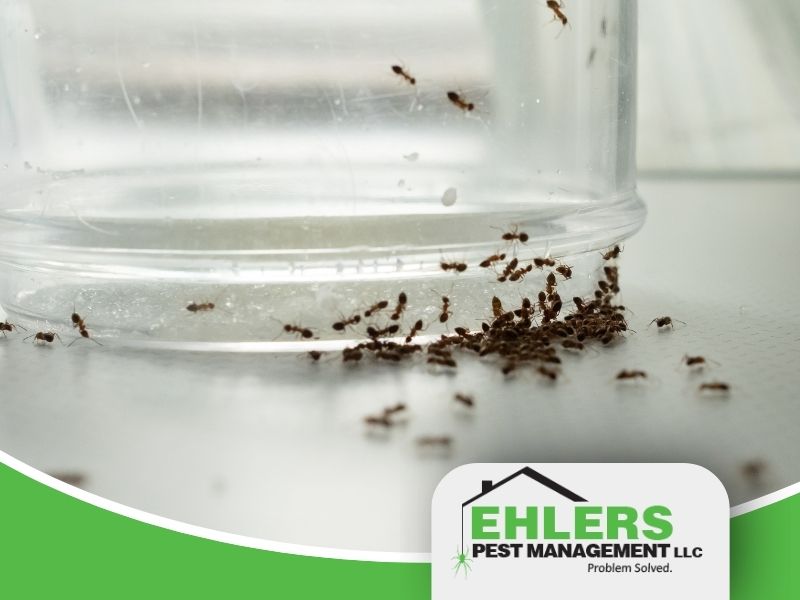
A close-up of numerous ants swarming around the edge of a clear plastic container, with the Ehlers Pest Management LLC logo in the bottom right corner, highlighting local pest control expertise.

If you’ve spotted ants in your kitchen in Milwaukee, you’re not dealing with a random straggler. You’re looking at the first sign of a much bigger problem nearby.

It’s easy to wipe them up and move on. But if they keep coming back, there’s a reason. Here’s what’s actually happening inside your home, and what to do about it before it gets worse.

Why You’re Seeing Ants in Your Kitchen

Ants don’t wander indoors by accident. When a single ant finds its way into your kitchen, it’s scouting on behalf of a colony that could number in the thousands. If it finds food or moisture, it leaves an invisible chemical trail for others to follow.

By the time you notice a line of ants moving across your counter or floor, the scouting phase is already over. The colony has decided your kitchen is worth exploiting — and they’ll keep coming back until something changes.

What One Ant Is Actually Telling You

Ant activity in your kitchen usually points to three things:

  • A colony is nearby. Ants don’t travel far. If they’re in your kitchen, the nest is likely in your walls, under your foundation, or close to the exterior of your home.
  • They’ve found a food or moisture source. Grease behind the stove, a drip under the sink, crumbs in a cabinet corner — ants don’t need much.
  • There’s an entry point they’ve found and are using. Gaps around pipes, cracks in the foundation, or unsealed windows are common access points.

None of these problems fix themselves. The trail gets reinforced every time an ant makes it back to the colony successfully.

Why Milwaukee Homes See More Ants in Spring and Summer

Ant activity in Southeastern Wisconsin spikes between May and August. Colonies expand in warmer months, and heavy spring rains push nests toward higher, drier ground — which often means toward your foundation and into your home.

The two most common species we see in Milwaukee kitchens are pavement ants (small, dark, usually near baseboards or under appliances) and odorous house ants (they emit a blue-cheese smell when crushed). Both are persistent. Neither goes away without treatment.

Why DIY Treatments Often Make It Worse

Store-bought sprays are the first thing most homeowners reach for — and they make sense in the moment. You kill what you can see, and the problem appears to go away.

Then they’re back.

Contact sprays don’t reach the colony. The queen keeps laying eggs, foragers keep following the trail, and the cycle continues. Worse, spraying can cause some colonies to “bud” — splitting into multiple satellite colonies and spreading the infestation further.

Bait traps are more effective because they let ants carry the product back to the nest. But using the wrong bait formulation for the wrong species, or placing it incorrectly, dramatically reduces effectiveness. Getting it right requires knowing what you’re actually dealing with.

When to Call an Ant Exterminator in Milwaukee

If you’ve seen ants more than once in the same area, tried a treatment that didn’t hold, or noticed activity in multiple rooms, it’s time to bring in a professional. A trained technician can:

  • Identify the species and locate likely entry points
  • Apply targeted treatment that addresses the colony, not just the foragers
  • Recommend a prevention plan so it doesn’t come back next season

Don’t Let a Few Ants Turn Into a Season-Long Problem

Ant problems are significantly easier to resolve when they’re caught early. A small infestation today can become a well-established, harder-to-treat problem by midsummer.

If you’re seeing ants in your kitchen — even just a few — Ehlers Pest Management can help. We serve homeowners across Milwaukee and Southeastern Wisconsin with straightforward, effective pest control. Schedule your inspection today.


Frequently Asked Questions

Why do I keep getting ants in my kitchen even after cleaning? Cleanliness helps, but it’s rarely the whole solution. If a colony is established nearby, foragers will keep exploring your kitchen looking for any available food or moisture. Cleaning removes the attractant, but it doesn’t address the colony or close entry points.

Are ants in my kitchen dangerous? Most ant species in Milwaukee homes aren’t dangerous, but they can contaminate food and, in the case of carpenter ants, cause structural damage over time. The bigger concern is that a small ant problem rarely stays small.

What time of year are ants worst in Milwaukee? Spring through late summer — roughly May through August — is peak ant season in Southeastern Wisconsin. Activity typically decreases as temperatures drop in the fall.

How do I know if I have a serious ant infestation? Signs include seeing ants regularly in the same areas, noticing trails along baseboards or behind appliances, or finding ants in multiple rooms. If DIY treatments haven’t worked after a week or two, it’s time to call a professional.

Categories Uncategorized

Yellowjacket Season Starts Earlier Than You Think in Wisconsin

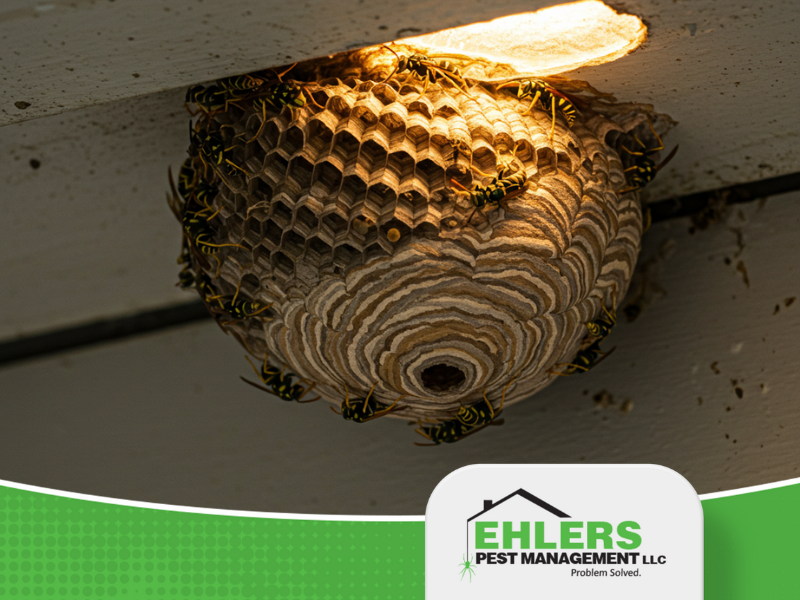
A large wasp nest with yellow and black wasps is attached to a white wooden ceiling. The Ehlers Pest Management logo appears at the bottom right corner, highlighting expert local pest solutions.

Many Wisconsin homeowners associate yellowjackets with late summer picnics and fall yard work. While peak activity does happen later in the season, yellowjacket problems actually begin much earlier—often before most people realize it.

In Wisconsin, yellowjacket season typically starts in spring. As temperatures rise and snow melts, overwintered queens emerge from protected areas such as soil, wall voids, or fallen logs. These queens immediately begin searching for nesting sites, often choosing locations close to human activity, including wall cavities, attics, sheds, and underground spaces near foundations.

During early spring, yellowjackets are easy to miss. Activity is minimal at first because colonies are just getting established. A single queen builds the initial nest and begins laying eggs, gradually growing the population. Because numbers are low early on, homeowners rarely notice a problem at this stage.

As spring turns into early summer, the colony grows rapidly. Worker yellowjackets emerge and begin foraging for food, which is usually when homeowners first become aware of their presence. By then, nests are already established and far more difficult to manage.

Wisconsin’s spring weather plays a role in early yellowjacket activity. Mild winters and early warm spells allow queens to emerge sooner and begin nesting earlier than expected. Properties with sheltered areas, ground voids, or older structures may be especially attractive nesting locations.

Another reason yellowjacket season feels sudden is behavior change. Early in the season, yellowjackets focus on building the colony. Later, as populations increase, they become more aggressive while defending their nest and searching for food. This is when stings become more common.

Early awareness makes a big difference. Identifying and addressing nesting activity in spring can prevent large colonies from developing later in summer. Preventative pest control focuses on monitoring, reducing nesting opportunities, and addressing early activity before it escalates.

Yellowjacket season doesn’t start when stings start—it starts when queens begin nesting. Recognizing that spring is the beginning of yellowjacket activity helps homeowners take proactive steps and avoid more serious problems as the season progresses.

Categories DIY vs. Professional Pest Control, Spiders

Spiders in Wisconsin: Which Ones Should You Worry About?

A person wearing gloves and overalls uses a flashlight to inspect a mattress, demonstrating professional pest control techniques. The Ehlers Pest Management LLC logo is in the corner.

The spiders in Wisconsin that people describe on the phone and the ones that actually turn up in Wisconsin basements are rarely the same animal. Almost every call starts with a question about whether it’s dangerous.

Here’s what’s actually living in Wisconsin houses, what the risk really is, and what a lot of spiders usually tells you.

Which spiders in Wisconsin actually live in houses?

Five, and none of them are the ones people are afraid of.

  • Cellar spiders. Long, thin legs, loose untidy webs in basement corners and ceiling joints. These are the ones most people mean by daddy long legs. Harmless, and they eat other spiders.
  • Common house spiders. Small, brown or grey, messy webs in corners, closets, and behind furniture. The most frequently encountered indoor spider in the state.
  • Wolf spiders. Large, fast, hairy, and they don’t build webs. They hunt on the ground, which is why they show up running across a basement floor and startle people badly. Not aggressive, and their size does most of the work on people’s nerves.
  • Orb weavers. The ones that build the big round webs on porches and around outdoor lights in late summer. Outdoor spiders that wander in occasionally and don’t establish indoors.

Jumping spiders round out the list. Small, stout, often with visible markings, and they move in quick hops. They have excellent vision and will turn to look at you, which people find either charming or deeply unsettling with no middle ground.

Are there dangerous spiders in Wisconsin?

Very few, and the two most people ask about are the two least likely to be in your house.

The brown recluse isn’t considered established in Wisconsin. Occasional specimens turn up, generally believed to arrive in shipments or belongings from states where the species does live, but a reproducing population here isn’t recognized. The overwhelming majority of spiders identified as brown recluse by homeowners turn out to be something else, and that pattern holds across the upper Midwest.

Black widows are also not a common Wisconsin animal. The northern black widow’s range touches the region, and encounters here are rare enough that most pest control careers in this state don’t include one.

What this means practically is that a bite from a Wisconsin house spider is unlikely to be medically significant, and that most skin lesions attributed to spider bites turn out to have other causes. If a bite becomes painful, spreads, or develops a wound, that’s a question for a physician rather than a pest control company, and it’s worth taking seriously regardless of what caused it. If you’ve got the spider, keep it, because identification changes the conversation.

Why am I suddenly seeing so many spiders?

Because something else increased first. Spiders are predators, and their numbers follow their food.

A house with a lot of spiders is usually a house with a lot of insects, and the insects are the part worth investigating. Three common drivers in Wisconsin:

  • Exterior lighting. A porch or garage light draws flying insects all night, and the spiders set up where the food is. Switching to warmer-toned bulbs or relocating a fixture away from a doorway often does more than any treatment.
  • Fall insect pressure. When box elder bugs, lady beetles, and cluster flies move toward buildings in autumn, the spiders that eat them concentrate in the same places.
  • Moisture. A damp basement or crawlspace supports the insects that live in damp conditions, which supports the spiders that eat them. The fix is sometimes a dehumidifier and a regraded downspout rather than anything from a pest control company.

This is why treating the spiders alone tends to disappoint. Remove the predators and the prey population they were feeding on is still there, which means new spiders find the same conditions within weeks.

When is spider treatment actually worth it?

When the numbers are high enough to be a real nuisance, or when the webbing itself is the problem.

Three situations where it makes sense. A house with persistent heavy webbing on the exterior, around soffits, eaves, and entryways, where knocking it down manually isn’t keeping up. A basement or garage where wolf spiders are frequent enough that people won’t use the space. And a commercial building where visible webbing is a presentation issue regardless of whether the spiders matter.

Treatment focuses on the exterior, because that’s where they come from. Web removal, attention to entry points, and targeted work around the foundation, window frames, soffits, and light fixtures. Interior work is usually limited and secondary, since a spider on a basement wall came from outside.

Two situations where it isn’t worth paying for. A handful of cellar spiders in basement corners, which are doing you a small favor. And a single large wolf spider, which is one animal that wandered in and can be escorted out with a cup and a piece of card.

How do you keep spiders out without treating?

Mostly by making the outside of the building less attractive and the openings smaller.

The things that work: moving or changing exterior lighting near doors, trimming vegetation back off the siding, clearing webs from soffits and eaves each season so they don’t accumulate, repairing window screens, fitting door sweeps, and keeping firewood off the ground and away from the wall. Indoors, reducing clutter in basements and closets removes the undisturbed spots webs get built in.

The thing that doesn’t work, despite being everywhere online, is scattering chestnuts or dousing baseboards in essential oils. Neither has held up under testing, and the time spent on them is time not spent on the door sweep.

What should you do next?

If you’re seeing more spiders than you’d like, the question worth asking first is what they’re eating, because that’s usually the actual problem and it’s often something simple like a light fixture by the back door.

If you want help identifying what you’ve got, our pest identification guide covers the species common in Wisconsin homes. Ehlers Pest Management handles spider control across Milwaukee, Waukesha, and Racine counties, and you can talk to our experienced team at (414) 303-6926 or schedule an inspection online. A certified technician will tell you what you have, and if what you have is a few harmless cellar spiders, you’ll hear that instead of a proposal.

Frequently asked questions

How can I tell a wolf spider from something dangerous?

Wolf spiders are large, hairy, brown or grey with mottled markings, and they run rather than build webs. The giveaway is behavior: they’re hunters, so finding one sprinting across a floor in the open is normal for the species. They’re not considered medically significant, and their reputation comes from their size and speed rather than from any real risk.

Do spiders come inside in winter?

Some are already inside and have been all along. Cellar spiders and common house spiders live indoors year round and don’t migrate seasonally. What changes in autumn is that outdoor species wander in while looking for shelter, and the insects they eat move toward buildings at the same time, so sightings tend to rise in fall rather than midwinter.

Should I knock down webs or leave them?

Knock them down. It discourages the spider from rebuilding in that spot, and on the exterior it keeps webbing from accumulating season after season into something that needs real work to remove. The one argument for leaving a web is inside a basement where the spider is quietly eating other insects, which is a reasonable trade if the web isn’t somewhere you have to look at it.

Does one spider mean there are hundreds?

No, and spiders are different from roaches this way. They’re territorial, often cannibalistic, and don’t live in colonies, so a single spider is frequently just a single spider. What does suggest a larger issue is consistent webbing in multiple rooms or a lot of spiders of the same kind in one area, since that usually points at a food source nearby.

Are spiders a sign of a dirty house?

Not really. Clutter gives them undisturbed places to build, so a crowded basement will hold more webs than an empty one, but the thing that actually drives spider numbers is the insect population they feed on. A spotless house with a bright porch light and a damp basement will have more spiders than a messy one without those conditions.