
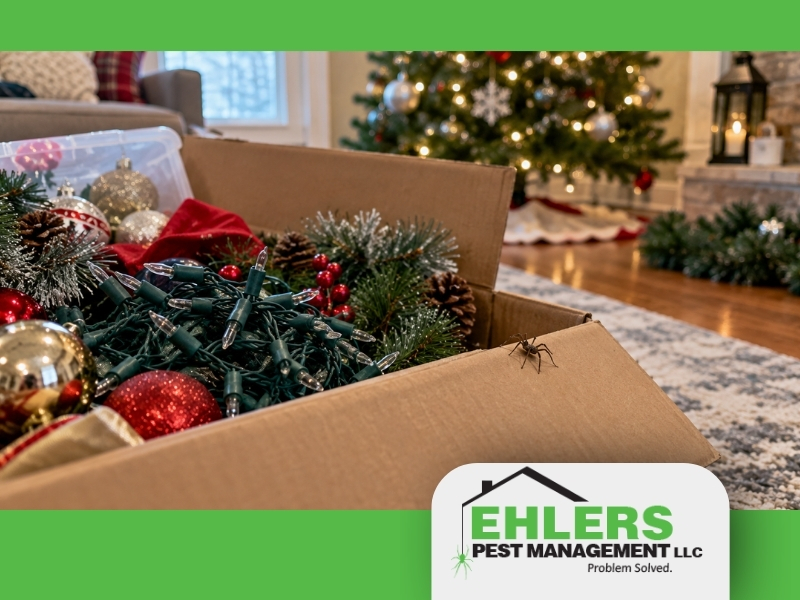
Nobody inspects a box of holiday decorations. You carry it up from the basement, cut the tape, and start unwinding a string of lights, and whatever spent eleven months living in that box is now in your living room.
Most of what comes in this way is harmless and slightly unpleasant. A few things are worth catching before they get past the door.
Boxes of holiday decorations that sat in a garage, attic, or basement all year commonly hold spiders, box elder bugs, Asian lady beetles, and mice, and the cardboard itself attracts them. Check boxes outside before carrying them in, shake out garland and tree skirts, and store everything in sealed plastic bins instead.
What pests live in holiday decorations?
Whatever was looking for a dark, undisturbed place to spend the winter, which describes a storage box precisely.
In Southeastern Wisconsin, the usual residents are:
- Spiders. Cellar spiders and cobweb spiders in particular, because a stack of boxes in a basement corner is exactly the habitat they want. You’ll usually see the webbing before you see the spider.
- Box elder bugs and Asian lady beetles. These cluster in attics, wall voids, and garages to overwinter, and they’ll gather inside a box or in the folds of stored fabric. Warm them up and they start moving, which is why they seem to appear out of nowhere a day after you decorate.
- Stink bugs. Same pattern, same places. Crushing them is how people find out they earned the name.
- Mice. Less common but much more consequential. A box of fabric garland, a tree skirt, or a nativity set packed in tissue paper is premium nesting material, and a mouse that found it in March has had months to work.
- Pantry pests. Only relevant if anything edible went into storage, which happens more than you’d think with gingerbread kits, decorative popcorn strings, and dried gourds.
Why is the cardboard itself a problem?
Because cardboard isn’t just a container to a pest. It’s food, bedding, and shelter at once.
Corrugated board is layered paper with air channels running through it, and those channels are the right size for insects to shelter in. Mice and rats shred it for nesting. The glue used in the layers has starch in it, which cockroaches and silverfish will feed on. A cardboard box sitting on a concrete floor also wicks moisture from below, and damp cardboard draws a wider range of insects than dry cardboard does.
None of that matters for a box that’s in and out of the house in a week. It matters a lot for a box that sits in the same spot for eleven months.
What should you check before a box comes inside?
Open it where a surprise doesn’t cost you anything, which means the garage, the porch, or the driveway rather than the living room floor.
Look for four things specifically:
- Webbing in the corners and under the flaps, which means spiders have been living in it
- Droppings, which look like dark grains of rice for mice and are usually concentrated in one corner
- Shredded paper, tissue, or fabric gathered into a loose ball, which is a nest whether or not anything is still in it
- Clusters of small insects in seams and folds, often tucked into the pleats of stored fabric
Then shake out anything soft. Tree skirts, stockings, fabric garland, table runners, and wreaths made with cloth or raffia should get a hard shake outdoors before they come in. Strings of lights can be unwound outside too, since that’s where the insects tucked into the coils will fall out.
If you find a nest, the box and its contents are a judgment call. Hard items like ornaments and plastic figures can be wiped down and kept. Fabric that’s been nested in and soiled is usually not worth saving, and it shouldn’t go into a washing machine with anything else.
What about a real Christmas tree?
A cut tree brings in a modest number of insects, and almost none of them can do anything about it.
Aphids, spider mites, bark beetles, praying mantis egg cases, and the occasional spider all travel in on trees. These are outdoor species adapted to outdoor conditions, and in a heated house they dry out and die within days. They don’t infest the house, they don’t bite, and they don’t eat anything in your kitchen.
What helps anyway: give the tree a vigorous shake outside before it comes in, and let it sit in the garage for a day if you have the space. Don’t spray a cut conifer with anything from under the sink, because most of what people reach for is flammable and the tree is going to sit next to light strings for a month.
Artificial trees have the opposite issue. They’re fine when they come in and they’re a storage problem for the rest of the year, which brings us to the part that actually prevents next November’s surprise.
Do deliveries bring pests in?
Boxes themselves rarely carry much, but the pile they create at the door does.
November and December mean a steady stream of cardboard, and in most houses it accumulates in the garage, the entryway, or the basement before anyone breaks it down. That stack is cover and nesting material right next to the walls of your house, which is the worst possible place for it in the season when mice are looking for a way in.
Break boxes down and get them into recycling the same week. If you’re keeping a few for storage, keep them off the floor and away from the walls.
The one delivery category worth a closer look is anything shipped with food or plant material: fruit baskets, cheese and sausage boxes, wreaths, and potted bulbs. These occasionally arrive with fruit flies or a few insects in the packaging material.
How should you store decorations for next year?
This is the part that pays off, and it costs one trip to a hardware store:
- Move everything out of cardboard and into rigid plastic bins with lids that snap or latch. Insects and mice can’t get into a sealed bin, and bins don’t absorb moisture off a concrete floor.
- Keep bins up on a shelf or pallet rather than directly on the floor, and a few inches off the wall.
- Put fabric items in sealed bags inside the bin, which protects them twice.
- Label the lids so you’re not opening six bins in the garage in December, because the whole point is to stop carrying unopened mystery boxes into the house.
Garages and sheds are harder to protect than basements, since they usually have more entry points and less temperature control. If you have a choice of where to store things, a dry basement or an interior closet beats a detached garage.
What should you do next?
Most of what comes in with decorations is a nuisance you can handle with a shake-out and a vacuum. The exceptions are worth taking seriously: if you find droppings in more than one stored box, gnaw marks on bins or baseboards, or a nest in stored fabric, you have mice in the space where you keep things, and that problem outlasts the holidays.
Ehlers Pest Management handles rodent and overwintering insect work across Milwaukee, Waukesha, and Racine counties, including garages, attics, and basements where storage problems usually start. You can talk to our experienced team at (414) 303-6926 or schedule service online, and a certified technician will find where they’re getting in rather than treating the box they ended up in.
Frequently asked questions
Can I wash decorations that had insects on them?
Fabric items like stockings, tree skirts, and cloth garland can go through a normal wash and a hot dryer cycle, which handles anything living in the fibers. Check care labels on anything beaded or glued first. Hard ornaments just need a wipe with soapy water.
Will Asian lady beetles stain things?
They can. When handled or crushed they release a yellowish fluid that stains light fabric and walls and has a distinct smell. Vacuum them rather than squashing them, and empty the canister or bag outside afterward so the smell doesn’t stay in the vacuum.
Do I need to treat the attic or garage before I go in for the boxes?
Usually not before. What’s more useful is looking at what you find when you bring boxes out, since that tells you whether the space has an ongoing problem. Droppings, nests, or heavy insect clusters in storage areas are worth having inspected regardless of the season.
Are plastic bins really better, or is that just a sales pitch?
They’re genuinely better, for two separate reasons. Nothing chews or crawls through sealed rigid plastic the way it gets through corrugated cardboard, and plastic doesn’t pull moisture up off a concrete floor the way cardboard does. Damp storage is what attracts most of the insects in the first place.
What if I find a mouse nest in a box of ornaments?
Open the box outside, keep the hard items and wash them, and discard soiled fabric and paper rather than trying to salvage it. Wear gloves, avoid stirring up dust from the nest material, and bag it before it goes in the trash. Then look at the storage area itself, because the mouse didn’t live only in that box.

John Ehlers is the owner of Ehlers Pest Management. Ehlers Pest Management is a veteran-owned family pest control company with the mission to provide responsible pest management solutions that protect people and the environment throughout every community with exceptional quality service. We service Milwaukee, Oak Creek, Shorewood, River Hills, Fox Point, Whitefish Bay, Racine and beyond.