Categories Pest Identification & Prevention

Spider Exterminator in Milwaukee: Why You See More Spiders in Fall

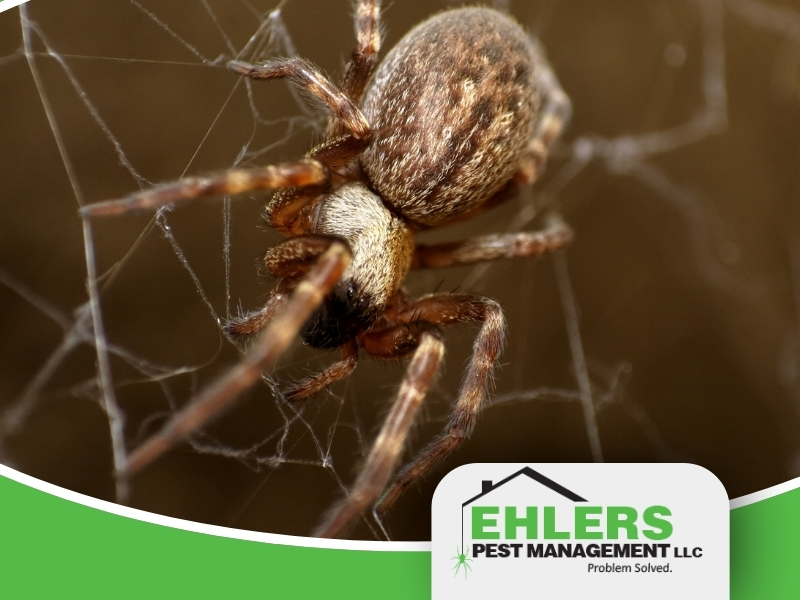
Close-up of a brown spider on its web, with the Ehlers Pest Management LLC logo and tagline Problem Solved. at the bottom right corner, highlighting their expertise as a trusted spider exterminator Milwaukee residents rely on.

People start looking for a spider exterminator in Milwaukee every September, and the reason isn’t the one most of them assume. Spiders aren’t flooding in from the yard to escape the cold. The house spiders you’re seeing mostly lived in your house all along. What changed is that they finished growing, the males started wandering to find mates, and both of those things happen at the end of summer. You’re seeing the same population you always had, at the point in the year when it’s biggest and most active.

Here’s what’s actually in a Wisconsin home, which ones are worth any concern, and when treatment is the right call.

You see more spiders in fall because house spiders reach full size in late summer and males begin wandering to find mates. Most of them lived in your home all along. Spiders are a secondary pest, so reducing the insects they feed on does more than removing spiders one at a time.

Why are there suddenly more spiders in my house?

Four things stack up at the same time, and only one of them has anything to do with temperature.

The biggest factor is maturity. Common house spiders hatch in spring, grow all summer, and reach full size in late August and September. A spider that was too small to notice in June is now large enough to catch your eye from across the room. Nothing arrived. It just got bigger.

The second is mate-searching. Male spiders that have matured leave their webs and wander looking for females, which is why the spider you find crossing the living room floor at nine at night is almost always a male. Wandering is temporary behavior and it peaks right now.

Third, their food supply moves. Box elder bugs, lady beetles, flies, and other insects push toward the house in fall, and spiders follow the insects. Where you have a lot of one, you get a lot of the other.

Fourth, people are inside more, with the windows shut and the lights on, and simply notice more of what was already there.

Which spiders actually live in Wisconsin homes?

The list is shorter than people expect, and almost all of it is harmless.

Common house spiders build the messy, tangled cobwebs in ceiling corners, basements, and behind furniture. They’re small, tan or gray, and they’re the reason you’re dusting webs down every few weeks.

Cellar spiders are the long-legged ones hanging in loose webs in basements and crawl spaces. People call them daddy longlegs. They eat other spiders, including bigger ones, so a basement full of cellar spiders is doing you a small favor.

Wolf spiders generate more phone calls than anything else on this list. They’re large, hairy, fast, brown or gray, and they don’t build webs. They hunt on the ground, which means you find them running across a basement floor rather than sitting in a corner. They look alarming and they’re not dangerous.

Funnel weavers, sometimes called grass spiders, build the flat sheet webs with a funnel at one end that you see all over lawns, window wells, and shrubs on dewy September mornings.

Orb weavers build the classic wheel-shaped webs outdoors. In September the females are at full size and their webs turn up across doorways and between porch railings overnight. They’re outdoor spiders, they’re harmless, and they’ll be gone with the first hard frost.

Yellow sac spiders are small, pale, and nocturnal, and they wander rather than sit in a web. They’re worth knowing about because they account for a fair share of the bites people actually get in this region.

Are any Wisconsin spiders dangerous?

Very few, and bites are far less common than most people believe.

Most spiders in a Wisconsin home either can’t break human skin or won’t try. Bites generally happen when a spider gets trapped against skin, usually in clothing, a glove, a shoe, or bedding. A yellow sac spider bite can be locally painful and slow to heal. A wolf spider bite is comparable to a bee sting and uncommon.

Northern black widows exist in Wisconsin but are genuinely rare here, concentrated in the southwestern part of the state, and they’re reclusive and non-aggressive. Most people go their whole lives in this state without encountering one.

If you have a bite that’s spreading, worsening, or accompanied by fever, see a doctor. That’s a medical question, not a pest control question, and the answer is frequently something other than a spider.

Is that a brown recluse?

Almost certainly not. Brown recluses aren’t established in Wisconsin.

Their range covers the south-central United States, and the occasional one that turns up here arrived in a shipment or a moving box rather than a local population. Confirmed Wisconsin sightings are rare enough to be notable.

This matters because brown recluse gets blamed for a lot of things it didn’t do. Skin infections, including bacterial ones that need actual treatment, get self-diagnosed as recluse bites, and that delays people getting care they need. The brown spider in your basement in Milwaukee is far more likely to be a wolf spider, a funnel weaver, or a common house spider.

Does killing spiders one at a time help?

Not much, and this is the part worth understanding before you spend money on anything.

Spiders are a secondary pest. They’re in your house because there’s something in your house for them to eat. A property with a heavy spider population almost always has a heavy insect population feeding it, and removing individual spiders doesn’t change that. New ones fill the space.

So the work that actually reduces spiders isn’t spider-specific. It’s cutting down the insects they’re hunting, clearing the webs that mark established territory, and closing up the gaps that let both in.

When is it worth calling a spider exterminator in Milwaukee?

When you’re seeing them consistently rather than occasionally, when webs come back within days of being cleared, or when there’s a bigger insect problem underneath the spider problem.

What treatment actually involves is a perimeter application around the foundation, doors, windows, eaves, and soffits, along with physically removing webs and egg sacs, since a web left in place is an invitation to rebuild. Spiders are covered under general interior and exterior pest control rather than being a standalone service, because handling the insects they feed on is most of the job.

One honest note. Spiders are harder to knock down than most insects, because they walk on the tips of their legs and pick up less material from a treated surface than a crawling insect does. Good results come from the combination of treatment, de-webbing, and reducing what they’re eating, rather than from a single application.

What can you do yourself?

Several things, and they help more here than they do with most pests.

  • Clear webs regularly, inside and out, with a vacuum or a web brush. This is the single most effective thing a homeowner can do.
  • Change exterior lighting to warm-toned or yellow bulbs, or move fixtures away from doors. White light draws the insects that draw the spiders.
  • Move firewood, leaf piles, and mulch back from the foundation, and cut back shrubs touching the siding.
  • Seal the same gaps that let mice in: around window and door frames, at the sill plate, and where utilities enter the wall.
  • Shake out gloves, boots, and anything stored in the garage or basement before you put it on. That’s how most bites get prevented.

What to do next

If it’s one wolf spider in the basement in September, you’ve got a normal Wisconsin fall and a vacuum will handle it. If webs are back a few days after you clear them, or you’re finding spiders daily, there’s an insect population feeding them and that’s the actual problem to solve.

Talk to our experienced team at (414) 303-6926. A certified technician will inspect the property, tell you what’s driving it, and treat the interior and exterior. They’ve seen how these homes behave in a Wisconsin September.hat’s actually in a Wisconsin home, which ones are worth any concern, and when treatment is the right call.

Why are there suddenly more spiders in my house?

Four things stack up at the same time, and only one of them has anything to do with temperature.

The biggest factor is maturity. Common house spiders hatch in spring, grow all summer, and reach full size in late August and September. A spider that was too small to notice in June is now large enough to catch your eye from across the room. Nothing arrived. It just got bigger.

The second is mate-searching. Male spiders that have matured leave their webs and wander looking for females, which is why the spider you find crossing the living room floor at nine at night is almost always a male. Wandering is temporary behavior and it peaks right now.

Third, their food supply moves. Box elder bugs, lady beetles, flies, and other insects push toward the house in fall, and spiders follow the insects. Where you have a lot of one, you get a lot of the other.

Fourth, people are inside more, with the windows shut and the lights on, and simply notice more of what was already there.

Which spiders actually live in Wisconsin homes?

The list is shorter than people expect, and almost all of it is harmless.

Common house spiders build the messy, tangled cobwebs in ceiling corners, basements, and behind furniture. They’re small, tan or gray, and they’re the reason you’re dusting webs down every few weeks.

Cellar spiders are the long-legged ones hanging in loose webs in basements and crawl spaces. People call them daddy longlegs. They eat other spiders, including bigger ones, so a basement full of cellar spiders is doing you a small favor.

Wolf spiders generate more phone calls than anything else on this list. They’re large, hairy, fast, brown or gray, and they don’t build webs. They hunt on the ground, which means you find them running across a basement floor rather than sitting in a corner. They look alarming and they’re not dangerous.

Funnel weavers, sometimes called grass spiders, build the flat sheet webs with a funnel at one end that you see all over lawns, window wells, and shrubs on dewy September mornings.

Orb weavers build the classic wheel-shaped webs outdoors. In September the females are at full size and their webs turn up across doorways and between porch railings overnight. They’re outdoor spiders, they’re harmless, and they’ll be gone with the first hard frost.

Yellow sac spiders are small, pale, and nocturnal, and they wander rather than sit in a web. They’re worth knowing about because they account for a fair share of the bites people actually get in this region.

Are any Wisconsin spiders dangerous?

Very few, and bites are far less common than most people believe.

Most spiders in a Wisconsin home either can’t break human skin or won’t try. Bites generally happen when a spider gets trapped against skin, usually in clothing, a glove, a shoe, or bedding. A yellow sac spider bite can be locally painful and slow to heal. A wolf spider bite is comparable to a bee sting and uncommon.

Northern black widows exist in Wisconsin but are genuinely rare here, concentrated in the southwestern part of the state, and they’re reclusive and non-aggressive. Most people go their whole lives in this state without encountering one.

If you have a bite that’s spreading, worsening, or accompanied by fever, see a doctor. That’s a medical question, not a pest control question, and the answer is frequently something other than a spider.

Is that a brown recluse?

Almost certainly not. Brown recluses aren’t established in Wisconsin.

Their range covers the south-central United States, and the occasional one that turns up here arrived in a shipment or a moving box rather than a local population. Confirmed Wisconsin sightings are rare enough to be notable.

This matters because brown recluse gets blamed for a lot of things it didn’t do. Skin infections, including bacterial ones that need actual treatment, get self-diagnosed as recluse bites, and that delays people getting care they need. The brown spider in your basement in Milwaukee is far more likely to be a wolf spider, a funnel weaver, or a common house spider.

Does killing spiders one at a time help?

Not much, and this is the part worth understanding before you spend money on anything.

Spiders are a secondary pest. They’re in your house because there’s something in your house for them to eat. A property with a heavy spider population almost always has a heavy insect population feeding it, and removing individual spiders doesn’t change that. New ones fill the space.

So the work that actually reduces spiders isn’t spider-specific. It’s cutting down the insects they’re hunting, clearing the webs that mark established territory, and closing up the gaps that let both in.

When is it worth calling a spider exterminator in Milwaukee?

When you’re seeing them consistently rather than occasionally, when webs come back within days of being cleared, or when there’s a bigger insect problem underneath the spider problem.

What treatment actually involves is a perimeter application around the foundation, doors, windows, eaves, and soffits, along with physically removing webs and egg sacs, since a web left in place is an invitation to rebuild. Spiders are covered under general interior and exterior pest control rather than being a standalone service, because handling the insects they feed on is most of the job.

One honest note. Spiders are harder to knock down than most insects, because they walk on the tips of their legs and pick up less material from a treated surface than a crawling insect does. Good results come from the combination of treatment, de-webbing, and reducing what they’re eating, rather than from a single application.

What can you do yourself?

Several things, and they help more here than they do with most pests.

  • Clear webs regularly, inside and out, with a vacuum or a web brush. This is the single most effective thing a homeowner can do.
  • Change exterior lighting to warm-toned or yellow bulbs, or move fixtures away from doors. White light draws the insects that draw the spiders.
  • Move firewood, leaf piles, and mulch back from the foundation, and cut back shrubs touching the siding.
  • Seal the same gaps that let mice in: around window and door frames, at the sill plate, and where utilities enter the wall.
  • Shake out gloves, boots, and anything stored in the garage or basement before you put it on. That’s how most bites get prevented.

What to do next

If it’s one wolf spider in the basement in September, you’ve got a normal Wisconsin fall and a vacuum will handle it. If webs are back a few days after you clear them, or you’re finding spiders daily, there’s an insect population feeding them and that’s the actual problem to solve.

Call Ehlers Pest Management at (414) 303-6926. A certified technician will inspect the property, tell you what’s driving it, and treat the interior and exterior. The person who looks at your house is the one who does the work, and they’ve seen how these homes behave in a Wisconsin September.

Categories Pest Treatment & Services

Box Elder Bug Pest Control in Wisconsin: Why They Swarm Your Siding in September

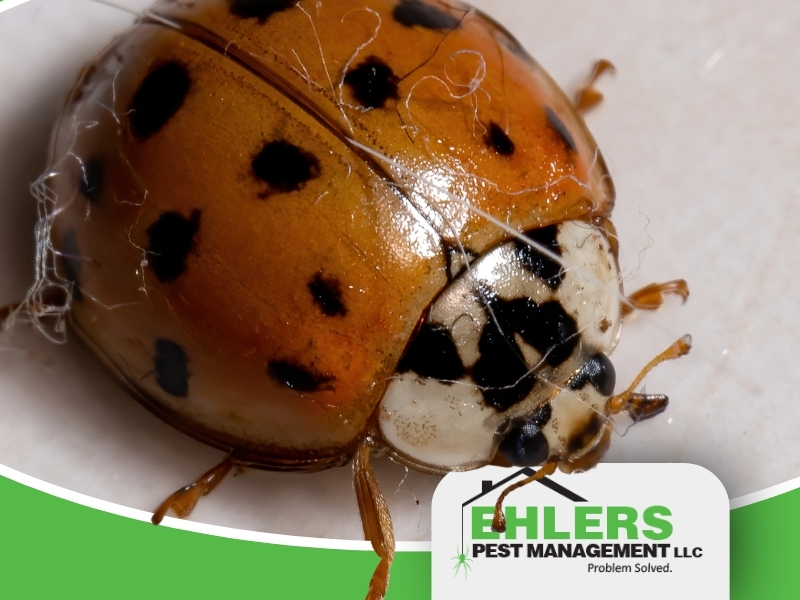
A close-up of a ladybug with black spots, sitting on a white surface. The image features the Ehlers Pest Management LLC logo in the bottom right corner, highlighting their expertise in box elder bug pest control.

If you’re looking into box elder bug pest control right now, you’re probably standing in the yard looking at a wall covered in insects. In southeastern Wisconsin that usually starts in the second or third week of September, and it’s almost always one of three species: box elder bugs, Asian lady beetles, or brown marmorated stink bugs. They show up together, they behave the same way, and they’re all doing the same thing. They’re looking for somewhere to spend the winter, and your south-facing wall is the warmest surface in the neighborhood.

Here’s how to tell them apart, whether they’ll actually hurt anything, and why the timing of treatment matters more than the treatment itself.

Box elder bug pest control works as an exterior treatment applied in September, before the insects move into wall voids. Box elder bugs, Asian lady beetles, and stink bugs all cluster on warm south and west walls in fall. Once they’re inside the structure, the options narrow considerably.

Why are hundreds of bugs on the side of my house?

Two things happen at once in mid-September. Daylight shortens, which tells these insects that the season is ending, and overnight temperatures start dropping into the forties. Both are cues to find shelter.

On a sunny afternoon, the south and west walls of a house can run twenty or thirty degrees warmer than the air. The insects land on that warm surface, and once a few arrive, more follow. Some of them are following the ones already there, and the aggregation builds on itself through the afternoon.

Then they start looking for a gap. Behind the siding, around a window frame, under a soffit, through a gap in the sill plate. They’re not trying to get into your living room. They’re trying to get into a wall void or an attic, which is a much better winter shelter than anything outside. Ending up in your kitchen in February is an accident on their part, and it usually means a warm spell woke them up and they crawled the wrong direction.

This is also why light-colored houses get hit harder than dark ones, and why the wall facing the afternoon sun collects almost all of them.

Is it box elder bugs, lady beetles, or stink bugs?

All three cluster the same way, so people describe them interchangeably. They’re easy to tell apart up close.

Box elder bugs are flat, narrow, and about half an inch long, black with thin red or orange lines outlining the wings and running along the edges. They feed on box elder, maple, and ash seeds, so properties with those trees nearby get the heaviest pressure. If you have a female box elder tree in the yard, that’s your source.

Asian lady beetles are round and domed, orange to deep red, with a spot count that varies wildly from none to nineteen. The reliable marking is behind the head: a black shape on the white area that reads like an M or a W depending on which way you’re looking at it.

Brown marmorated stink bugs are the shield-shaped ones, mottled brown, roughly the size of a thumbnail. The identifying marks are the alternating light and dark bands on the antennae and along the outer edge of the abdomen.

Are Asian lady beetles the same as ladybugs?

No, and this is the distinction that matters most, because the two behave very differently indoors.

Native ladybugs are the ones people grew up liking. They overwinter outdoors under leaf litter and bark, they don’t gather on houses, and they leave you alone.

Asian lady beetles were introduced to North America for aphid control in agriculture and have spread widely since. They aggregate on structures in fall, they overwinter inside walls and attics, and they do three things native ladybugs don’t. They nip, which most people describe as a pinch rather than a bite. They release a yellow defensive fluid when handled or squashed, and that fluid stains fabric, carpet, and painted trim. And in some households they trigger allergy or asthma symptoms once a large population is overwintering in the structure.

So if the beetles on your siding are leaving yellow marks on the window sills, they’re Asian lady beetles.

Do any of them damage your house or hurt you?

Structurally, no. None of the three chew wood, damage insulation, or eat anything in your home. They don’t reproduce indoors either, so a population inside your walls in January is the same population that got in during September. It won’t grow.

What they do cause is mess and aggravation. Box elder bugs leave dark fecal spots on siding, curtains, and light-colored surfaces. Lady beetles stain with that defensive fluid. Stink bugs release their odor when they’re crushed or feel threatened, which is why the standard advice is to vacuum rather than swat.

There’s one secondary problem worth knowing about. A large number of insects dying inside a wall void becomes a food source for carpet beetles, and those do damage wool, silk, and stored fabric. That’s the argument for keeping them out rather than letting them in and dealing with it later.

Should you cut down the box elder tree?

Probably not, and it usually doesn’t fix the problem anyway.

Box elder bugs feed on the seeds of female box elder trees, and they’ll also use maple and ash. Removing a tree in your own yard reduces the local population somewhat, and if the tree is right against the house it can make a noticeable difference. But these insects fly, and they’ll come from a neighbor’s tree or from a stand two lots over without much trouble. We’ve seen properties with no box elder anywhere on the parcel get covered every year.

If the tree is healthy and you like it, keep it and treat the house instead. If it’s a volunteer box elder that seeded itself against the foundation and you were never attached to it, taking it out is reasonable, and you’ll still want the exterior treatment.

When does box elder bug pest control actually work?

Before they get in. That’s the whole answer, and it’s why this is a September conversation rather than a November one.

An exterior treatment applied to the walls, foundation line, eaves, and around window and door frames while the insects are still massing outside is what reduces the number that make it into the structure. Once they’re behind the siding or inside a wall void, spraying doesn’t reach them, and treating a wall cavity full of overwintering insects creates the dead-insect problem described above.

This is exterior work, and it’s separate from general pest control. Seasonal exterior treatments in southeastern Wisconsin run from April through October, with the two treatments that matter most falling in spring and again right now. If you’re also dealing with ants, spiders, or mice inside, that’s a different service, and you’d have both.

Sealing helps too, and it’s the same list of openings that lets mice in. Gaps behind siding, around window and door frames, at the sill plate, and where utilities enter the wall. Work done on those gaps pays off against several problems at once.

What should you do about the ones already inside?

Vacuum them, and use a shop vac or a bagged vacuum you can empty outside right away.

Don’t crush them. Lady beetles stain, stink bugs smell, and box elder bugs leave marks that are hard to get off painted trim. Don’t spray insecticide along interior baseboards for these either, because it accomplishes very little and puts product where you don’t need it.

If they’re coming out of a light fixture, a ceiling vent, or the gap around a window frame on warm winter days, that tells you where the population is sitting. Write it down. That’s useful information for next fall’s exterior work.

Will treatment get rid of all of them?

No, and any company that tells you otherwise is setting you up to be disappointed.

When there are thousands of insects on the outside of a house, some of them are getting in. A well-timed exterior treatment cuts the number substantially, and on a property that gets hit hard every year the difference between treated and untreated is dramatic. It isn’t zero, and we’re not going to tell you it will be.

We’re also not going to promise unlimited return visits to make up the difference. What we’ll do is treat at the right time, tell you honestly what to expect, and come back on a schedule that fits how much pressure your property actually gets.

What to do next

If your siding is covered right now, this is the week to deal with it. The window for exterior work closes once the insects move into the walls, and after that the only real option is a vacuum and a wait until spring.

Call Ehlers Pest Control at (414) 303-6926 and describe what you’re seeing and which wall it’s on. A certified technician will come out, confirm which of the three you’ve got, look at where they’re getting in, and treat the exterior. They know how these houses behave in a Wisconsin fall.

Categories Pest Treatment & Services

Mouse Entry Points: How Mice Get Into Milwaukee Homes

A brown rat chewing on beige furniture near a wall—potentially taking advantage of unseen mouse entry points—with an Ehlers Pest Management LLC logo in the corner.

Mouse entry points are smaller than almost anyone expects. A house mouse fits through a gap about a quarter inch wide, roughly the diameter of a pencil, and an older Milwaukee home usually has somewhere between six and twenty openings that size or bigger. None of them look like a hole. They look like the ordinary gaps a house develops over eighty or a hundred years, which is exactly why people walk past them.

Here’s the full list, in the order a technician walks a property, starting at the ground.

Mouse entry points are any gap a quarter inch wide or larger, roughly the diameter of a pencil. An older Milwaukee home usually has six to twenty of them. The most common are the sill plate, utility penetrations, garage door corners, dryer vents, and gaps where soffits meet the wall.

How small a gap can a mouse actually get through?

A quarter inch. The limit is the skull, and a mouse skull is more flexible at the joints than you’d think, so once the head clears the opening the rest of the body follows. Young mice manage smaller gaps than that.

They also don’t need to find a perfect opening, because they’ll make one bigger. Mouse incisors grow continuously, so they gnaw constantly whether they’re hungry or not. Soft mortar, foam board insulation, vinyl, aluminum, plastic, and wood all give way. Steel mesh, hardware cloth, and properly fitted metal don’t.

So when you’re looking, you’re not looking for a mouse hole. You’re looking for a gap wide enough to start with.

Where do mice get in at the foundation?

This is where most of them come in, and the sill plate is the single most common point on older homes in this area.

The sill plate is the horizontal beam where the wood framing sits on top of the foundation. On a stone or older block foundation, the mortar under and around it deteriorates, and the top of the wall isn’t flat to begin with. That leaves a running gap that’s invisible from outside and only visible from the basement if you look up under the joists with a flashlight.

The rest of the foundation list:

  • Utility penetrations. Water service, gas line, electrical conduit, and cable or fiber drops all pass through the wall, and whoever ran them almost never sealed the hole properly.
  • Dryer vents and bath fan terminations where the damper is broken, propped open with lint, or missing entirely.
  • Basement hopper windows with rotted or shrunken frames, and window wells that collect leaf litter against the glass.
  • The garage. The bottom seal on an overhead door wears down in the middle and pulls away at both corners, and those corners are usually the largest single opening on the whole house.
  • Bulkhead and cellar doors, particularly the old steel ones that no longer sit flush.
  • Any spot where a concrete stoop, porch slab, or walkway has settled and pulled away from the house.

What about the siding and the walls?

Siding is a shell, and mice get behind it more often than through it.

Look at the inside and outside corners where the trim pieces meet, and at the bottom edge where the starter strip runs. On vinyl and aluminum, those joints open up as the material expands and contracts through Wisconsin winters. Once a mouse is behind the siding it has a protected highway running the full height of the wall.

Check anywhere two parts of the house meet. An addition, a bump-out, an enclosed porch, or a converted breezeway was framed separately and has settled at a different rate than the original structure, and a gap opens along that seam almost every time.

Also worth a look: hose bib penetrations, gutter downspout straps where they’re anchored through the siding, and the ledger board where a deck bolts to the house.

On prewar Milwaukee homes, don’t skip the coal chute or the milk door. Plenty of them were covered over with a sheet of plywood or a piece of tin decades ago and never actually sealed.

How do mice get in through the roof line?

This is the assumption that costs people the most time. Mice climb, and they climb well. Rough brick, downspouts, siding seams, tree limbs, and overhead utility lines all work as a route to the roof.

Once they’re up there, the openings are:

  • The gap where the soffit meets the wall, which on a lot of bungalows was never fully closed in the first place.
  • Soffit and fascia joints, especially where a soffit run ends at a corner.
  • Gable vents with torn, rusted, or missing screening.
  • The open ends of a ridge vent.
  • Roof-to-wall intersections, which on Cape Cods and any house with dormers are numerous and complicated.
  • Chimney flashing that’s lifted away from the brick.

If you’re hearing activity overhead rather than in the walls, start at the roof line rather than the basement.

Which mouse entry points do homeowners miss most often?

Four, consistently.

The attached garage, because people don’t think of it as part of the house. It’s heated enough to survive a Wisconsin winter, it’s full of stored food and pet food and birdseed, and it usually has both a gap under the overhead door and a worn sweep on the door into the house. Mice stage there and then move in.

The dryer vent, because the flap is on the outside and nobody looks at it.

The sill plate, because seeing it means standing in the basement with a light aimed up into the joist bays.

And the roof line, because the whole search usually happens at eye level and below.

Why does this matter more in September?

Because the timing of when a mouse gets in decides how big the problem gets.

Overnight temperatures in southeastern Wisconsin start dropping into the forties in September, and mice respond by looking for a warm cavity. That’s not a slow drift. It’s a distinct seasonal push, and it’s the reason rodent calls climb sharply this month every year.

The math after that is unforgiving. A female house mouse can produce several litters a year, five or six pups at a time, and those pups reach breeding age in about six weeks. A pair that finds a gap in September has produced multiple generations by the time you hear them in January.

Sealing the house this month is prevention. Sealing it in January is cleanup after a population has already established itself in the walls.

Can you find and seal these yourself?

Some of them, yes, and it’s worth doing.

What holds up: steel wool or copper mesh packed tightly into a gap and then sealed over with caulk or sealant, hardware cloth cut and fastened over larger openings, a new sweep on the garage service door, and a working damper on the dryer vent.

What doesn’t hold up: expanding foam on its own, which mice chew straight through in a season. Caulk on its own, for the same reason. Steel wool with nothing sealing it in place, because it works loose. Peppermint oil, ultrasonic plug-ins, and dryer sheets do nothing at all, and every fall we get called to homes where someone spent a month on them.

The honest limitation is that sealing isn’t the hard part. Finding every opening is. A technician who inspects these houses year-round knows where the gaps are on a 1920s bungalow versus a 1960s ranch versus a duplex with a stone foundation, and checks those places first. Missing two openings out of fifteen means the work didn’t accomplish much, because mice only need the two.

What to do next

Walk the outside of your house once with a flashlight, low and slow, and look at the foundation line, the garage door corners, and every place a pipe or wire enters the wall. Then go stand in the basement and aim the light up where the framing meets the foundation. Those two passes catch a good share of what’s there.

If you find openings, or if you’re already hearing something in the walls, talk to our experienced team at (414) 303-6926. A certified technician will inspect the property, show you what they found, and tell you what it’ll take to close it up before winter.

Categories Commercial Pest Control

Do Landlords Pay for Pest Control in Wisconsin?

A pest control worker in protective gear sprays inside a home near a couch. As they work to eliminate unwanted pests, the question may arise: do landlords pay for pest control? The Ehlers Pest Management LLC logo appears at the bottom right.

Landlord or Tenant?

Green badge with a large check mark and the words SATISFACTION GUARANTEED in bold white letters, with EHLERS below on the badge—a trusted symbol of quality pest control solutions.

Do Landlords Have to Pay for Pest Control in Wisconsin?

In Wisconsin, do landlords have to pay for pest control? In most situations, yes. State law requires a landlord to keep a rental in reasonable repair and to follow local housing codes, and a pest infestation that affects whether the place is livable falls under that duty. The exception is when the tenant caused the problem. That’s the whole rule in two sentences, and the rest of this comes down to which side of it your situation lands on.

Below is what the law actually says, where responsibility shifts, how long a landlord has to act, and what each side can do when the other one won’t.

A note before we get into it. This is general information about how pest responsibility usually works in Wisconsin rentals, written by a pest control company, not by attorneys. For a specific dispute, talk to a lawyer or your local tenant resource center.

Who's responsible for roaches in an apartment?

Landlords have to disclose any condition that’s a substantial hazard to your health or safety before you sign. If your landlord knew about a serious pest problem in the unit and didn’t tell you, they’re liable for the cost of removal.

In a multi-unit building, this lands on the landlord almost every time, and it isn’t really a legal question so much as a practical one.

Cockroaches don’t stay in one unit. Treating a single apartment while the units on either side go untreated produces a temporary drop and then a full recovery, because the population simply moves and comes back. Any pest control company that agrees to treat one unit in a building with a known roach problem is selling a visit, not a solution.

Roach work in a rental setting is specialty work, and it looks different from general pest control. The protocol runs treatments every two weeks, requires the unit prepared with cabinets emptied and clutter cleared, includes monitoring of adjacent units, and isn’t considered resolved until eight weeks pass with zero activity. Tenants have to cooperate for any of that to work, which is why the responsibility question matters less than getting everyone in the building on the same schedule.

Who pays when it's bed bugs?

Same answer, same reasoning, higher stakes.

Bed bug treatment follows a three-treatment protocol. Occupants prepare the unit and vacate for four hours per visit, adjacent units get inspected and given a preventative treatment, and the job isn’t finished until there’s an eight-week window with no activity at all. That’s a real commitment from everyone involved.

This is also where responsibility genuinely can shift. A landlord who schedules treatment and gets refused entry, or whose tenant won’t do the preparation, has a documentable record of trying. A tenant who cooperates fully and still can’t get the landlord to act has the same thing pointed the other way. In either direction, the person with the paper trail is in a much better position than the person without one.

Which pests actually affect habitability?

This is the practical threshold, and it’s where most disagreements between landlords and tenants actually sit. Not every insect in a rental rises to the level of a habitability problem.

Cockroaches, bed bugs, and rodents are the three that consistently do. They carry health implications, they multiply fast, they spread between units, and local housing codes name vermin directly. If any of these are established in a unit, treat it as the landlord’s obligation and move quickly.

Ants, spiders, centipedes, box elder bugs, and the seasonal invaders that show up on siding every fall usually don’t rise to that level on their own. They’re still worth handling, and a landlord who takes care of them keeps tenants longer, but a few ants along a baseboard isn’t a habitability claim. Where it changes is scale and cause. Carpenter ants tunneling into structural wood is a repair issue. Thousands of box elder bugs getting in through gaps around windows points at a building envelope that needs attention, and that’s the landlord’s side of the line.

Wasps and hornets sit in their own category. A nest at a shared entry, on a stairwell, or anywhere tenants have to walk past it is a safety issue, and it’s reasonable to expect that handled quickly.

What has to be disclosed before the lease is signed?

This part gets overlooked, and it carries more risk for landlords than the repair obligation does.

Under ATCP 134.04, a landlord has to disclose known conditions affecting habitability before a tenant signs or pays a deposit, and a pest infestation is on that list. A unit with a known roach problem or an active bed bug history has to be disclosed. So does a building-wide issue that hasn’t been resolved yet.

Landlords also have to identify who manages and maintains the property and how to reach them, which matters here because a tenant who can’t reach anyone can’t give the notice that starts the clock.

The reason to take this seriously is the penalty structure. ATCP 134 violations can carry double damages plus attorney fees, so a failure to disclose can end up costing considerably more than the treatment would have.

How long does a landlord have to fix a pest problem?

Wisconsin doesn’t put a specific number of days in the statute. The standard is reasonableness, and what counts as reasonable scales with how bad the problem is.

A few ants along a baseboard in August is not the same as a roach infestation in a kitchen or bed bugs in a child’s bedroom. The more the problem affects whether someone can actually live in the unit, the shorter the reasonable window gets.

What starts the clock is written notice. A text or an email works and is better than a phone call, because it creates a record with a date on it. Tenants should describe what they’re seeing, where, and how long it’s been happening, and keep a copy. Landlords should respond in writing too, even if the response is just a scheduled date.

One practical note on timing that catches both sides off guard. Scheduling the first visit is not the same as resolving the problem. Roach and bed bug work runs on multi-week protocols by design, so a job that starts promptly can still take two months to finish. A landlord acting in good faith on a realistic timeline is meeting the obligation even while activity continues, and a tenant who understands that up front is far less likely to end up in a dispute over it.

What can a tenant do if the landlord won't act?

This is the part most articles on the internet get wrong, so it’s worth being precise. Wisconsin does not allow repair and deduct, and it does not allow a tenant to withhold full rent. Hiring an exterminator and subtracting the bill from next month’s rent is not a remedy available to you in this state, and doing it can put your tenancy at risk.

Under Wis. Stat. 704.07(4), a tenant dealing with a unit that’s become untenantable has two options. Move out and terminate the tenancy, which relieves you of rent going forward. Or stay and claim rent abatement, meaning a reduction proportional to the portion of the unit you’ve lost the use of. Abatement is partial by definition.

Two other paths are worth knowing about. If a landlord is unresponsive, tenants can contact their local building or health inspector, and in Milwaukee that inspection creates an official record that tends to move things along quickly. And violations of ATCP 134, including the failure to disclose a known infestation before the lease, can carry double damages plus attorney fees under Wis. Stat. 100.20(5).

Again, this is general information. Before you act on any of it, talk to an attorney or a tenant resource center about your specific situation.

What should a landlord do to stay ahead of this?

  • The landlords who never end up in these disputes tend to do four things.

    • They treat the building rather than the unit. One complaint in a four-family usually means an inspection of all four.
    • They keep everything in writing, including the report of the problem, the scheduled treatment, and what the technician found.
    • They have a pest control company they can actually reach, rather than starting a search the day a tenant calls.
    • They get seasonal work done before the season starts, which for southeastern Wisconsin means rodent exclusion in September and October rather than a December emergency.

    That last one matters more than people expect. Mice move indoors as the weather turns, and a duplex that gets sealed in the fall generates far fewer winter complaints than one that gets trapped in January.

What to do next

If you’re a landlord with a property in southeastern Wisconsin, a certified technician can walk the building, tell you what’s actually happening in it, and give you a plan that fits the property. We work with independent landlords on duplexes, four-families, and eight-families, and we handle roach and bed bug work in rental settings of any size. Our goal on a specialty job is to finish it, so the work eventually stops.

If you’re a tenant, put your report in writing, keep a copy, and give your landlord a specific description of what you’re seeing and where. If you’re being asked to prepare your unit for treatment, do the preparation exactly as it’s written, because incomplete prep is the most common reason these jobs have to start over.

Either way, you can reach us at (414) 303-6926. When you call, you’re talking to someone local who knows southeastern Wisconsin rentals.

Contact Ehlers Pest Management to take care of your pest problem immediately.

This page is general information about Wisconsin pest control law, not legal advice. Your lease terms and the specific circumstances of your situation matter, so consult an attorney before acting on a dispute.

Categories Pest Identification & Prevention

Bee and Wasp Removal in Milwaukee: Which One Do You Actually Have?

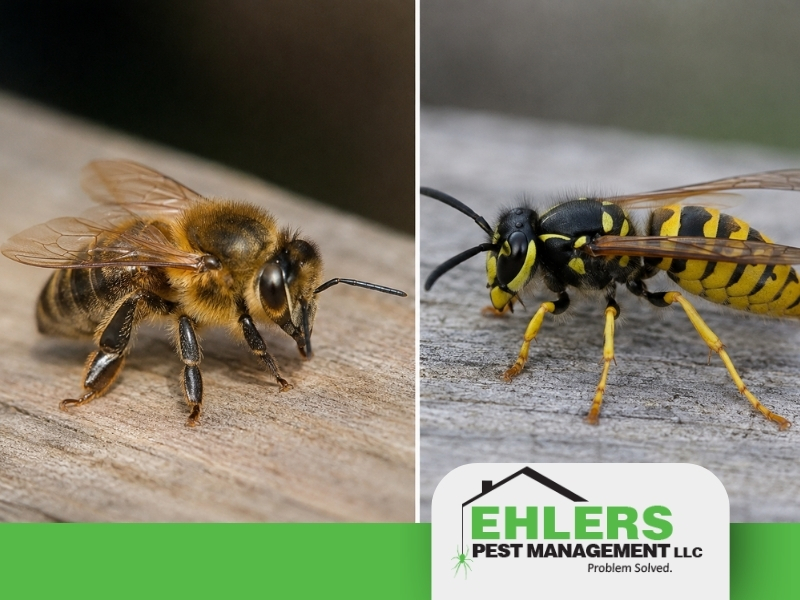
Close-up photos of a honeybee on the left and a wasp on the right, both resting on wooden surfaces, highlight the need for professional bee and wasp removal. At the bottom is the Ehlers Pest Management LLC logo.

Most Milwaukee homeowners who search for bee and wasp removal are looking at wasps. That distinction matters more than it sounds, because the two get handled in completely different ways. Wasps, hornets, and yellow jackets are pest control work, and a certified technician treats the nest. Honeybees are a beekeeper’s job, and they get relocated rather than killed. Telling them apart takes about thirty seconds once you know what to look at.

Here’s how to identify what’s on your property, and what happens next depending on the answer.

Most Milwaukee homeowners searching for bee and wasp removal are looking at wasps. Wasps, hornets, and yellow jackets are pest control work. Honeybees are a beekeeper’s job and get relocated rather than killed. Body shape tells them apart: wasps are smooth and narrow-waisted, bees are round and fuzzy.

What’s the fastest way to tell a bee from a wasp?

Four things give it away, and you can check them from a comfortable distance.

  • Body shape. Bees are round and fuzzy, almost like they’re wearing a coat. Wasps are smooth, shiny, and pinched sharply in the middle, with an obvious narrow waist.
  • Legs in flight. A wasp lets its back legs hang down while it flies. A bee tucks everything up close to the body.
  • Where you find them. Bees work flowers and flowering shrubs. Wasps show up at your grill, your trash can, your pet’s food bowl, and anything sweet you left outside.
  • Color. Yellow jackets are bright, sharp yellow and black with clean stripes. Honeybees are softer, more amber or golden brown, and they look dusty.

If the insect is smooth, striped, and hovering around your picnic, you have wasps. If it’s fuzzy, rounded, and busy on the hydrangeas, leave it alone.

Which stinging insects actually show up around Milwaukee homes?

Southeastern Wisconsin gives you a fairly short list, and most of it turns up between June and October.

Yellow jackets are the ones people call about most in September. Smooth bodies, bright markings, and they nest out of sight in wall voids, under decks, and in holes in the ground. They’re the most aggressive stinging insect in the state and they get worse as the season ends.

Paper wasps build the open, umbrella-shaped nest you can see hanging under a soffit or a porch ceiling. Long legs dangling in flight, slower and less aggressive than yellow jackets until you get close to the nest.

Bald-faced hornets build the enclosed gray nest that people describe as football-shaped, usually in a tree or against a wall. They defend a wide radius around it.

Honeybees are amber and fuzzy, and they don’t build exposed nests on your house. If you have honeybees, they’re either passing through, or they’ve moved into a wall void or a hollow tree and you’ll see a steady column going in and out of one small opening.

Bumble bees are large, very fuzzy, and mostly harmless to people. They nest in the ground, under sheds, and in compost piles, and a colony is usually a few dozen insects rather than a few hundred.

Carpenter bees look like bumble bees with a shiny black rear end instead of a fuzzy one. The tell is the hole: a perfectly round opening about the diameter of a pencil, drilled into fascia, deck rails, or trim.

Mining bees are the small ones that leave little dirt mounds in thin patches of lawn in spring. They’re solitary, they don’t defend anything, and they’re gone in a few weeks.

What’s nesting in the ground in my yard?

This is the question we get most often, and the answer is usually one of three things.

If it’s April or May and you’re seeing dozens of small dirt volcanoes across a bare patch of lawn, those are mining bees. Each hole is one solitary bee. They don’t swarm, they rarely sting, and they’ll be finished before Memorial Day.

If it’s summer, the insects are big and fuzzy, and there are maybe a dozen coming and going from one hole under a shed or a landscape timber, that’s a bumble bee colony. Give it space and the colony will be gone by the first hard frost.

If it’s August or September, the insects are smooth and bright, and there’s heavy traffic pouring in and out of a single hole all day long, that’s yellow jackets. This is the one that matters. A mature ground nest can hold close to a thousand insects, and running a lawn mower past the opening is how most people find out it’s there.

Do honeybees have to be removed, or can they stay?

We don’t kill honeybees, and we’ll tell you that on the phone. If you’ve got a honeybee colony, call a beekeeper. Plenty of local beekeepers will collect a swarm at no charge, because a free colony is worth having.

A colony that’s moved into a wall void is a bigger job than a swarm hanging on a branch. Comb and honey inside a wall will eventually attract ants, roaches, and rodents, and honey can work its way through drywall. That still isn’t an extermination job. It’s a removal and relocation job, and it takes a beekeeper who does structural cutouts, sometimes working alongside a contractor to open and close the wall.

Any pest control company that offers to spray a honeybee colony out of your wall should give you pause. That leaves dead bees, abandoned comb, and several pounds of honey in the cavity, which becomes a second pest problem a few months later.

When does bee and wasp removal actually mean a pest control call?

When it’s wasps, hornets, or yellow jackets, and there’s a reason to act.

Paper wasps under a soffit near a door or a deck are worth treating, especially if the nest keeps coming back to the same spot every year. Ongoing service handles that better than one-off calls, because the nests get knocked down before they establish.

Yellow jackets in a wall void, under a step, or in the ground near a walkway are worth treating now. These are the ones that put people in urgent care in September.

Carpenter bees drilling into structural wood are worth an inspection. The individual bee isn’t dangerous, and the tunneling adds up over several seasons, especially once woodpeckers start opening the galleries to get at the larvae.

Two situations where the answer is no. Yellow jacket nests above eight feet don’t get treated, because that means putting a technician on an extension ladder next to an agitated colony. And a yellow jacket nest in a far corner of the yard that nobody walks past will die off on its own once the weather turns, so waiting it out is a legitimate choice.

What if you can’t tell what you’re looking at?

Take a photo from as far back as your phone will let you, and pay attention to the traffic pattern instead of the individual insect. Steady two-way movement through one small opening tells a technician more than a blurry close-up does.

Then talk to our experienced team at (414) 303-6926 and describe what you’re seeing. The person you talk to knows southeastern Wisconsin stinging insects, and can usually narrow it down before anyone drives out. If it’s a wasp or hornet problem, a certified technician comes out, confirms what it is, and treats the nest. If it turns out to be honeybees, we’ll point you toward someone who’ll come get them.