Categories Pest Treatment & Services

Wasps in the House in October: Why They’re Coming Out of Your Walls

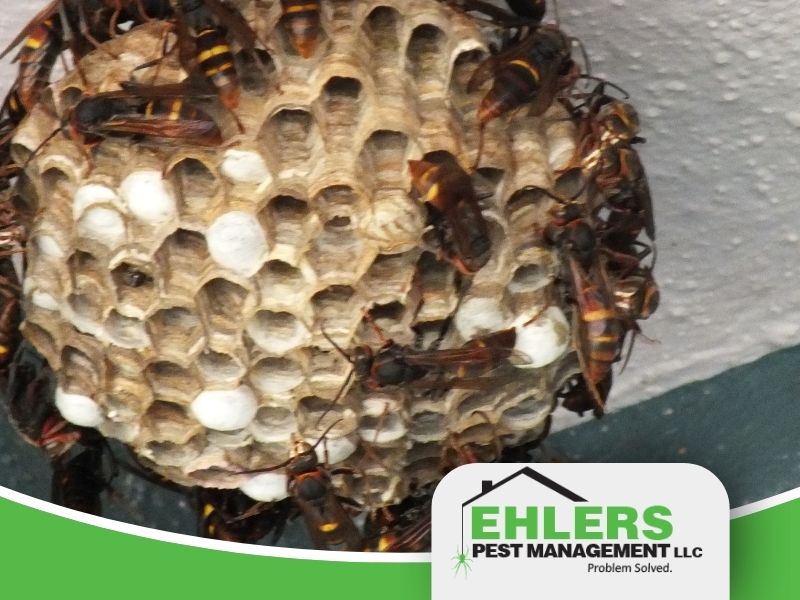
A close-up of a wasp nest with many wasps on it, attached to a textured wall—a common sight for anyone dealing with wasps in the house. In the corner is the Ehlers Pest Management LLC logo with the tagline Problem Solved.

Last Updated on October 15, 2026

If you’re finding wasps in the house this month, they almost certainly didn’t fly in through an open door. October is too late in the season for that. What’s far more likely is that they were already in the building, in a wall void, a soffit, or the attic, and something about a warm afternoon brought them into the room with you.

Here’s what’s actually happening inside the wall, what makes it worse, and when it’s worth doing something about.

Wasps in the house in October almost always come from inside the structure rather than through an open door. Either a nest has been in a wall void or attic since summer, or mated queens have moved in to overwinter. Warm afternoons wake them, and they follow heat and light into your living space.

Why are wasps showing up indoors now?

Two separate things happen in a Wisconsin fall, and they both push wasps toward your interior.

The first is that colonies break up. Yellow jacket and paper wasp colonies spend the whole season building toward one goal, which is producing new queens. Once that’s done in early fall, the colony stops functioning. Old workers die off, and the newly mated queens leave to find somewhere to spend the winter. A heated building is the best shelter available, so they move into attics, wall voids, gaps behind siding, and the folds of insulation.

The second is temperature swing. Any nest that’s been sitting in your wall since June is still physically there, and the insects in it respond to warmth. A cold night followed by a sunny October afternoon heats that wall cavity, the survivors get active, and they move toward the warmest, brightest thing available. In an insulated wall, that direction is inward.

So the wasp on your kitchen window in October isn’t lost. It came from about four feet away, on the other side of the drywall.

Does it mean there’s a nest in the wall?

Usually yes, or there was one recently. A few things point to it.

  • You’re seeing them repeatedly in the same room or at the same window rather than one insect on one day.
  • They turn up on warm days and not on cold ones, which tracks the temperature in the cavity.
  • You can hear a faint rustling or ticking in a wall or ceiling on a warm afternoon.
  • You remember watching wasps go in and out of a gap in the siding, soffit, or fascia earlier in the summer, and you meant to deal with it.

A large nest inside a ceiling can also produce a stain on drywall, though that’s uncommon and usually means it’s been there a while.

Where are they getting into the living space?

Through the same small openings that let air move between the wall cavity and the room, which is more places than most people realize.

The common ones are recessed light fixtures and ceiling cans, bath fan and ceiling vent housings, the channels in window frames and sashes, gaps around outlet and switch plates, the seam where baseboard meets flooring, attic access hatches, and plumbing penetrations under sinks.

They’re not trying to get into your kitchen. They’re following warmth and daylight, and in a finished house those two things lead to the room you’re sitting in.

What makes the problem worse?

Four responses that feel right and aren’t.

  • Sealing the interior opening only. If you caulk the gap around the light fixture and leave the nest in the wall, they find a different route and it’s usually into another room.
  • Spraying an aerosol into a wall void or a ceiling gap. It doesn’t reach the nest, it scatters the insects deeper into the cavity, and it pushes some of them toward you.
  • Opening up the wall to get at the nest. That turns a pest problem into a drywall repair, and you’ll be in the room with them when it happens.
  • Treating a nest inside a wall and then forgetting about it. Killing a large colony in place leaves brood, comb, and dead insects in the cavity, and that becomes a food source for carpet beetles and other scavengers a few months later.

There’s also a straightforward safety point. If anyone in the house has a sting allergy, this isn’t a project to experiment with.

Will they die off on their own?

The colony will. The queens won’t.

Yellow jacket colonies in southeastern Wisconsin die at the end of the season. Every worker in that nest is finished by the time you get a few hard freezes, and the nest itself will never be used again. So if you have a nest in your siding and nobody has to walk past it, waiting it out is a legitimate choice, and we’d rather tell you that than sell you a treatment you don’t need.

What doesn’t resolve on its own is the queens. They’ve already left the nest and found somewhere else in your structure to overwinter, usually the attic or an exterior wall. Those will be active on warm winter days, showing up at windows in January and February, and again when spring arrives. Waiting doesn’t address them, and the insects you’re finding indoors in October are frequently these rather than the original colony.

What does treatment actually involve?

Finding the exterior entry point first, which is the part homeowners can rarely do from inside.

Once a technician locates where the insects are entering the structure from outside, treatment goes in at that point so the material gets carried into the nest by the wasps themselves. Then activity has to stop before anything gets sealed. Sealing a live entry point traps the colony inside the cavity, and their only remaining exit is into your house.

Two limits worth knowing up front. Yellow jacket nests above eight feet don’t get treated, because that means putting a technician on an extension ladder next to an agitated colony. And if the colony is already dead and what you have is overwintering queens spread through an attic, treatment isn’t really the answer. Exclusion is.

How do you keep it from happening next fall?

Close the exterior openings, and do it at the right time of year.

Late fall through winter is the window, once activity has stopped and before queens start new nests in spring. The list is short: soffit and fascia gaps, seams and corners in siding, the openings around vents and utility penetrations, ridge vent ends, and attic or gable vents with torn screening.

That’s the same list that keeps mice out, which is why this work tends to pay off against more than one problem. If you’re already planning rodent exclusion this fall, the wasp entry points get handled in the same pass.

What to do next

If you’re seeing wasps indoors on warm days, note which room, which window, and roughly how many, then look at the outside of the house in that same area for a gap in the siding or soffit. Those two pieces of information make the visit far more productive.

Ehlers Pest Management works throughout southeastern Wisconsin, and you can reach our experienced team at (414) 303-6926 to schedule service. A certified technician will find where they’re entering the structure, tell you whether you’re dealing with a live colony or overwintering queens, and explain what’s worth doing about it. If the honest answer is that the colony is already finished and you only need the openings closed, that’s what we’ll tell you.

Categories Pest Treatment & Services

Flea Control in Milwaukee: Why Fall Is Peak Flea Season

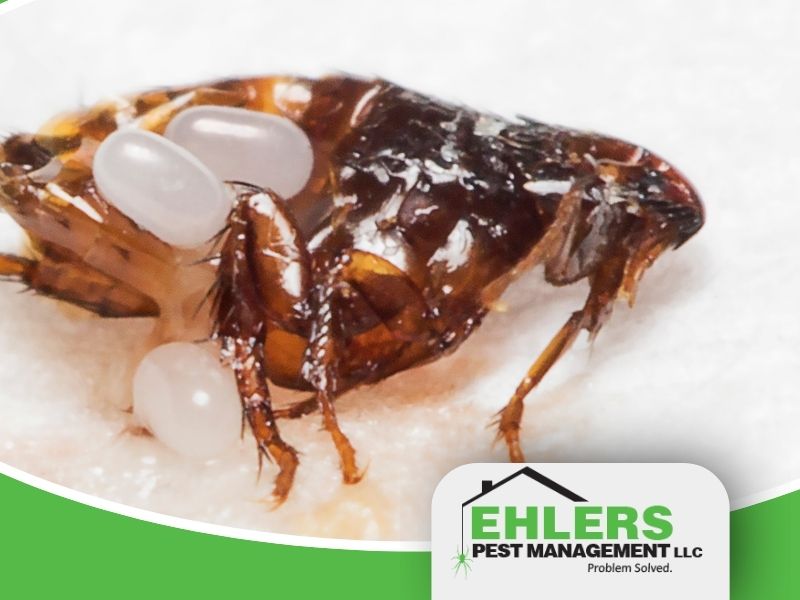
Close-up of a dead flea with white eggs attached to its legs, lying on a white surface during Milwaukee’s peak flea season. EHLERS Pest Management LLC logo appears in the bottom right corner, highlighting their expertise in effective flea control.

Last Updated on October 15, 2026

Most people start looking into flea control in Milwaukee in October, after weeks of assuming the problem was handled. The pet got its treatment, the scratching slowed down, and then the bites showed up on someone’s ankles anyway. That pattern isn’t a failed product. It’s what happens when the part of the infestation living in your floor gets ignored.

Here’s why fall is the worst for fleas in southeastern Wisconsin, how to confirm what you’re dealing with, and what actually ends it.

Flea control in Milwaukee is a fall priority because populations peak in late summer and early fall, then move indoors with pets. Treating the pet alone rarely finishes the problem, since adult fleas on the animal are a small share of the population. The rest sits in carpet, bedding, and floor cracks.

Why do fleas get worse in fall?

Outdoor flea populations build through the whole warm season and reach their highest point in late summer and early fall. Every week a pet spends in the yard from June through September is a week of picking up more of them.

Then October happens. Nights get cold, pets spend more time indoors, the furnace comes on, and the house holds a steady temperature for the next six months. Fleas that make it inside at that point have found somewhere the season never changes. A Wisconsin winter ends the outdoor population. It does nothing at all to the one in your living room.

That’s the reason fall is the pivot. Deal with it in October and you’re interrupting a problem before it settles in. Wait until the bites get bad in January and you’re dealing with a population that’s been breeding in your carpet for three months.

Why does treating the pet never seem to finish it?

Because the animal is the visible part of a much larger population, and a relatively small part of it.

Adult fleas living on your pet are roughly one in twenty of what’s in the house. The other nineteen are in a stage you can’t see. Eggs get laid on the animal, then fall off wherever it sleeps, walks, and lies down. Larvae hatch in the carpet and burrow down toward the base of the fibers, away from light. Pupae spin a sticky cocoon that collects dust and debris and sits protected in the fabric.

So a product that kills fleas on the pet is doing exactly what it says. It just isn’t touching the eggs in the rug, the larvae in the floorboard cracks, or the pupae under the couch. Those keep maturing, and they keep finding the pet.

How do you confirm it’s actually fleas?

Three checks, and you can do all of them in a few minutes.

  • Flea dirt. Comb the pet over a sheet of white paper, especially at the base of the tail and along the spine. If the black specks that fall out smear reddish brown when you dab them with a damp paper towel, that’s digested blood, and it confirms fleas.
  • Bite pattern. Flea bites on people land on the ankles and lower legs, usually in small clusters, because fleas jump from the floor rather than traveling across the body.
  • The white sock test. Put on white socks, walk slowly across suspect carpet for a few minutes, then look at your ankles. Newly emerged fleas jump toward movement and show up clearly against white.

Where are the fleas actually coming from?

Your pet is the obvious answer and it’s often not the whole one, particularly in older Milwaukee neighborhoods.

Wildlife is the source people miss. Squirrels, raccoons, opossums, and outdoor cats nest under decks, porches, sheds, and in crawl spaces, and they bring fleas with them. When that animal moves on or dies, the fleas it left behind start looking for the next warm-blooded thing in the area, and the nearest one is inside your house. We see this every fall on properties with an open deck or a crawl space that something has been getting under.

Two other routes worth knowing about. Moving into a home where the previous residents had pets can set off a wave of hatching, because dormant pupae respond to footsteps and body heat after sitting empty for weeks. And secondhand upholstered furniture brings them in the same way it brings in other things.

What does flea control in Milwaukee involve?

An inspection first, to confirm the species, find where the population is concentrated, and figure out whether something outside is feeding it.

Interior work targets the places the immature stages actually live: carpet and rugs, the pet’s resting areas, upholstered furniture, and the cracks where flooring meets baseboard. Exterior work matters when wildlife is involved, and that means treating the shaded harborage under decks and porches and along the foundation, plus dealing with the access that let the animal under there in the first place.

The piece that has to happen alongside all of it is the pet. Premises treatment without a veterinary product on the animal fails, and the product on the animal without premises treatment fails. Your vet handles that side. We handle the building. Both have to be running at once, and this is the most common reason a flea job stalls out.

Why do fleas come back two weeks after a treatment?

Because of the pupae, and this catches almost everyone off guard.

The pupal stage is protected inside a cocoon that treatments have a hard time penetrating. A pupa can sit dormant for weeks or months, waiting. What wakes it up is vibration, warmth, and the carbon dioxide of something breathing nearby. In other words, footsteps.

So after a treatment, pupae keep hatching on their own schedule, and you see adult fleas again a week or two later. That isn’t the treatment failing. Those new adults are emerging onto treated surfaces, which is exactly where you want them, and it’s why flea work takes more than one visit and a few weeks rather than an afternoon.

Vacuuming helps for the same reason. The vibration triggers hatching, which pulls the pupae out of their protected stage and into contact with the treatment. Vacuuming daily for two to three weeks after a treatment does more than most people expect.

What should you do before and after treatment?

Preparation makes a real difference on this one.

  • Vacuum thoroughly beforehand, including under furniture, along baseboards, and anywhere the pet sleeps. Empty the canister or bag outside immediately.
  • Wash all pet bedding and any washable throws in hot water.
  • Pick up items off the floor so the treatment can reach the carpet and the edges of the room.
  • Keep vacuuming every day or two for two to three weeks afterward, and keep the pet on whatever your veterinarian prescribed.

One thing to avoid: don’t shampoo or steam clean carpets right after a treatment. That removes the material you just paid to have applied, right when the pupae are starting to hatch into it.

What to do next

If you’re seeing bites around your ankles, catching the pet scratching at the base of the tail, or finding flea dirt in the bedding, this is worth dealing with now rather than in February. The population is at its annual high right now and your house is about to hold a steady temperature until spring.

Talk to Ehler’s Pest Management’s experienced team at (414) 303-6926 to schedule service. A certified technician will inspect the property, confirm what you have, check whether something under the deck or in the crawl space is feeding the problem, and lay out what the treatment sequence looks like. We’ll also tell you plainly what needs to happen on the veterinary side, because the work only holds if both halves happen together.

Categories Rodents

Commercial Rodent Control in Milwaukee: Fall Prep for Restaurants, Warehouses, and Schools

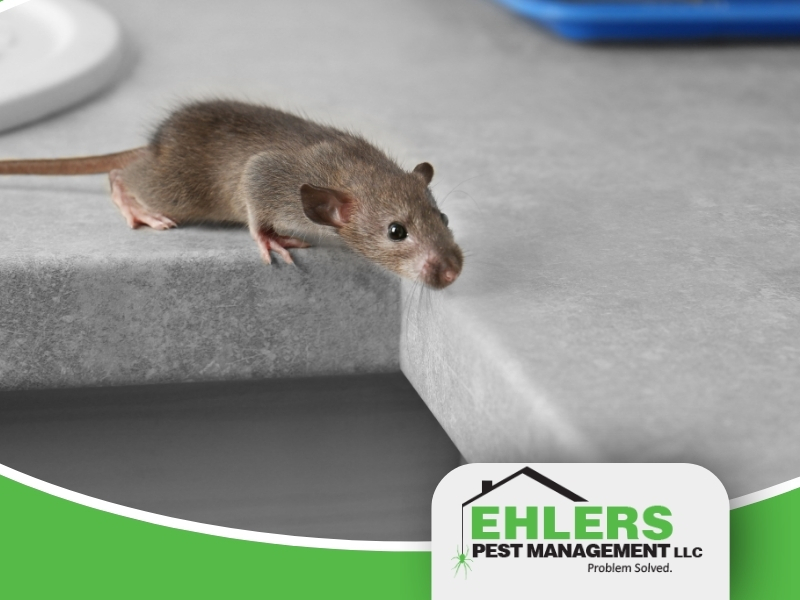
A small brown mouse leans over the edge of a gray countertop, hinting at the importance of commercial rodent control for businesses in Milwaukee. The bottom right corner shows the Ehlers Pest Management LLC logo.

Last Updated on October 29, 2026

Commercial rodent control in Milwaukee is a fall decision that shows up as a winter outcome. Rodents move toward heated buildings as the ground cools in September and October, and a commercial property has far more ways in than a house does: dock doors, deliveries, floor drains, roof penetrations, and a trash area that stays busy all day. The buildings that get sealed and monitored now stay quiet. The ones that don’t tend to surface in January, often during an inspection.

Here’s what to have handled before the first freeze, broken out by the three property types where this goes wrong most often.

Why does fall decide how your winter goes?

Because rodent pressure is seasonal and building vulnerability isn’t.

A gap under a dock door is a gap in July too. What changes in fall is the number of rodents actively looking for it. Once they’re inside a heated commercial building with a food source, they stop being a perimeter problem and become an interior one, and interior populations in a warehouse or a school are considerably harder and more disruptive to resolve than exterior pressure is.

There’s a documentation angle too. If a finding turns up on an inspection in February, what protects you is a record showing you had a program running and acted on what it found. That record has to have been created before the inspection, which means the work happens now.

What should a restaurant have done before October?

For a restaurant, the back of house is where these problems start, and most of it is operational rather than chemical.

  • Back and dock doors. Propping them open during deliveries and shift changes is the single most common way rodents get into a restaurant. Door sweeps get worn down fast in a commercial kitchen and need checking, not assuming.
  • Dumpster and grease container placement, distance from the building, lid discipline, and the condition of the pad underneath. A dumpster area is a food source with an address.
  • Floor drains and grease traps, which are both an entry route and a harborage.
  • Dry storage held off the floor and away from walls, with enough clearance to actually inspect behind and under the shelving.
  • Employee areas and lockers, where food gets stored and forgotten.
  • The base of walk-in coolers and the utility penetrations behind equipment, which are warm, dark, and rarely looked at.

On the compliance side, evidence of rodent activity is a serious finding on a health inspection, and what an inspector wants alongside the absence of evidence is a documented program with service records. Having the records and not needing them is the goal.

What’s different about a warehouse?

For a warehouse, rodent vulnerability comes from scale, dock doors, and the fact that rodents arrive on the truck.

Dock doors and dock levelers are the largest recurring opening in almost any warehouse, and the gaps at the corners of a leveler pit are a standing invitation. Brush seals and dock shelters wear out on a schedule nobody tracks, and fall is the right time to walk them.

Incoming freight is the other route. Rodents travel in on pallets and in packaging, which means an interior population can establish in a building whose exterior is sealed well. Receiving inspection catches this and almost nobody does it consistently.

Inside, the practical problem is racking against walls. Product stored tight to the perimeter blocks the aisle a technician needs to inspect and monitor, and it creates protected harborage the length of the building. Keeping a clear perimeter aisle is worth more than any product you can apply.

The cost side isn’t just contamination. Chewed packaging writes off inventory, and rodents gnawing wiring in a racking system or a mechanical room is a fire exposure that most operations don’t price in until it happens.

What do schools need to account for?

For schools, it’s two things: the summer gap, and Wisconsin’s posting requirements.

Summer break is when populations establish without anyone noticing. Buildings sit quiet, kitchens are idle, custodial routines change, and by the time staff return in late August a small problem has had ten weeks to grow. Fall reopening is when it gets discovered, which is exactly the wrong time.

The places to check first are the kitchen and cafeteria, dry storage, custodial closets, boiler rooms and tunnels, classroom areas where food or classroom pets are kept, and any storage holding food, seed, or plant material.

On the regulatory side, Wisconsin governs pesticide use in schools under Wis. Stat. 94.715, with the detail in ATCP 29. Notice of each pesticide application has to be posted for 72 hours from the time of application, with signs placed where people would see them before entering the treated area, and different signage for indoor and perimeter applications versus lawn and field applications.

Here’s the part worth knowing if you manage a school facility. Mechanical rodent traps are exempt from those posting requirements. That means a rodent program built on exclusion, monitoring, and mechanical trapping can run without triggering the notification and posting burden that comes with pesticide applications. It’s a practical reason that approach fits schools well, on top of being the approach that actually resolves rodent problems.

What does commercial rodent control in Milwaukee actually include?

An inspection first, then a program built around what the inspection found rather than a standard route.

On the exterior, that means mapped monitoring and bait stations placed where the pressure actually is, exclusion work on the openings a building has, and honest recommendations about sanitation and storage that sit outside what a pest control company can fix. On the interior, it means monitoring devices and mechanical trapping in the areas where product, food, or people make other approaches inappropriate.

Service is typically monthly for commercial accounts, and rodent work in particular is year-round rather than seasonal, because commercial buildings don’t stop having doors. Every visit should produce a service report that names what was found, what was done, and what still needs attention from your side.

Rodent control is the majority of the work we do, across commercial buildings, homes, and smaller multi-unit properties. It’s the thing we’re set up for.

What does an inspector or an auditor actually want to see?

Five things, and most programs have the first four.

  • A current service agreement.
  • A site map showing device locations and numbering.
  • Service reports for every visit, with findings recorded rather than a checkbox.
  • Applicator licensing and product documentation on site.
  • Evidence that findings got acted on.

The last one is where programs fail. A log showing the same finding at the same device for six consecutive months, with no corrective action recorded, is worse than no log at all, because it documents that you knew. A good program closes items out and shows the trend going the right direction.

Who we work with, and who we don’t

We work with independently owned local businesses. Offices, warehouses and shops, banks and credit unions, small pubs and independent restaurants, and schools.

We’re not a fit for national chains that need centralized billing across multiple regions, and we’ll tell you that rather than take the account and underperform. We don’t service 24-hour operations, because we’re not staffed to work a kitchen at two in the morning and pretending otherwise wouldn’t serve you. For restaurants, we work best with operations that close at least one day a week. General pest control doesn’t require you to be closed, though specialty work does. And we don’t take general maintenance contracts at large apartment complexes.

What to do next

Walk your dock doors, your back doors, and your trash area this week, and look at the gaps rather than the doors. That’s a fifteen-minute exercise that tells you most of what you need to know about how your winter is going to go.

If you want a professional look at it, call Ehlers Pest Management at (414) 303-6926 to schedule a commercial inspection. A certified technician will walk the building, tell you what they found and where, and give you a program built around your property and your operation.