Categories Pest Identification & Prevention

Voles in Wisconsin: The Lawn Damage You’ll See This Fall

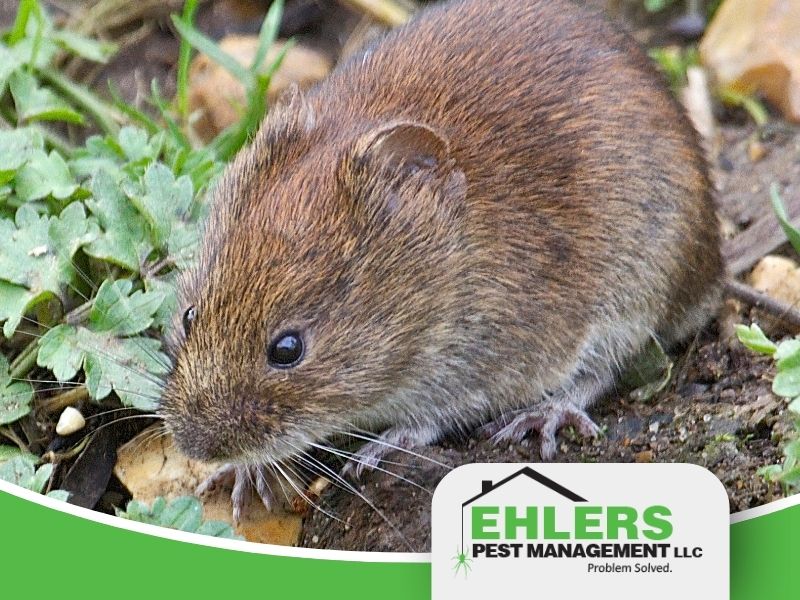
A close-up of a brown vole on grass and soil, with the Ehlers Pest Management LLC logo in the lower right corner.

Voles in Wisconsin do most of their damage where nobody can see it, under the snow, between December and March. What you find at snowmelt is a lawn crossed with dead brown trails and a young tree with its bark chewed off at the base. By then the damage is done and the tree may not recover. That’s why October is the month voles are worth dealing with.

Here’s how to confirm what you have, what separates them from moles, and what’s worth doing before the ground freezes.

Voles in Wisconsin leave narrow surface runways through the grass and chew bark off the base of young trees and shrubs. They’re often mistaken for moles, which raise tunnels and eat insects instead of plants. Most vole damage happens under winter snow, which makes fall the window to act.

What do voles in Wisconsin actually look like?

Like a mouse that got stockier and lost its tail.

The meadow vole is the common one here. Four to seven inches nose to tail, brown or gray, with a blunt rounded nose, small ears mostly buried in fur, and a short tail roughly the length of its head. That tail is the quickest tell. A house mouse has a long, thin, nearly hairless tail about as long as its body. A vole’s looks stubby by comparison.

They’re herbivores, which matters. Grasses, roots, bulbs, tubers, and tree bark are what they’re after, and they have no interest in your pantry. They’re active around the clock all year and they don’t hibernate.

Is it voles or moles?

This is the most common mix-up in Wisconsin yards, and the two need completely different work.

Voles leave surface runways. Narrow paths, an inch or two wide, worn through the grass at ground level, with clipped vegetation and small droppings along them. You see them best in early spring or after mowing a neglected area. They’re paths, not tunnels.

Moles leave raised ridges and volcano-shaped mounds of soil. They’re pushing dirt because they’re digging, and they’re digging because they eat grubs and earthworms. Moles do not eat plants. If something chewed the bark off your burning bush, that was not a mole.

There’s a useful shortcut here. Damage to the plant itself means voles. Damage to the soil surface means moles. Plenty of people spend a season treating for the wrong animal because nobody told them that.

What damage do they actually do?

Two kinds, and the second one is expensive.

The first is turf. Runways and feeding trails leave the lawn crossed with dead brown lines, most of it revealed at snowmelt. It’s ugly and it usually grows back with some raking and overseeding.

The second is girdling, and it’s the one that kills things. Voles chew the bark off the base of young trees and shrubs, working under snow cover where they feel protected. If the chewing goes all the way around the trunk, the plant loses its ability to move water and nutrients, and it dies even though it looks fine until it leafs out in spring and then doesn’t. Young fruit trees, crabapples, arborvitae, burning bush, and newly planted ornamentals are the usual casualties.

Bulbs get eaten too, which is why a tulip bed planted in October sometimes produces nothing in April.

Why does fall matter more than any other season?

Because of the snow, and because of the timing of everything you’d want to do about it.

Vole populations peak in fall after a full breeding season. As the weather turns, they move toward cover and start feeding on woody material. Then the snow comes, and they tunnel through the layer between the snowpack and the ground, where they’re hidden from hawks, owls, and foxes, and insulated from the cold. That protected space is where they do their worst work on your trees and shrubs.

Everything that helps has to happen before that. You can see the runways now and you won’t be able to in January. Tree guards go on before snow, not after. Habitat work needs open ground. Once there’s a foot of snow on the lawn, you’re a spectator until March.

Do voles get into houses?

Rarely, and if something is in your house it’s almost certainly not a vole.

Voles are outdoor animals built for runways and burrows in vegetation. They occasionally turn up in an attached garage or a walkout basement, but they don’t establish indoors the way mice do, and they aren’t looking for your kitchen.

If you’re hearing activity in a wall or finding droppings in a cabinet, that’s a mouse, and it’s a different job with a different approach. Getting the identification right saves you from paying for the wrong service.

What reduces them?

Habitat first, protection second, and treatment where it’s warranted.

  • Mow late into the season and cut back tall grass, weeds, and ground cover, especially along fence lines and foundation beds. Voles need cover and won’t cross open ground willingly.
  • Pull mulch back several inches from tree trunks and shrub bases. A mulch volcano piled against a trunk is ideal vole habitat placed exactly where the damage hurts most.
  • Put hardware cloth cylinders around young trees and valuable shrubs, pushed an inch or two into the soil and tall enough to clear the expected snow depth. This is the single most effective thing you can do in October.
  • Clear brush piles, stacked wood, and leaf litter away from the lawn and the foundation.

Beyond that, bait placement and trapping in active runways are what a technician handles, and both are far more effective when the habitat work has already been done.

Does anything eat voles?

Plenty of things, and it’s part of why habitat work matters more than people assume.

Hawks, owls, foxes, coyotes, and snakes all hunt voles, and an outdoor cat will take a few. None of that solves a vole problem on its own, because a single female can produce several litters in a season and the reproduction outruns the predation. What predators do is punish exposure. A vole crossing open, short grass is in real danger. A vole running a covered runway under tall grass, ground cover, or a mulch bed is not.

That’s the practical argument for mowing late and pulling mulch back. You’re not just removing shelter, you’re handing the population over to the owls. It’s the cheapest control available and it costs an afternoon.

Can you actually get rid of voles?

Not permanently, and it’s worth being straight about that before anyone spends money.

Voles are a landscape animal. If your property backs onto a field, a prairie restoration, a retention pond, a wooded lot, or any unmowed ground, new ones will move in from there no matter what happens on your side of the line. What’s realistic is keeping the population down and protecting the plants that matter, on a recurring basis rather than as a one-time fix.

On a tight suburban lot surrounded by other mowed lawns, results hold much better. Knowing which situation you’re in changes what’s worth spending.

What to do next

Walk the lawn this week, particularly along fence lines, garden beds, and anywhere the grass has gotten long, and look for narrow worn paths at ground level. Then check the base of every young tree and shrub you’d be unhappy to lose. If you find runways near plantings you care about, get guards on those trunks before the first lasting snow.

Ehlers Pest Management works across southeastern Wisconsin, and you can reach our experienced team at (414) 303-6926 to schedule service. A certified technician will confirm whether you have voles or moles, which changes everything about the approach, look at what’s giving them cover, and tell you what’s realistic for your property given what surrounds it.


Categories Pest Identification & Prevention

Preventive Pest Control in Milwaukee: What It Actually Prevents

A man wearing safety glasses and green gloves sprays a window with pest control chemicals. The Ehlers Pest Management LLC logo appears in the bottom right corner.

Almost everything written about preventive pest control in Milwaukee promises the same vague things, so here’s a more useful version. Prevention works extremely well against some pests and not at all against others, and the dividing line is simple. If a pest walks, crawls, or flies to your house on its own, prevention works. If it arrives in a suitcase, a box, or a used couch, prevention does nothing.

Here’s which pests fall on each side of that line, what a plan actually does between visits, and why fall is a better starting point than spring.

Preventive pest control in Milwaukee works against pests that find their own way in, like mice, ants, spiders, wasps, and fall invaders. It does not work against pests that arrive by hitchhiking, including bed bugs and German cockroaches. That line is the whole thing worth understanding.

What does preventive pest control actually prevent?

Anything that has to cross your property line under its own power. That covers most of what people call about.

  • Mice and rats. This is where prevention earns the most. Sealing entry points and monitoring for activity genuinely stops the problem from starting, and it’s the difference between a one-time fix and a recurring expense.
  • Ants. A treated perimeter interrupts the foraging trails before they establish a route into a kitchen, which is why homes on a schedule rarely get the spring ant call.
  • Wasps and hornets. Paper wasps rebuild on the same soffits every year, and knocking nests down before they establish is far easier than removing a mature one in September.
  • Fall invaders. Box elder bugs, Asian lady beetles, stink bugs, and cluster flies all mass on exterior walls before they get in, which makes a timed exterior treatment effective.
  • Spiders, crickets, millipedes, centipedes, and silverfish. These follow moisture and the insects they eat, so reducing both reduces them.

What doesn’t it prevent?

Two things, and no amount of scheduled service changes that.

Bed bugs cannot be prevented by a treatment plan. They arrive on luggage, clothing, used furniture, and people, and they go straight into a bedroom without crossing any treated surface. Quarterly service does not stop them, and anyone selling bed bug prevention is selling something that doesn’t exist. What actually helps is knowing what to check on a hotel mattress and being careful about secondhand upholstered furniture.

German cockroaches work the same way. They come in inside grocery bags, cardboard boxes, used appliances, and through shared walls in a duplex or apartment. A perimeter treatment does nothing about a box carried through the front door.

Both of those are specialty work when they do happen, with their own protocols, and they’re a different conversation from a maintenance plan. Being clear about that up front matters, because a homeowner who thinks their plan covers bed bugs is going to be justifiably angry the day it doesn’t.

How does prevention actually work?

Three mechanisms, and only one of them involves product.

The first is exclusion, which means physically closing the gaps that let pests in. That’s permanent, it doesn’t wear off, and it’s the highest-value work on any property.

The second is a treated perimeter. A band of material around the foundation, entry points, eaves, and window frames means insects crossing toward the building make contact before they reach it. This does wear off, which is the actual reason service runs on a schedule rather than once a year.

The third is monitoring, and it’s the one people underrate. A technician walking the same property every quarter notices the new gap where a contractor ran a line, the droppings in a corner of the garage, the wasp nest starting under the eave. Catching those at the start is the entire point, and it’s something you can’t do from a single annual visit.

Why is fall the right time to start?

Because the calendar works in your favor right now in a way it doesn’t in April.

Rodents are moving toward buildings this month, so exclusion work done in October prevents the population that would otherwise spend the winter in your walls. Fall invaders are massing on exterior walls now, which is the only window when treating them accomplishes anything. And the ground isn’t frozen, so the foundation work is straightforward instead of impossible.

Starting in spring means you spent a winter with whatever got in during the fall. Most people find that out in January, which is the worst possible time to be looking for a pest control company.

What does a preventive plan include?

It depends on the property, and that’s not a dodge. A ranch with a crawl space and a wooded lot line needs something different from a two-story in a dense neighborhood.

Broadly, general pest control covers the interior and the exterior on a quarterly, tri-annual, or seasonal schedule, and it targets the general insects: ants, spiders, centipedes, crickets, and similar. Seasonal exterior treatment is a separate thing, exterior only, aimed at box elder bugs, Asian lady beetles, and stink bugs, and it runs April through October. Rodent work is often ongoing on its own schedule because the pressure is constant.

The part worth insisting on with any company is a clear answer about what’s covered and what isn’t. Interior versus exterior, which pests are included, and what happens if something shows up between visits. Vague answers there are where most of the complaints in this industry come from.

Why is it billed monthly if you only come a few times a year?

Because customers who pay monthly actually keep their appointments, and that’s the honest reason.

When people are billed per visit, they start skipping. Things seem fine in March, so the spring visit gets pushed, then it gets cancelled, and the problem that would have been caught early gets found in July when it’s much larger. Monthly billing keeps the service active and keeps the visits happening, which is the only way prevention works at all.

It isn’t a financing trick and we’d rather explain it than have someone assume it is.

Is preventive pest control worth it?

Depends entirely on the property, and there are homes where the answer is no.

A newer, tight house on a small lot with no history of problems may genuinely not need a plan. We’d rather say that than sign someone up for service they won’t benefit from. What we’d still suggest for that house is an inspection and whatever sealing it needs, which is a one-time piece of work.

Where a plan earns its keep is on older housing stock with a stone or block foundation, properties backing onto woods, fields, or water, homes with a history of recurring problems, and anywhere a previous problem was treated but the entry points were never closed. If two of those describe your house, reactive service is going to cost you more over a few years than scheduled service would.

What to do next

Start with an inspection rather than a plan. Find out what your building actually has going on, which gaps are open, and whether the pests you’re worried about are even the ones prevention works on. The plan, if you need one, comes out of that.

Ehlers Pest Management serves homes and businesses across southeastern Wisconsin, and you can reach our experienced team at (414) 303-6926 to schedule service. A certified technician will walk the property, tell you what they found, and recommend what makes sense for your building rather than a package off a list. If the honest answer is that you need some sealing and not a recurring plan, that’s what you’ll hear.

Categories Pest Identification & Prevention

Bugs in Firewood: What Comes Inside With the Wood Pile

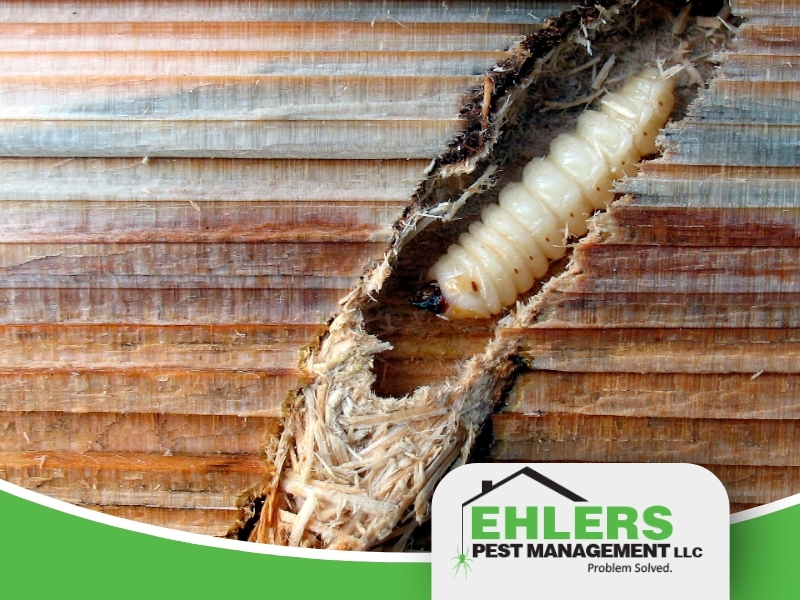
A close-up of a wood-boring insect larva inside damaged wood highlights the risk of bugs in firewood, with the Ehlers Pest Management LLC logo in the bottom right corner.

Bugs in firewood come into Wisconsin houses every October, usually about twenty minutes after someone brings an armload in and sets it next to the stove. The wood warms up, whatever was dormant in it wakes up, and suddenly there are beetles on the hearth rug.

It’s less alarming than it looks. Here’s what’s actually living in the pile, the short list of things worth caring about, and how to stack wood so this mostly stops happening.

Bugs in firewood are common and mostly harmless indoors. Carpenter ants, bark beetles, wood borers, spiders, and sowbugs all overwinter in a wood pile and wake up when the wood warms. Almost none of them can infest the dry, finished lumber in a house.

What bugs in firewood are you actually looking at?

A wood pile is a habitat, and by October it’s full.

Carpenter ants are the ones worth knowing by name. They excavate galleries in damp or decaying wood, and a split log can contain an entire overwintering colony that becomes active in a warm room.

Wood borers and bark beetles are the most common and the most startling. Longhorned beetles and metallic wood borers develop under the bark and in the sapwood of dead trees, and the adults emerge when the wood warms. Some of them are large and they fly, which is how you end up with an inch-long beetle circling a lamp in February.

Then there’s everything using the pile as shelter rather than food: spiders, centipedes, sowbugs and pillbugs, wood roaches, overwintering wasps and lady beetles tucked into bark crevices, and occasionally a mouse nest in the middle of the stack.

Will any of it infest my house?

Almost none of it, and this is the reassurance most people are looking for.

Wood borers and bark beetles need unseasoned wood with bark and moisture still in it. The framing lumber, flooring, and trim in your house are dry, finished, and years past the condition those insects require. They emerge, fly around, and die without reproducing. They’re a nuisance, not a threat to the structure.

Wood roaches are the same story. They’re an outdoor insect that can’t establish indoors and doesn’t behave like a German cockroach.

Carpenter ants are the exception worth watching. They don’t eat wood, but they do excavate it, and they need moisture to do it. A house with a chronic damp spot, a leaking window, or a wet sill plate can support them. A dry house generally can’t, and the ones that ride in on firewood usually just die.

Why do they come out indoors?

Because your living room is a false spring.

These insects go dormant as temperatures drop and they take their cue to become active from warmth. A log that’s been at twenty degrees in the yard and then sits at seventy next to a wood stove gets a signal that winter has ended. The insects inside it respond accordingly and come out looking for a world that isn’t there.

That’s the entire mechanism, and it’s why this happens with wood brought in and stacked indoors rather than wood carried straight to the fire.

How should you stack firewood?

Four rules, and the first one prevents most of the problem.

  • Never store firewood inside the house or in an attached garage. Bring in only what you’ll burn that day, and put it on the fire rather than in a rack by the hearth for a week.
  • Stack outdoors, off the ground on a rack or pallets, so the bottom row isn’t sitting in soil and moisture.
  • Keep the pile well away from the house rather than against the siding or foundation. A pile against the wall is shelter for mice, voles, spiders, and anything else looking for a way in, positioned exactly where they can find one.
  • Cover the top to shed rain and snow, and leave the sides open so air moves through and the wood keeps drying.

Burning the oldest wood first helps too, since a stack that sits for three seasons becomes considerably more populated than one that turns over each winter.

Should you spray firewood?

No, and this is the one piece of advice in here that matters for a different reason.

Firewood is going to be burned, and whatever you apply to it goes up the chimney and into the air, some of it into the room. Insecticides are not manufactured or labeled for that, and applying them to something you intend to set on fire is genuinely a bad idea rather than a cautious one.

Knocking logs together outside before carrying them in does more than any product would, and it costs nothing.

Does it matter where the wood came from?

Yes, and Wisconsin has rules about it.

Moving firewood is one of the main ways invasive tree pests spread, emerald ash borer being the obvious example, and Wisconsin restricts how far firewood can travel, particularly onto state land. The general principle is to buy wood close to where you’ll burn it, or buy certified heat-treated wood, rather than hauling a load across the state. Rules change, so it’s worth checking current Wisconsin DNR guidance if you’re transporting any distance.

This one isn’t really about your house. It’s about not moving something into a stand of trees that hasn’t got it yet.

What about the pile that’s already against the house?

Move it, and do it before the ground freezes.

A wood pile stacked against siding or a foundation is one of the more reliable ways to end up with mice in a wall. It gives them cover right at the point where they’d be looking for a gap, it holds moisture against the building, and it hides the foundation line you’d otherwise be inspecting.

The same pile is also prime habitat for voles chewing at nearby shrubs and for the millipedes and centipedes that end up in the basement. Moving it twenty feet out solves a surprising amount at once.

What to do next

If bugs come out of the wood next to your stove, sweep or vacuum them up and don’t worry much about it. They came in on the log and they’re not going anywhere in your walls.

What’s worth doing this month is relocating the pile off the house and getting the foundation line clear before the ground hardens. If you’re finding carpenter ants indoors repeatedly, or you’re seeing activity that doesn’t line up with the firewood, that’s worth an actual look. Ehlers Pest Management serves southeastern Wisconsin, and you can reach our experienced team at (414) 303-6926 to schedule service. A certified technician can tell you whether what you’re seeing came in on the wood or is living in the building, which are two very different conversations.

Categories Pest Identification & Prevention

Cluster Flies in Wisconsin: Why There Are Flies at Your Window in October

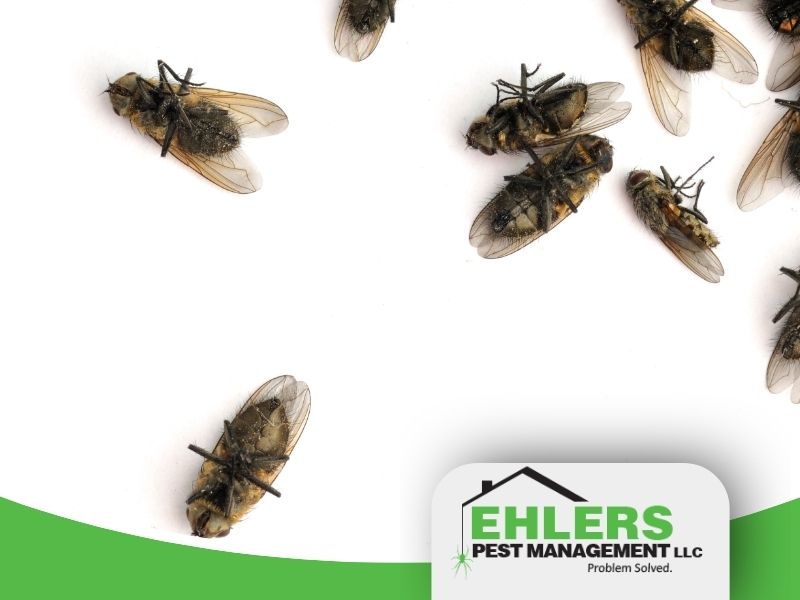
Several dead cluster flies are scattered on a white surface, mostly in the upper right. The Ehlers Pest Management LLC logo appears in the lower right corner, highlighting their expertise in tackling cluster flies in Wisconsin.

Cluster flies in Wisconsin show up the same way every year. A warm October afternoon, a dozen slow flies bumping around an upstairs window, and no obvious reason for them. There’s no garbage nearby, nothing rotting, and the house is clean. People find it unsettling for exactly that reason, because the usual explanation doesn’t fit.

It doesn’t fit because these flies have nothing to do with sanitation. Here’s where they actually come from, how to tell them apart from the flies that do mean something, and what reduces them.

Cluster flies in Wisconsin gather on sunny walls in fall and work their way into attics and wall voids to overwinter. They come from earthworms in the soil rather than garbage or drains, so finding them says nothing about how clean a house is.

What are cluster flies?

They’re a group of flies that spend their larval stage inside earthworms.

The adult female lays her eggs in soil. The larvae that hatch out find an earthworm, enter it, and develop inside it over a few weeks. Several generations run through that cycle over a Wisconsin summer, entirely outdoors and entirely out of sight.

So the population building up around your house all season has been living in your lawn, your garden beds, and the field behind you. Properties with a lot of turf, open ground, or pasture nearby get the heaviest pressure, which is why this is more common in the suburbs and out toward the county lines than it is downtown.

Why are there flies at my window in October?

Because the last generation of the year is looking for somewhere to spend the winter, and your house is the warmest thing in the neighborhood.

On sunny fall afternoons they gather on south and west facing walls, the same warm surfaces that collect box elder bugs and Asian lady beetles. From there they work into gaps around window and door frames, under siding, at soffit and fascia joints, and through attic and gable vents. What they’re aiming for is an unheated but protected space, so attics, wall voids, and rooms nobody uses are where they settle.

Then they go quiet. What brings them back out is a warm spell, which in Wisconsin can be a sunny January afternoon as easily as an October one. The warmth wakes them, they move toward light, and they end up at the nearest window, which is usually upstairs. That’s why this problem tends to announce itself in a spare bedroom or a bathroom on the top floor.

They’re slow and clumsy when they emerge, which is a useful tell. A fly you can catch with a cup is not a house fly.

Are they a sign the house is dirty?

No, and this is the part worth saying plainly, because it’s the first thing most people assume.

They don’t breed in garbage, they don’t come up from drains, and they don’t feed on waste. They can’t reproduce indoors at all, because their entire life cycle requires soil and earthworms. A house with cluster flies in the attic has good soil outside it and gaps in the building envelope. That’s the whole story.

We’ve found them in immaculate homes, brand new construction, and houses that had been deep cleaned the week before. It’s a building and landscape situation rather than a housekeeping one.

How do you tell them from house flies and blow flies?

This matters more than it sounds, because one of the three means something is genuinely wrong.

Cluster flies are slightly larger than a house fly, dark gray, and sluggish. The reliable marks are short golden or yellowish hairs on the thorax, just behind the head, and wings that overlap across the back when they’re at rest. They show up in groups, at windows, on warm days.

House flies are smaller, faster, and hold their wings apart in a V shape when resting. If you’re seeing quick flies around a kitchen, a trash can, or a drain, that’s a different problem with a different cause.

Blow flies are the ones to pay attention to. They’re metallic, shiny blue or emerald, and unmistakable once you’ve seen one. A sudden appearance of blow flies indoors usually means something died in a wall void, a chimney, or an attic, most often a mouse or a bird. If the flies at your window are shiny and metallic rather than dull gray, the fly isn’t the problem you need to solve.

Do they cause any harm?

Very little directly, and a bit indirectly.

They don’t bite, they don’t damage the structure, and they don’t carry the contamination risk that flies breeding in waste do. What they do leave behind is small dark spots on walls, window frames, and curtains, and a greasy smear if you swat one against a painted surface.

The indirect problem is the same one that comes with box elder bugs. A large number of flies dying inside a wall void or attic becomes a food source for carpet beetles and larder beetles, and those do damage wool, stored fabric, and dry goods. That’s the real argument for keeping them out rather than letting them in and vacuuming the survivors every spring.

What reduces cluster flies in Wisconsin homes?

An exterior treatment applied before they get in, and sealing after they’re gone.

The window for exterior work is late summer into early fall, while the flies are still massing on the outside walls. A treatment on the siding, eaves, soffits, and around window and door frames reduces how many make it into the structure. Once they’re inside a wall void or an attic, that opportunity has passed for the year, because spraying doesn’t reach them in there and treating a cavity full of insects creates the dead-insect problem described above.

Sealing is the durable half. Soffit and fascia gaps, siding seams and corners, the openings around vents and utility penetrations, gaps at window and door frames, and attic or gable vents with damaged screening. That’s the same list that keeps mice and box elder bugs out, so one pass handles several problems.

Being straight about the result: even a well-timed exterior treatment on a property with heavy pressure won’t get you to zero. It reduces the number substantially. Any company promising a fly-free attic is setting you up to be disappointed.

What should you do with the ones already inside?

Vacuum them, and use something you can empty outside.

Don’t swat them against walls or window trim, because of the spotting. And don’t spray insecticide along interior window sills for this, since it accomplishes very little against insects that are emerging from a wall cavity a few at a time over several months.

If you want to know where they’re coming from, pay attention to which room and which window. Flies concentrating at one upstairs window on warm days point at the wall or attic space right behind it, and that’s the information a technician needs to find the entry point outside.

What to do next

If you’re seeing them now, note the room and the wall, then walk outside and look at that same section of the house for gaps at the soffit, the siding seams, and around the window frames. The exterior window for treatment is open in early fall and it closes once they’ve moved into the walls.

Ehlers Pest Management serves southeastern Wisconsin, and you can reach our experienced team at (414) 303-6926 to schedule service. A certified technician will confirm what kind of fly you actually have, which matters more than people expect, find where they’re getting in, and treat the exterior. If it turns out you have blow flies rather than cluster flies, we’ll tell you that too, because that’s a different job entirely.

Categories Pest Identification & Prevention

Centipedes in Wisconsin: What’s Really Living in Your Basement This Fall

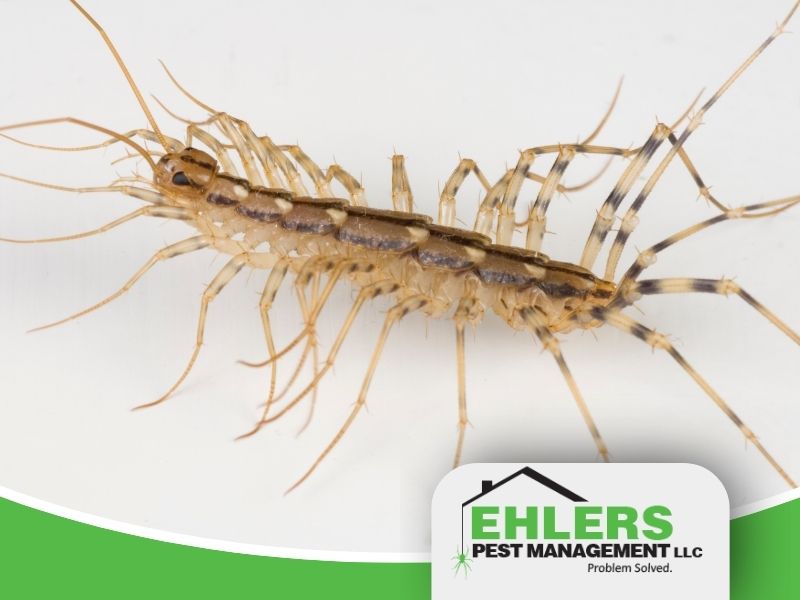
A close-up of a house centipede on a white surface, with the Ehlers Pest Management LLC logo in the bottom right corner.

If you’ve been finding centipedes in Wisconsin basements this fall, you’ve probably also found a few other things down there. Millipedes curled up on the floor, crickets that hop instead of chirp, and something silver that darts under the water heater when the light comes on. Those four show up together for the same reason, and once you know what that reason is, the answer to all of them is mostly the same.

Here’s what each one actually is, which of them can do damage, and what finding them repeatedly is telling you about the building.

Centipedes in Wisconsin basements usually turn up alongside millipedes, camel crickets, and silverfish. All four are drawn to moisture, and three of them wander in from outside and die there. Finding them repeatedly points at a damp basement or crawl space rather than an infestation.

What are these things in my basement?

Four species account for almost every call we get about basement bugs in southeastern Wisconsin.

House centipedes are the fast ones with the long legs, grayish yellow with dark stripes down the back, roughly an inch of body and a lot more leg. They move in quick bursts and stop dead. People find them genuinely alarming and they’re the most harmless thing on this list.

Millipedes are rounded, dark, slow, and segmented, with two pairs of tiny legs on each segment. When they’re disturbed or dying they curl into a tight spiral, which is how most people find them, motionless on the floor near a wall.

Camel crickets, sometimes called cave crickets, are the humpbacked, long-legged, wingless crickets that live in damp basements and crawl spaces. They don’t chirp, and they jump toward you when startled rather than away, which is why they have a reputation. The crickets you hear chirping in October are field crickets, a different insect that comes in from outside.

Silverfish are teardrop shaped, silver gray, with three bristles trailing off the back end. They move with a wriggle that looks like a fish swimming, they’re nocturnal, and they run for cover the moment a light goes on.

Are house centipedes in Wisconsin dangerous?

No, and they’re arguably working for you.

House centipedes are predators. What they eat is spiders, silverfish, small roaches, firebrats, and other soft-bodied insects living in the same damp spaces. They have venom for subduing prey, but their mouthparts struggle to break human skin, and bites are rare and comparable to a mild sting when they happen. They don’t damage the building, they don’t get into food, and they don’t carry disease.

Here’s the part worth acting on though. Unlike most things in this article, house centipedes can live indoors for years, and they only stay where there’s food. A basement with a persistent centipede population is a basement with a steady supply of other insects in it. The centipede is a symptom worth reading rather than the problem itself.

Which of these actually damage anything?

Two of the four, and it’s not the ones people worry about.

Silverfish eat starch. That means paper, cardboard, book bindings, wallpaper paste, photographs, and the glue in box seams, along with dried goods in a pantry. Boxes of stored documents, photo albums, and anything on a basement shelf are what they go after, and the damage is slow enough that people usually find it long after it started.

Camel crickets chew too. Fabric, paper, cardboard, and stored clothing are all fair game, and a large population in a crawl space can do noticeable damage to anything boxed up down there.

Millipedes and centipedes damage nothing. Millipedes do release a defensive fluid that can stain and has an unpleasant smell, which is a reason not to squash them on a light-colored floor.

Why do they all show up in fall?

Because the moisture outside changes, and moisture is the only thing all four of them care about.

Millipedes and field crickets live outdoors in leaf litter, mulch, and damp soil. When fall brings the first cold nights, or when a heavy rain floods their harborage, they move. A foundation wall is warm and the gaps along it lead somewhere sheltered, so they end up in the basement by accident. Most of them die within a few days, because there’s nothing down there for them to eat and the air is too dry to survive in for long.

Centipedes, silverfish, and camel crickets are a different case. They were probably already there. What changes in October is that the furnace comes on and dries out the upstairs, which concentrates them in whatever damp space is left. That’s usually the basement, the crawl space, or the bathroom, and it’s also where you’ve started going more often to pull out storage bins.

What does it mean if you keep finding them?

That the building has more moisture in it than it should.

One millipede on the floor in October is normal in Wisconsin and means nothing. Finding them every few days through the fall means something along the foundation is staying wet. Same with silverfish. Same with camel crickets.

The usual culprits are a downspout dumping against the foundation, grading that slopes toward the house rather than away, mulch or leaf litter piled against the siding, a crawl space with no vapor barrier, a dehumidifier that quit, or a slow plumbing leak nobody has found yet. That last one is worth ruling out, because an unexplained silverfish population in one corner of a basement has more than once turned out to be a leaking supply line inside a wall.

What actually reduces them?

Drying the space out does more than any product, so start there.

  • Run a dehumidifier in the basement or crawl space and keep it running through fall. Getting relative humidity down is the single most effective thing available.
  • Extend downspouts well away from the foundation, and check that grading carries water away from the house rather than toward it.
  • Pull mulch, leaf litter, and stacked firewood back off the siding and foundation. That’s where millipedes and crickets live before they come inside.
  • Get stored items off the floor and out of cardboard. Plastic bins with lids remove both the food source and the harborage for silverfish.

Sealing helps too, and it’s the same list of gaps that keeps mice out: the sill plate, utility penetrations, basement window frames, and the gaps around a bulkhead or garage door.

When is it worth calling someone?

When the moisture work is done and they’re still there, or when the population is clearly established rather than wandering in.

A perimeter treatment around the foundation reduces the wanderers, since millipedes and crickets have to cross treated ground to reach the building. Silverfish and camel crickets need interior work, because they breed indoors and drying the space alone takes a long time to catch up with an established population.

One honest note on centipedes. Treating for centipedes specifically accomplishes very little. They’re there because other insects are there, so the work that matters is reducing the population they’re feeding on and taking the moisture away. Handle those and the centipedes leave on their own.

What to do next

Go down to the basement and look at the floor along the walls rather than in the middle of the room. That’s where you’ll find them, and the corner they’re concentrated in usually points straight at the moisture source. Check what’s directly outside that corner while you’re at it, because the answer is often a downspout.

Ehlers Pest Management works across southeastern Wisconsin, and you can reach our experienced team at (414) 303-6926 to schedule service. A certified technician will identify what you actually have, look at the moisture conditions feeding it, and tell you whether this needs a treatment or a dehumidifier and a downspout extension. Sometimes it’s the second one, and we’ll say so.