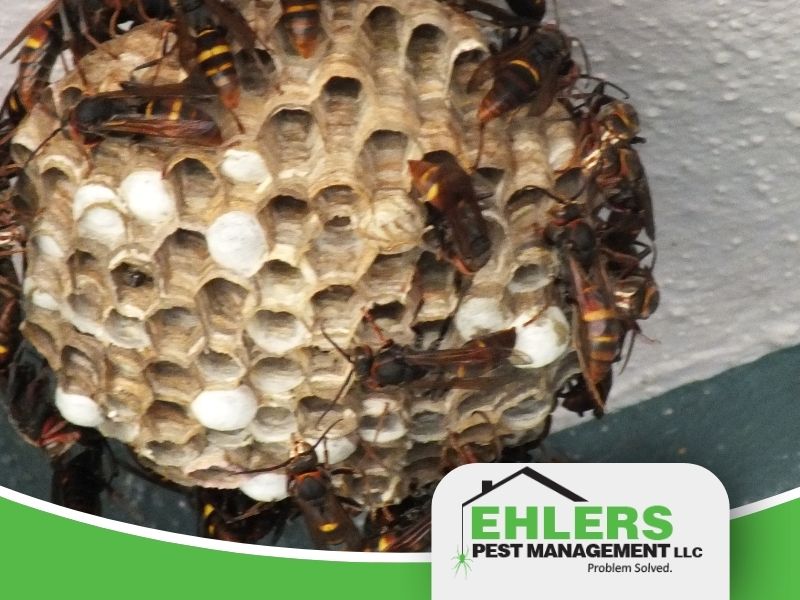
If you’re finding wasps in the house this month, they almost certainly didn’t fly in through an open door. October is too late in the season for that. What’s far more likely is that they were already in the building, in a wall void, a soffit, or the attic, and something about a warm afternoon brought them into the room with you.
Here’s what’s actually happening inside the wall, what makes it worse, and when it’s worth doing something about.
Wasps in the house in October almost always come from inside the structure rather than through an open door. Either a nest has been in a wall void or attic since summer, or mated queens have moved in to overwinter. Warm afternoons wake them, and they follow heat and light into your living space.
Why are wasps showing up indoors now?
Two separate things happen in a Wisconsin fall, and they both push wasps toward your interior.
The first is that colonies break up. Yellow jacket and paper wasp colonies spend the whole season building toward one goal, which is producing new queens. Once that’s done in early fall, the colony stops functioning. Old workers die off, and the newly mated queens leave to find somewhere to spend the winter. A heated building is the best shelter available, so they move into attics, wall voids, gaps behind siding, and the folds of insulation.
The second is temperature swing. Any nest that’s been sitting in your wall since June is still physically there, and the insects in it respond to warmth. A cold night followed by a sunny October afternoon heats that wall cavity, the survivors get active, and they move toward the warmest, brightest thing available. In an insulated wall, that direction is inward.
So the wasp on your kitchen window in October isn’t lost. It came from about four feet away, on the other side of the drywall.
Does it mean there’s a nest in the wall?
Usually yes, or there was one recently. A few things point to it.
- You’re seeing them repeatedly in the same room or at the same window rather than one insect on one day.
- They turn up on warm days and not on cold ones, which tracks the temperature in the cavity.
- You can hear a faint rustling or ticking in a wall or ceiling on a warm afternoon.
- You remember watching wasps go in and out of a gap in the siding, soffit, or fascia earlier in the summer, and you meant to deal with it.
A large nest inside a ceiling can also produce a stain on drywall, though that’s uncommon and usually means it’s been there a while.
Where are they getting into the living space?
Through the same small openings that let air move between the wall cavity and the room, which is more places than most people realize.
The common ones are recessed light fixtures and ceiling cans, bath fan and ceiling vent housings, the channels in window frames and sashes, gaps around outlet and switch plates, the seam where baseboard meets flooring, attic access hatches, and plumbing penetrations under sinks.
They’re not trying to get into your kitchen. They’re following warmth and daylight, and in a finished house those two things lead to the room you’re sitting in.
What makes the problem worse?
Four responses that feel right and aren’t.
- Sealing the interior opening only. If you caulk the gap around the light fixture and leave the nest in the wall, they find a different route and it’s usually into another room.
- Spraying an aerosol into a wall void or a ceiling gap. It doesn’t reach the nest, it scatters the insects deeper into the cavity, and it pushes some of them toward you.
- Opening up the wall to get at the nest. That turns a pest problem into a drywall repair, and you’ll be in the room with them when it happens.
- Treating a nest inside a wall and then forgetting about it. Killing a large colony in place leaves brood, comb, and dead insects in the cavity, and that becomes a food source for carpet beetles and other scavengers a few months later.
There’s also a straightforward safety point. If anyone in the house has a sting allergy, this isn’t a project to experiment with.
Will they die off on their own?
The colony will. The queens won’t.
Yellow jacket colonies in southeastern Wisconsin die at the end of the season. Every worker in that nest is finished by the time you get a few hard freezes, and the nest itself will never be used again. So if you have a nest in your siding and nobody has to walk past it, waiting it out is a legitimate choice, and we’d rather tell you that than sell you a treatment you don’t need.
What doesn’t resolve on its own is the queens. They’ve already left the nest and found somewhere else in your structure to overwinter, usually the attic or an exterior wall. Those will be active on warm winter days, showing up at windows in January and February, and again when spring arrives. Waiting doesn’t address them, and the insects you’re finding indoors in October are frequently these rather than the original colony.
What does treatment actually involve?
Finding the exterior entry point first, which is the part homeowners can rarely do from inside.
Once a technician locates where the insects are entering the structure from outside, treatment goes in at that point so the material gets carried into the nest by the wasps themselves. Then activity has to stop before anything gets sealed. Sealing a live entry point traps the colony inside the cavity, and their only remaining exit is into your house.
Two limits worth knowing up front. Yellow jacket nests above eight feet don’t get treated, because that means putting a technician on an extension ladder next to an agitated colony. And if the colony is already dead and what you have is overwintering queens spread through an attic, treatment isn’t really the answer. Exclusion is.
How do you keep it from happening next fall?
Close the exterior openings, and do it at the right time of year.
Late fall through winter is the window, once activity has stopped and before queens start new nests in spring. The list is short: soffit and fascia gaps, seams and corners in siding, the openings around vents and utility penetrations, ridge vent ends, and attic or gable vents with torn screening.
That’s the same list that keeps mice out, which is why this work tends to pay off against more than one problem. If you’re already planning rodent exclusion this fall, the wasp entry points get handled in the same pass.
What to do next
If you’re seeing wasps indoors on warm days, note which room, which window, and roughly how many, then look at the outside of the house in that same area for a gap in the siding or soffit. Those two pieces of information make the visit far more productive.
Ehlers Pest Management works throughout southeastern Wisconsin, and you can reach our experienced team at (414) 303-6926 to schedule service. A certified technician will find where they’re entering the structure, tell you whether you’re dealing with a live colony or overwintering queens, and explain what’s worth doing about it. If the honest answer is that the colony is already finished and you only need the openings closed, that’s what we’ll tell you.