Cluster flies in Wisconsin show up the same way every year. A warm October afternoon, a dozen slow flies bumping around an upstairs window, and no obvious reason for them. There’s no garbage nearby, nothing rotting, and the house is clean. People find it unsettling for exactly that reason, because the usual explanation doesn’t fit.
It doesn’t fit because these flies have nothing to do with sanitation. Here’s where they actually come from, how to tell them apart from the flies that do mean something, and what reduces them.
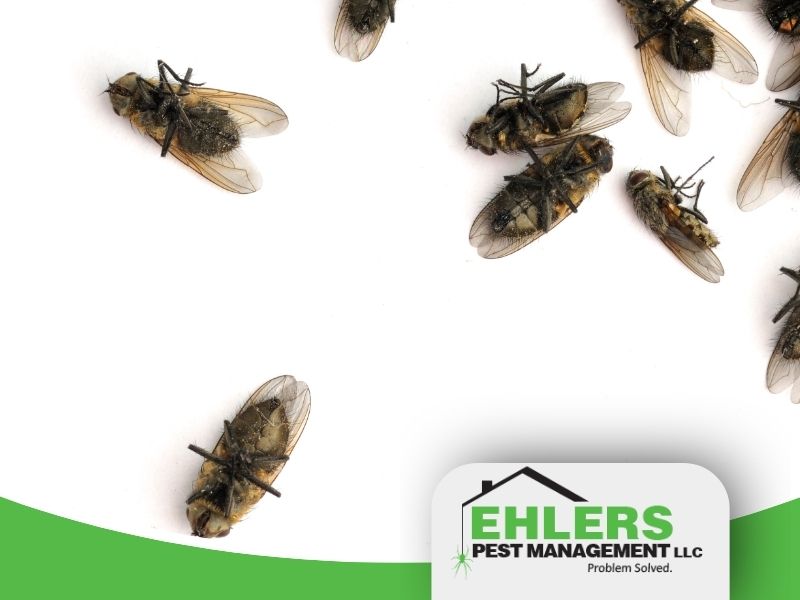
Cluster flies in Wisconsin gather on sunny walls in fall and work their way into attics and wall voids to overwinter. They come from earthworms in the soil rather than garbage or drains, so finding them says nothing about how clean a house is.
What are cluster flies?
They’re a group of flies that spend their larval stage inside earthworms.
The adult female lays her eggs in soil. The larvae that hatch out find an earthworm, enter it, and develop inside it over a few weeks. Several generations run through that cycle over a Wisconsin summer, entirely outdoors and entirely out of sight.
So the population building up around your house all season has been living in your lawn, your garden beds, and the field behind you. Properties with a lot of turf, open ground, or pasture nearby get the heaviest pressure, which is why this is more common in the suburbs and out toward the county lines than it is downtown.
Why are there flies at my window in October?
Because the last generation of the year is looking for somewhere to spend the winter, and your house is the warmest thing in the neighborhood.
On sunny fall afternoons they gather on south and west facing walls, the same warm surfaces that collect box elder bugs and Asian lady beetles. From there they work into gaps around window and door frames, under siding, at soffit and fascia joints, and through attic and gable vents. What they’re aiming for is an unheated but protected space, so attics, wall voids, and rooms nobody uses are where they settle.
Then they go quiet. What brings them back out is a warm spell, which in Wisconsin can be a sunny January afternoon as easily as an October one. The warmth wakes them, they move toward light, and they end up at the nearest window, which is usually upstairs. That’s why this problem tends to announce itself in a spare bedroom or a bathroom on the top floor.
They’re slow and clumsy when they emerge, which is a useful tell. A fly you can catch with a cup is not a house fly.
Are they a sign the house is dirty?
No, and this is the part worth saying plainly, because it’s the first thing most people assume.
They don’t breed in garbage, they don’t come up from drains, and they don’t feed on waste. They can’t reproduce indoors at all, because their entire life cycle requires soil and earthworms. A house with cluster flies in the attic has good soil outside it and gaps in the building envelope. That’s the whole story.
We’ve found them in immaculate homes, brand new construction, and houses that had been deep cleaned the week before. It’s a building and landscape situation rather than a housekeeping one.
How do you tell them from house flies and blow flies?
This matters more than it sounds, because one of the three means something is genuinely wrong.
Cluster flies are slightly larger than a house fly, dark gray, and sluggish. The reliable marks are short golden or yellowish hairs on the thorax, just behind the head, and wings that overlap across the back when they’re at rest. They show up in groups, at windows, on warm days.
House flies are smaller, faster, and hold their wings apart in a V shape when resting. If you’re seeing quick flies around a kitchen, a trash can, or a drain, that’s a different problem with a different cause.
Blow flies are the ones to pay attention to. They’re metallic, shiny blue or emerald, and unmistakable once you’ve seen one. A sudden appearance of blow flies indoors usually means something died in a wall void, a chimney, or an attic, most often a mouse or a bird. If the flies at your window are shiny and metallic rather than dull gray, the fly isn’t the problem you need to solve.
Do they cause any harm?
Very little directly, and a bit indirectly.
They don’t bite, they don’t damage the structure, and they don’t carry the contamination risk that flies breeding in waste do. What they do leave behind is small dark spots on walls, window frames, and curtains, and a greasy smear if you swat one against a painted surface.
The indirect problem is the same one that comes with box elder bugs. A large number of flies dying inside a wall void or attic becomes a food source for carpet beetles and larder beetles, and those do damage wool, stored fabric, and dry goods. That’s the real argument for keeping them out rather than letting them in and vacuuming the survivors every spring.
What reduces cluster flies in Wisconsin homes?
An exterior treatment applied before they get in, and sealing after they’re gone.
The window for exterior work is late summer into early fall, while the flies are still massing on the outside walls. A treatment on the siding, eaves, soffits, and around window and door frames reduces how many make it into the structure. Once they’re inside a wall void or an attic, that opportunity has passed for the year, because spraying doesn’t reach them in there and treating a cavity full of insects creates the dead-insect problem described above.
Sealing is the durable half. Soffit and fascia gaps, siding seams and corners, the openings around vents and utility penetrations, gaps at window and door frames, and attic or gable vents with damaged screening. That’s the same list that keeps mice and box elder bugs out, so one pass handles several problems.
Being straight about the result: even a well-timed exterior treatment on a property with heavy pressure won’t get you to zero. It reduces the number substantially. Any company promising a fly-free attic is setting you up to be disappointed.
What should you do with the ones already inside?
Vacuum them, and use something you can empty outside.
Don’t swat them against walls or window trim, because of the spotting. And don’t spray insecticide along interior window sills for this, since it accomplishes very little against insects that are emerging from a wall cavity a few at a time over several months.
If you want to know where they’re coming from, pay attention to which room and which window. Flies concentrating at one upstairs window on warm days point at the wall or attic space right behind it, and that’s the information a technician needs to find the entry point outside.
What to do next
If you’re seeing them now, note the room and the wall, then walk outside and look at that same section of the house for gaps at the soffit, the siding seams, and around the window frames. The exterior window for treatment is open in early fall and it closes once they’ve moved into the walls.
Ehlers Pest Management serves southeastern Wisconsin, and you can reach our experienced team at (414) 303-6926 to schedule service. A certified technician will confirm what kind of fly you actually have, which matters more than people expect, find where they’re getting in, and treat the exterior. If it turns out you have blow flies rather than cluster flies, we’ll tell you that too, because that’s a different job entirely.
If you’ve been finding centipedes in Wisconsin basements this fall, you’ve probably also found a few other things down there. Millipedes curled up on the floor, crickets that hop instead of chirp, and something silver that darts under the water heater when the light comes on. Those four show up together for the same reason, and once you know what that reason is, the answer to all of them is mostly the same.
Here’s what each one actually is, which of them can do damage, and what finding them repeatedly is telling you about the building.
Centipedes in Wisconsin basements usually turn up alongside millipedes, camel crickets, and silverfish. All four are drawn to moisture, and three of them wander in from outside and die there. Finding them repeatedly points at a damp basement or crawl space rather than an infestation.
What are these things in my basement?
Four species account for almost every call we get about basement bugs in southeastern Wisconsin.
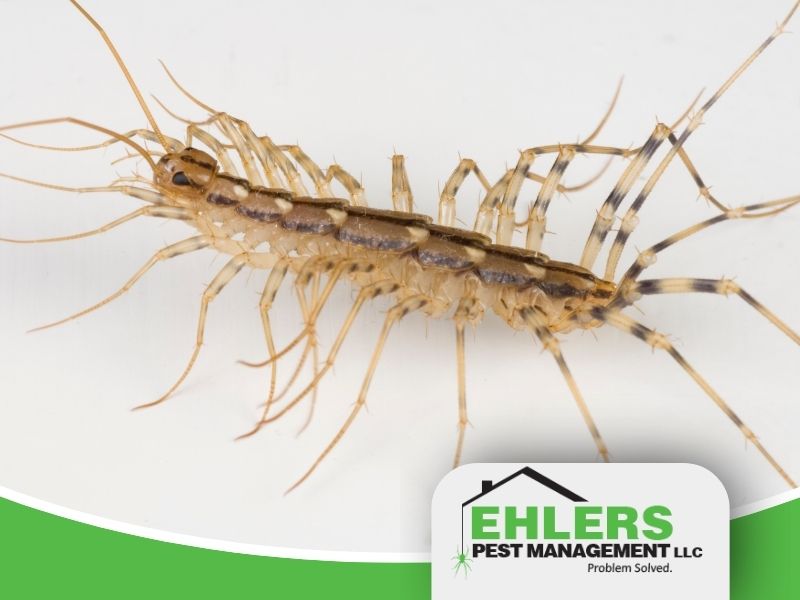
House centipedes are the fast ones with the long legs, grayish yellow with dark stripes down the back, roughly an inch of body and a lot more leg. They move in quick bursts and stop dead. People find them genuinely alarming and they’re the most harmless thing on this list.
Millipedes are rounded, dark, slow, and segmented, with two pairs of tiny legs on each segment. When they’re disturbed or dying they curl into a tight spiral, which is how most people find them, motionless on the floor near a wall.
Camel crickets, sometimes called cave crickets, are the humpbacked, long-legged, wingless crickets that live in damp basements and crawl spaces. They don’t chirp, and they jump toward you when startled rather than away, which is why they have a reputation. The crickets you hear chirping in October are field crickets, a different insect that comes in from outside.
Silverfish are teardrop shaped, silver gray, with three bristles trailing off the back end. They move with a wriggle that looks like a fish swimming, they’re nocturnal, and they run for cover the moment a light goes on.
Are house centipedes in Wisconsin dangerous?
No, and they’re arguably working for you.
House centipedes are predators. What they eat is spiders, silverfish, small roaches, firebrats, and other soft-bodied insects living in the same damp spaces. They have venom for subduing prey, but their mouthparts struggle to break human skin, and bites are rare and comparable to a mild sting when they happen. They don’t damage the building, they don’t get into food, and they don’t carry disease.
Here’s the part worth acting on though. Unlike most things in this article, house centipedes can live indoors for years, and they only stay where there’s food. A basement with a persistent centipede population is a basement with a steady supply of other insects in it. The centipede is a symptom worth reading rather than the problem itself.
Which of these actually damage anything?
Two of the four, and it’s not the ones people worry about.
Silverfish eat starch. That means paper, cardboard, book bindings, wallpaper paste, photographs, and the glue in box seams, along with dried goods in a pantry. Boxes of stored documents, photo albums, and anything on a basement shelf are what they go after, and the damage is slow enough that people usually find it long after it started.
Camel crickets chew too. Fabric, paper, cardboard, and stored clothing are all fair game, and a large population in a crawl space can do noticeable damage to anything boxed up down there.
Millipedes and centipedes damage nothing. Millipedes do release a defensive fluid that can stain and has an unpleasant smell, which is a reason not to squash them on a light-colored floor.
Why do they all show up in fall?
Because the moisture outside changes, and moisture is the only thing all four of them care about.
Millipedes and field crickets live outdoors in leaf litter, mulch, and damp soil. When fall brings the first cold nights, or when a heavy rain floods their harborage, they move. A foundation wall is warm and the gaps along it lead somewhere sheltered, so they end up in the basement by accident. Most of them die within a few days, because there’s nothing down there for them to eat and the air is too dry to survive in for long.
Centipedes, silverfish, and camel crickets are a different case. They were probably already there. What changes in October is that the furnace comes on and dries out the upstairs, which concentrates them in whatever damp space is left. That’s usually the basement, the crawl space, or the bathroom, and it’s also where you’ve started going more often to pull out storage bins.
What does it mean if you keep finding them?
That the building has more moisture in it than it should.
One millipede on the floor in October is normal in Wisconsin and means nothing. Finding them every few days through the fall means something along the foundation is staying wet. Same with silverfish. Same with camel crickets.
The usual culprits are a downspout dumping against the foundation, grading that slopes toward the house rather than away, mulch or leaf litter piled against the siding, a crawl space with no vapor barrier, a dehumidifier that quit, or a slow plumbing leak nobody has found yet. That last one is worth ruling out, because an unexplained silverfish population in one corner of a basement has more than once turned out to be a leaking supply line inside a wall.
What actually reduces them?
Drying the space out does more than any product, so start there.
Run a dehumidifier in the basement or crawl space and keep it running through fall. Getting relative humidity down is the single most effective thing available.
Extend downspouts well away from the foundation, and check that grading carries water away from the house rather than toward it.
Pull mulch, leaf litter, and stacked firewood back off the siding and foundation. That’s where millipedes and crickets live before they come inside.
Get stored items off the floor and out of cardboard. Plastic bins with lids remove both the food source and the harborage for silverfish.
Sealing helps too, and it’s the same list of gaps that keeps mice out: the sill plate, utility penetrations, basement window frames, and the gaps around a bulkhead or garage door.
When is it worth calling someone?
When the moisture work is done and they’re still there, or when the population is clearly established rather than wandering in.
A perimeter treatment around the foundation reduces the wanderers, since millipedes and crickets have to cross treated ground to reach the building. Silverfish and camel crickets need interior work, because they breed indoors and drying the space alone takes a long time to catch up with an established population.
One honest note on centipedes. Treating for centipedes specifically accomplishes very little. They’re there because other insects are there, so the work that matters is reducing the population they’re feeding on and taking the moisture away. Handle those and the centipedes leave on their own.
What to do next
Go down to the basement and look at the floor along the walls rather than in the middle of the room. That’s where you’ll find them, and the corner they’re concentrated in usually points straight at the moisture source. Check what’s directly outside that corner while you’re at it, because the answer is often a downspout.
Ehlers Pest Management works across southeastern Wisconsin, and you can reach our experienced team at (414) 303-6926 to schedule service. A certified technician will identify what you actually have, look at the moisture conditions feeding it, and tell you whether this needs a treatment or a dehumidifier and a downspout extension. Sometimes it’s the second one, and we’ll say so.
People start looking for a spider exterminator in Milwaukee every September, and the reason isn’t the one most of them assume. Spiders aren’t flooding in from the yard to escape the cold. The house spiders you’re seeing mostly lived in your house all along. What changed is that they finished growing, the males started wandering to find mates, and both of those things happen at the end of summer. You’re seeing the same population you always had, at the point in the year when it’s biggest and most active.
Here’s what’s actually in a Wisconsin home, which ones are worth any concern, and when treatment is the right call.
You see more spiders in fall because house spiders reach full size in late summer and males begin wandering to find mates. Most of them lived in your home all along. Spiders are a secondary pest, so reducing the insects they feed on does more than removing spiders one at a time.
Why are there suddenly more spiders in my house?
Four things stack up at the same time, and only one of them has anything to do with temperature.
The biggest factor is maturity. Common house spiders hatch in spring, grow all summer, and reach full size in late August and September. A spider that was too small to notice in June is now large enough to catch your eye from across the room. Nothing arrived. It just got bigger.
The second is mate-searching. Male spiders that have matured leave their webs and wander looking for females, which is why the spider you find crossing the living room floor at nine at night is almost always a male. Wandering is temporary behavior and it peaks right now.
Third, their food supply moves. Box elder bugs, lady beetles, flies, and other insects push toward the house in fall, and spiders follow the insects. Where you have a lot of one, you get a lot of the other.
Fourth, people are inside more, with the windows shut and the lights on, and simply notice more of what was already there.
Which spiders actually live in Wisconsin homes?
The list is shorter than people expect, and almost all of it is harmless.
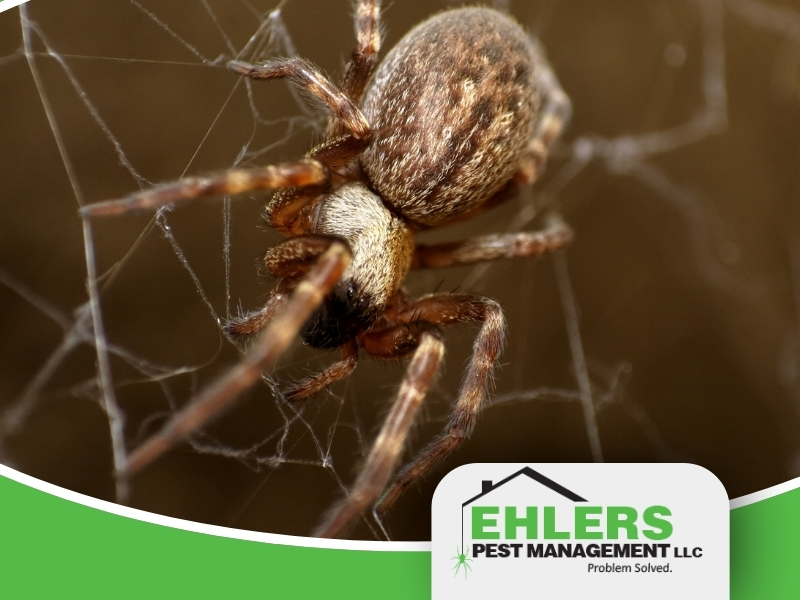
Common house spiders build the messy, tangled cobwebs in ceiling corners, basements, and behind furniture. They’re small, tan or gray, and they’re the reason you’re dusting webs down every few weeks.
Cellar spiders are the long-legged ones hanging in loose webs in basements and crawl spaces. People call them daddy longlegs. They eat other spiders, including bigger ones, so a basement full of cellar spiders is doing you a small favor.
Wolf spiders generate more phone calls than anything else on this list. They’re large, hairy, fast, brown or gray, and they don’t build webs. They hunt on the ground, which means you find them running across a basement floor rather than sitting in a corner. They look alarming and they’re not dangerous.
Funnel weavers, sometimes called grass spiders, build the flat sheet webs with a funnel at one end that you see all over lawns, window wells, and shrubs on dewy September mornings.
Orb weavers build the classic wheel-shaped webs outdoors. In September the females are at full size and their webs turn up across doorways and between porch railings overnight. They’re outdoor spiders, they’re harmless, and they’ll be gone with the first hard frost.
Yellow sac spiders are small, pale, and nocturnal, and they wander rather than sit in a web. They’re worth knowing about because they account for a fair share of the bites people actually get in this region.
Are any Wisconsin spiders dangerous?
Very few, and bites are far less common than most people believe.
Most spiders in a Wisconsin home either can’t break human skin or won’t try. Bites generally happen when a spider gets trapped against skin, usually in clothing, a glove, a shoe, or bedding. A yellow sac spider bite can be locally painful and slow to heal. A wolf spider bite is comparable to a bee sting and uncommon.
Northern black widows exist in Wisconsin but are genuinely rare here, concentrated in the southwestern part of the state, and they’re reclusive and non-aggressive. Most people go their whole lives in this state without encountering one.
If you have a bite that’s spreading, worsening, or accompanied by fever, see a doctor. That’s a medical question, not a pest control question, and the answer is frequently something other than a spider.
Is that a brown recluse?
Almost certainly not. Brown recluses aren’t established in Wisconsin.
Their range covers the south-central United States, and the occasional one that turns up here arrived in a shipment or a moving box rather than a local population. Confirmed Wisconsin sightings are rare enough to be notable.
This matters because brown recluse gets blamed for a lot of things it didn’t do. Skin infections, including bacterial ones that need actual treatment, get self-diagnosed as recluse bites, and that delays people getting care they need. The brown spider in your basement in Milwaukee is far more likely to be a wolf spider, a funnel weaver, or a common house spider.
Does killing spiders one at a time help?
Not much, and this is the part worth understanding before you spend money on anything.
Spiders are a secondary pest. They’re in your house because there’s something in your house for them to eat. A property with a heavy spider population almost always has a heavy insect population feeding it, and removing individual spiders doesn’t change that. New ones fill the space.
So the work that actually reduces spiders isn’t spider-specific. It’s cutting down the insects they’re hunting, clearing the webs that mark established territory, and closing up the gaps that let both in.
When is it worth calling a spider exterminator in Milwaukee?
When you’re seeing them consistently rather than occasionally, when webs come back within days of being cleared, or when there’s a bigger insect problem underneath the spider problem.
What treatment actually involves is a perimeter application around the foundation, doors, windows, eaves, and soffits, along with physically removing webs and egg sacs, since a web left in place is an invitation to rebuild. Spiders are covered under general interior and exterior pest control rather than being a standalone service, because handling the insects they feed on is most of the job.
One honest note. Spiders are harder to knock down than most insects, because they walk on the tips of their legs and pick up less material from a treated surface than a crawling insect does. Good results come from the combination of treatment, de-webbing, and reducing what they’re eating, rather than from a single application.
What can you do yourself?
Several things, and they help more here than they do with most pests.
Clear webs regularly, inside and out, with a vacuum or a web brush. This is the single most effective thing a homeowner can do.
Change exterior lighting to warm-toned or yellow bulbs, or move fixtures away from doors. White light draws the insects that draw the spiders.
Move firewood, leaf piles, and mulch back from the foundation, and cut back shrubs touching the siding.
Seal the same gaps that let mice in: around window and door frames, at the sill plate, and where utilities enter the wall.
Shake out gloves, boots, and anything stored in the garage or basement before you put it on. That’s how most bites get prevented.
What to do next
If it’s one wolf spider in the basement in September, you’ve got a normal Wisconsin fall and a vacuum will handle it. If webs are back a few days after you clear them, or you’re finding spiders daily, there’s an insect population feeding them and that’s the actual problem to solve.
Talk to our experienced team at (414) 303-6926. A certified technician will inspect the property, tell you what’s driving it, and treat the interior and exterior. They’ve seen how these homes behave in a Wisconsin September.hat’s actually in a Wisconsin home, which ones are worth any concern, and when treatment is the right call.
Why are there suddenly more spiders in my house?
Four things stack up at the same time, and only one of them has anything to do with temperature.
The biggest factor is maturity. Common house spiders hatch in spring, grow all summer, and reach full size in late August and September. A spider that was too small to notice in June is now large enough to catch your eye from across the room. Nothing arrived. It just got bigger.
The second is mate-searching. Male spiders that have matured leave their webs and wander looking for females, which is why the spider you find crossing the living room floor at nine at night is almost always a male. Wandering is temporary behavior and it peaks right now.
Third, their food supply moves. Box elder bugs, lady beetles, flies, and other insects push toward the house in fall, and spiders follow the insects. Where you have a lot of one, you get a lot of the other.
Fourth, people are inside more, with the windows shut and the lights on, and simply notice more of what was already there.
Which spiders actually live in Wisconsin homes?
The list is shorter than people expect, and almost all of it is harmless.
Common house spiders build the messy, tangled cobwebs in ceiling corners, basements, and behind furniture. They’re small, tan or gray, and they’re the reason you’re dusting webs down every few weeks.
Cellar spiders are the long-legged ones hanging in loose webs in basements and crawl spaces. People call them daddy longlegs. They eat other spiders, including bigger ones, so a basement full of cellar spiders is doing you a small favor.
Wolf spiders generate more phone calls than anything else on this list. They’re large, hairy, fast, brown or gray, and they don’t build webs. They hunt on the ground, which means you find them running across a basement floor rather than sitting in a corner. They look alarming and they’re not dangerous.
Funnel weavers, sometimes called grass spiders, build the flat sheet webs with a funnel at one end that you see all over lawns, window wells, and shrubs on dewy September mornings.
Orb weavers build the classic wheel-shaped webs outdoors. In September the females are at full size and their webs turn up across doorways and between porch railings overnight. They’re outdoor spiders, they’re harmless, and they’ll be gone with the first hard frost.
Yellow sac spiders are small, pale, and nocturnal, and they wander rather than sit in a web. They’re worth knowing about because they account for a fair share of the bites people actually get in this region.
Are any Wisconsin spiders dangerous?
Very few, and bites are far less common than most people believe.
Most spiders in a Wisconsin home either can’t break human skin or won’t try. Bites generally happen when a spider gets trapped against skin, usually in clothing, a glove, a shoe, or bedding. A yellow sac spider bite can be locally painful and slow to heal. A wolf spider bite is comparable to a bee sting and uncommon.
Northern black widows exist in Wisconsin but are genuinely rare here, concentrated in the southwestern part of the state, and they’re reclusive and non-aggressive. Most people go their whole lives in this state without encountering one.
If you have a bite that’s spreading, worsening, or accompanied by fever, see a doctor. That’s a medical question, not a pest control question, and the answer is frequently something other than a spider.
Is that a brown recluse?
Almost certainly not. Brown recluses aren’t established in Wisconsin.
Their range covers the south-central United States, and the occasional one that turns up here arrived in a shipment or a moving box rather than a local population. Confirmed Wisconsin sightings are rare enough to be notable.
This matters because brown recluse gets blamed for a lot of things it didn’t do. Skin infections, including bacterial ones that need actual treatment, get self-diagnosed as recluse bites, and that delays people getting care they need. The brown spider in your basement in Milwaukee is far more likely to be a wolf spider, a funnel weaver, or a common house spider.
Does killing spiders one at a time help?
Not much, and this is the part worth understanding before you spend money on anything.
Spiders are a secondary pest. They’re in your house because there’s something in your house for them to eat. A property with a heavy spider population almost always has a heavy insect population feeding it, and removing individual spiders doesn’t change that. New ones fill the space.
So the work that actually reduces spiders isn’t spider-specific. It’s cutting down the insects they’re hunting, clearing the webs that mark established territory, and closing up the gaps that let both in.
When is it worth calling a spider exterminator in Milwaukee?
When you’re seeing them consistently rather than occasionally, when webs come back within days of being cleared, or when there’s a bigger insect problem underneath the spider problem.
What treatment actually involves is a perimeter application around the foundation, doors, windows, eaves, and soffits, along with physically removing webs and egg sacs, since a web left in place is an invitation to rebuild. Spiders are covered under general interior and exterior pest control rather than being a standalone service, because handling the insects they feed on is most of the job.
One honest note. Spiders are harder to knock down than most insects, because they walk on the tips of their legs and pick up less material from a treated surface than a crawling insect does. Good results come from the combination of treatment, de-webbing, and reducing what they’re eating, rather than from a single application.
What can you do yourself?
Several things, and they help more here than they do with most pests.
Clear webs regularly, inside and out, with a vacuum or a web brush. This is the single most effective thing a homeowner can do.
Change exterior lighting to warm-toned or yellow bulbs, or move fixtures away from doors. White light draws the insects that draw the spiders.
Move firewood, leaf piles, and mulch back from the foundation, and cut back shrubs touching the siding.
Seal the same gaps that let mice in: around window and door frames, at the sill plate, and where utilities enter the wall.
Shake out gloves, boots, and anything stored in the garage or basement before you put it on. That’s how most bites get prevented.
What to do next
If it’s one wolf spider in the basement in September, you’ve got a normal Wisconsin fall and a vacuum will handle it. If webs are back a few days after you clear them, or you’re finding spiders daily, there’s an insect population feeding them and that’s the actual problem to solve.
Call Ehlers Pest Management at (414) 303-6926. A certified technician will inspect the property, tell you what’s driving it, and treat the interior and exterior. The person who looks at your house is the one who does the work, and they’ve seen how these homes behave in a Wisconsin September.
Most Milwaukee homeowners who search for bee and wasp removal are looking at wasps. That distinction matters more than it sounds, because the two get handled in completely different ways. Wasps, hornets, and yellow jackets are pest control work, and a certified technician treats the nest. Honeybees are a beekeeper’s job, and they get relocated rather than killed. Telling them apart takes about thirty seconds once you know what to look at.
Here’s how to identify what’s on your property, and what happens next depending on the answer.
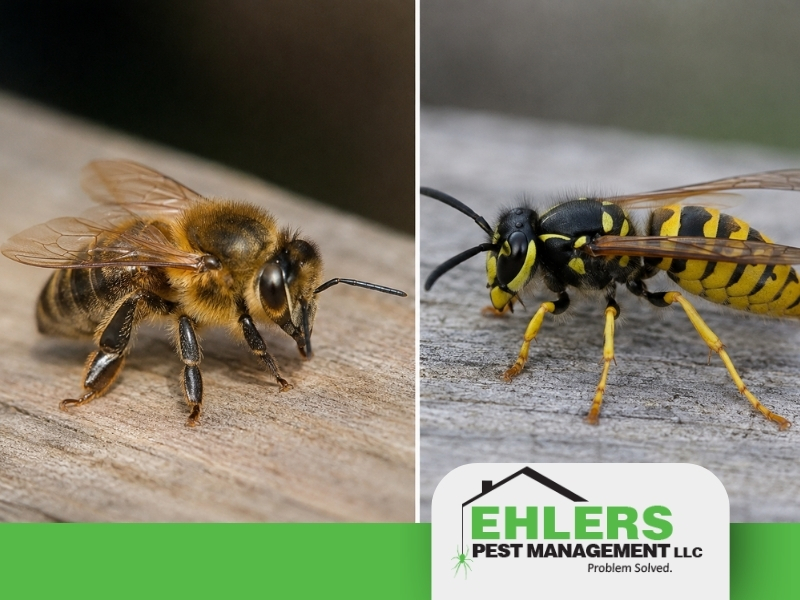
Most Milwaukee homeowners searching for bee and wasp removal are looking at wasps. Wasps, hornets, and yellow jackets are pest control work. Honeybees are a beekeeper’s job and get relocated rather than killed. Body shape tells them apart: wasps are smooth and narrow-waisted, bees are round and fuzzy.
What’s the fastest way to tell a bee from a wasp?
Four things give it away, and you can check them from a comfortable distance.
Body shape. Bees are round and fuzzy, almost like they’re wearing a coat. Wasps are smooth, shiny, and pinched sharply in the middle, with an obvious narrow waist.
Legs in flight. A wasp lets its back legs hang down while it flies. A bee tucks everything up close to the body.
Where you find them. Bees work flowers and flowering shrubs. Wasps show up at your grill, your trash can, your pet’s food bowl, and anything sweet you left outside.
Color. Yellow jackets are bright, sharp yellow and black with clean stripes. Honeybees are softer, more amber or golden brown, and they look dusty.
If the insect is smooth, striped, and hovering around your picnic, you have wasps. If it’s fuzzy, rounded, and busy on the hydrangeas, leave it alone.
Which stinging insects actually show up around Milwaukee homes?
Southeastern Wisconsin gives you a fairly short list, and most of it turns up between June and October.
Yellow jackets are the ones people call about most in September. Smooth bodies, bright markings, and they nest out of sight in wall voids, under decks, and in holes in the ground. They’re the most aggressive stinging insect in the state and they get worse as the season ends.
Paper wasps build the open, umbrella-shaped nest you can see hanging under a soffit or a porch ceiling. Long legs dangling in flight, slower and less aggressive than yellow jackets until you get close to the nest.
Bald-faced hornets build the enclosed gray nest that people describe as football-shaped, usually in a tree or against a wall. They defend a wide radius around it.
Honeybees are amber and fuzzy, and they don’t build exposed nests on your house. If you have honeybees, they’re either passing through, or they’ve moved into a wall void or a hollow tree and you’ll see a steady column going in and out of one small opening.
Bumble bees are large, very fuzzy, and mostly harmless to people. They nest in the ground, under sheds, and in compost piles, and a colony is usually a few dozen insects rather than a few hundred.
Carpenter bees look like bumble bees with a shiny black rear end instead of a fuzzy one. The tell is the hole: a perfectly round opening about the diameter of a pencil, drilled into fascia, deck rails, or trim.
Mining bees are the small ones that leave little dirt mounds in thin patches of lawn in spring. They’re solitary, they don’t defend anything, and they’re gone in a few weeks.
What’s nesting in the ground in my yard?
This is the question we get most often, and the answer is usually one of three things.
If it’s April or May and you’re seeing dozens of small dirt volcanoes across a bare patch of lawn, those are mining bees. Each hole is one solitary bee. They don’t swarm, they rarely sting, and they’ll be finished before Memorial Day.
If it’s summer, the insects are big and fuzzy, and there are maybe a dozen coming and going from one hole under a shed or a landscape timber, that’s a bumble bee colony. Give it space and the colony will be gone by the first hard frost.
If it’s August or September, the insects are smooth and bright, and there’s heavy traffic pouring in and out of a single hole all day long, that’s yellow jackets. This is the one that matters. A mature ground nest can hold close to a thousand insects, and running a lawn mower past the opening is how most people find out it’s there.
Do honeybees have to be removed, or can they stay?
We don’t kill honeybees, and we’ll tell you that on the phone. If you’ve got a honeybee colony, call a beekeeper. Plenty of local beekeepers will collect a swarm at no charge, because a free colony is worth having.
A colony that’s moved into a wall void is a bigger job than a swarm hanging on a branch. Comb and honey inside a wall will eventually attract ants, roaches, and rodents, and honey can work its way through drywall. That still isn’t an extermination job. It’s a removal and relocation job, and it takes a beekeeper who does structural cutouts, sometimes working alongside a contractor to open and close the wall.
Any pest control company that offers to spray a honeybee colony out of your wall should give you pause. That leaves dead bees, abandoned comb, and several pounds of honey in the cavity, which becomes a second pest problem a few months later.
When does bee and wasp removal actually mean a pest control call?
When it’s wasps, hornets, or yellow jackets, and there’s a reason to act.
Paper wasps under a soffit near a door or a deck are worth treating, especially if the nest keeps coming back to the same spot every year. Ongoing service handles that better than one-off calls, because the nests get knocked down before they establish.
Yellow jackets in a wall void, under a step, or in the ground near a walkway are worth treating now. These are the ones that put people in urgent care in September.
Carpenter bees drilling into structural wood are worth an inspection. The individual bee isn’t dangerous, and the tunneling adds up over several seasons, especially once woodpeckers start opening the galleries to get at the larvae.
Two situations where the answer is no. Yellow jacket nests above eight feet don’t get treated, because that means putting a technician on an extension ladder next to an agitated colony. And a yellow jacket nest in a far corner of the yard that nobody walks past will die off on its own once the weather turns, so waiting it out is a legitimate choice.
What if you can’t tell what you’re looking at?
Take a photo from as far back as your phone will let you, and pay attention to the traffic pattern instead of the individual insect. Steady two-way movement through one small opening tells a technician more than a blurry close-up does.
Then talk to our experienced team at (414) 303-6926 and describe what you’re seeing. The person you talk to knows southeastern Wisconsin stinging insects, and can usually narrow it down before anyone drives out. If it’s a wasp or hornet problem, a certified technician comes out, confirms what it is, and treats the nest. If it turns out to be honeybees, we’ll point you toward someone who’ll come get them.
Fall pest control in Milwaukee isn’t something most homeowners think about in August — but that’s exactly when the preparation window opens. By the time October arrives and you’re finding mice in your kitchen or box elder bugs on your walls, the seasonal push has already been underway for weeks. Getting ahead of it now, while the outdoor population is still largely outside, is the most effective and least disruptive approach to fall pest management in a Wisconsin home.
Preparing a Milwaukee home for fall pest season means addressing entry points, eliminating attractants, and treating the exterior perimeter before temperatures drop — ideally in August and September. The three highest-priority pests to prepare for are mice, box elder bugs, and occasional invaders like stink bugs and Asian lady beetles, all of which begin their movement toward structures in late summer in Southeastern Wisconsin.
Why Fall Pest Preparation Starts in August in Wisconsin
Wisconsin’s fall pest pressure doesn’t wait for leaves to change. Mice begin scouting for indoor entry points as overnight temperatures start dropping in late August. Box elder bugs begin aggregating on sun-warmed exterior walls in early September. Stink bugs and Asian lady beetles follow a similar pattern, clustering on south and west-facing walls before pushing through gaps into wall voids and attic spaces.
Each of these pests responds to the same environmental trigger — declining overnight temperatures — and acts on it weeks before the first frost. Homeowners who address vulnerabilities in August and early September intercept this movement at the most effective point: before the bulk of the population has made it inside.
What Should You Check Around the Exterior of Your Home?
The exterior of your home is where fall pest control in Milwaukee starts. A thorough walk-around in August identifies the vulnerabilities that mice, box elder bugs, and other fall invaders will exploit over the next two months:
Foundation gaps and cracks. Even hairline cracks in foundation mortar are sufficient for mice. Look particularly around utility penetrations, where pipes and conduit enter the building.
Door and window weatherstripping. Compressed, torn, or missing weatherstripping along the bottom of exterior doors is one of the most common mouse entry points in Milwaukee homes. Replace anything that’s degraded.
Soffit and fascia gaps. Gaps where soffit meets the roofline are entry points for mice, squirrels, and overwintering insects. Check for separations, rot, or missing sections.
Dryer vents and HVAC penetrations. These should be screened with appropriate mesh to prevent entry. Check that existing screens are intact and properly seated.
Move wood piles, dense ground cover, and debris away from the foundation. These provide harborage for mice and cover for travel routes directly to your home’s entry points.
A Room-by-Room Fall Pest Control Checklist for Milwaukee Homes
Kitchen
Inspect cabinet interiors for gaps around plumbing penetrations and seal with steel wool or caulk
Check behind and under the refrigerator, stove, and dishwasher for gaps at floor level
Store dry goods in sealed containers rather than original packaging
Fix any dripping faucets or slow drains that create standing moisture
Basement and Utility Areas
Inspect the sill plate and rim joist area for gaps where the foundation meets the framing
Check around the water heater, furnace, and utility connections for gaps and penetrations
Ensure floor drains have functional covers
Reduce clutter that provides harborage, particularly stored cardboard boxes
Attic and Upper Floors
Inspect attic access points for gaps around the hatch frame
Check that attic vents are screened and screens are intact
Look for evidence of existing activity including droppings, nesting material, or gnaw marks on wood framing
Garage
Check the bottom seal of the garage door for gaps or deterioration
Inspect where the garage walls meet the foundation for gaps
Store birdseed, pet food, and other attractants in sealed metal or heavy plastic containers
When Should You Schedule Professional Fall Pest Control in Milwaukee?
DIY exclusion work and eliminating attractants are meaningful steps, but they work best alongside professional treatment rather than as a complete replacement for it. A professional pest control Milwaukee provider can identify entry points that aren’t obvious to the untrained eye, treat the exterior perimeter with a residual product timed to intercept fall pests before they enter, and assess whether any activity is already present inside the home that needs to be addressed simultaneously.
August and September are the highest-value months for scheduling a fall perimeter treatment in Milwaukee. Treatment applied before large numbers of box elder bugs aggregate on your exterior walls, and before the seasonal mouse push peaks, is significantly more effective than reactive treatment after the fall invasion is already underway.
Ehlers Pest Management provides fall pest control across Milwaukee and Southeastern Wisconsin. To schedule service or talk to our experienced team about getting ahead of this fall’s pest pressure, contact us today.
Frequently Asked Questions
When should I schedule fall pest control in Milwaukee?
August is the ideal window for fall pest preparation in Milwaukee. Scheduling a professional perimeter treatment and completing exclusion work before September gives you the best chance of intercepting the seasonal mouse scouting push and the box elder bug aggregation before they reach your home’s exterior and begin finding entry points.
What pests should Milwaukee homeowners prepare for in fall?
The three highest-priority fall pests in Southeastern Wisconsin are mice, which begin scouting for indoor entry points in late August; box elder bugs, which aggregate on exterior walls in September before pushing inside; and Asian lady beetles and stink bugs, which follow a similar pattern. Squirrels seeking attic access also become more active in fall as they prepare for winter.
Can I do fall pest preparation myself or do I need a professional?
Homeowners can meaningfully reduce fall pest risk through DIY exclusion work: sealing foundation gaps, replacing weatherstripping, moving wood piles away from the foundation, and storing attractants properly. Professional treatment adds a residual perimeter barrier and a trained eye for entry points that aren’t obvious from a surface inspection. For homes with a history of fall pest problems, combining both approaches delivers the most reliable results.
How do I keep box elder bugs out of my Milwaukee home this fall?
Box elder bug prevention combines exterior perimeter treatment applied in late August or early September before aggregation peaks, and sealing gaps in the building envelope that allow them to enter wall voids. Once large numbers have aggregated on your exterior walls, treatment is less effective and the focus shifts to preventing entry rather than eliminating the outdoor population.