Categories Pest Treatment & Services

Wasp Nest Removal in Milwaukee: Why September Is Peak Season

A wasp nest attached to the corner of a yellow wooden ceiling, with a wasp on it—an all-too-common sight that highlights the need for professional wasp nest removal Milwaukee services. The Ehlers Pest Management LLC logo is visible in the lower right corner.

If you’re looking for wasp nest removal in Milwaukee right now, you’ve hit the worst month of the year to have a nest on your house, and that isn’t bad luck. September is when wasp and hornet colonies reach their maximum size. A yellow jacket nest that started with a single queen in April can hold close to a thousand workers by Labor Day. Those workers are running short on food, they’re far more aggressive than they were in July, and they’ll defend the nest over almost nothing. If there’s a nest on your property, this is the month it turns into a real problem.

Here’s what’s actually happening in that nest, how to tell what you’re dealing with, and when it’s worth calling someone.

Why are wasps more aggressive in September?

It comes down to colony math and a food supply that runs out.

A yellow jacket colony starts every spring with one queen. She builds a small nest, raises the first workers herself, and from there the workers take over. All summer the colony grows. By late August or early September it’s at peak population, which for yellow jackets in southeastern Wisconsin often means several hundred to a thousand insects in one nest.

At the same time, the queen stops laying. The larvae she’d been raising were feeding the adult workers a sugary secretion, and once that supply dries up, the workers go looking for sugar somewhere else. That’s why they suddenly show up at your grill, your garbage can, your kids’ juice box, and the last inch of soda you left on the deck rail.

So you’ve got the most wasps you’ll see all year, they’re hungry, and they’re spending their time exactly where people are. Sting calls spike in September for that reason. The wasps didn’t change. Their situation did.

What does a wasp nest look like at full size?

That depends on what’s living in it, and the differences matter more than people expect.

Paper wasps build the open, umbrella-shaped nest you can see hanging under a soffit, an eave, a deck rail, or a porch ceiling. The cells are visible from below. These nests stay relatively small and they’re usually easy to spot.

Bald-faced hornets build the enclosed gray nest people describe as football-shaped or basketball-shaped, usually in a tree, on a wall, or tucked into a corner of a roof line. By September these can get genuinely large.

Yellow jackets are the ones you often can’t see at all. They nest inside wall voids, under decks and porches, in gaps behind siding, and in holes in the ground. The nest itself is hidden, so what you notice instead is traffic: a steady stream of wasps going in and out of one specific spot, over and over, all day. If you’re watching insects disappear into a gap in your siding or a hole in the lawn, that’s a yellow jacket nest, and it’s bigger than it looks.

Is it paper wasps or yellow jackets, and does it change the treatment?

It changes it quite a bit.

Paper wasps build visible external nests and they keep building all season. If your house tends to collect them under the soffits every year, ongoing service works better than one-off calls, because a technician knocks the nests down before they get established.

Yellow jackets go into voids and ground holes, and they’re typically handled on a one-time, as-needed basis. When we treat one, we’re treating a specific nest in a specific location, not doing a general perimeter spray and hoping.

Two honest limits worth knowing before you call anyone. Our technicians don’t treat yellow jacket nests above eight feet, because that puts someone on an extension ladder with a thousand agitated insects, and we’re not going to ask that of our people. And yellow jacket colonies die off naturally at the end of the season, so if you’ve got a high nest in a spot nobody walks past, waiting it out is a legitimate option.

One more thing that comes up every fall. If what you’re seeing is honeybees, we’ll tell you to call a beekeeper. We treat paper wasps, yellow jackets, and hornets. We don’t kill honeybees, and any pest control company that offers to should give you pause.

Can you remove a wasp nest yourself?

Sometimes, and September is the month when the odds get worse.

A small paper wasp nest, visible, reachable from the ground, early in the season, is something plenty of homeowners handle with a can of spray. That’s a reasonable call.

A mature nest in September is a different situation, for four reasons:

  • The population is at its highest point of the year, so a nest that would have released a dozen wasps in June releases hundreds now.
  • Anything that requires a ladder puts you above the nest with no way to retreat quickly, which is how most serious stinging incidents happen.
  • Ground nests don’t take spray the way exposed nests do, and the colony comes out at you rather than staying put.
  • Knocking a nest inside a wall void scatters the colony into the wall cavity, and from there they find their way into living space. We get called for this every year, and it’s a harder job than the original nest would have been.

If anyone in the house has a sting allergy, skip the deliberation entirely and let a technician handle it.

How fast can you get wasp nest removal in Milwaukee?

Usually same day, depending on where you are and what the schedule looks like when you call.

When we come out, the person who shows up is a certified, licensed, and insured technician. They inspect the situation, tell you what you’ve got, and do the work on that visit. There’s no salesperson stopping by first and a different crew showing up next week. The person looking at your nest is the person treating it, and they know southeastern Wisconsin homes well enough to find the nest you couldn’t.

That matters more in September than any other month, because a hidden nest that gets found in the first week costs you a phone call. The same nest found in October, after the colony has worked its way behind your siding, costs you considerably more than that.

What to do right now

Walk the perimeter of your house once and look at the roof line, the soffits, the deck, and the corners of the porch. Then stand still for a minute and watch for traffic going into siding gaps, foundation cracks, or holes in the lawn. Those two checks catch most nests.

If you find one, call us at (414) 303-6926, or schedule an inspection online. A technician can tell you over the phone whether it’s something to watch or something to treat, and if it needs treating, we’ll get out there.

Categories Pest Treatment & Services

Pest Control for Schools and Universities in Milwaukee: What Facilities Managers Need to Know

A pest control worker in uniform sprays near a wall in a hallway with blue lockers, holding a sprayer connected to a backpack tank. The Ehlers Pest Management LLC logo appears in the bottom right corner, highlighting their professional pest solutions.

School pest control in Milwaukee is a health, safety, and operational concern that carries specific regulatory weight. It requires a pest control provider who understands how educational environments work. With the fall semester approaching, August is the right time for facilities managers to assess their current pest control program and make sure the right protocols are in place before students and staff return.

Why School Buildings Are High-Risk Pest Environments

Educational facilities create conditions that attract and sustain pest activity in ways that differ from most commercial properties. Cafeterias and food service areas generate food debris and moisture daily. Locker rooms and storage areas provide harborage for a range of pests. High foot traffic brings pests in on clothing, backpacks, and equipment. And the sheer size and complexity of most school buildings means pest activity in one area can go unnoticed until it’s well established.

The pests most commonly affecting Milwaukee schools and universities include:

  • Rodents — mice and rats follow food sources into cafeterias, kitchens, and maintenance areas. Fall is the highest-pressure season as outdoor populations begin moving indoors.
  • Cockroaches — kitchen and food service areas in older school buildings are particularly vulnerable to German cockroach infestations, which spread rapidly through shared plumbing and utility spaces.
  • Ants — cafeteria and food prep areas attract ant activity throughout the warmer months, with pavement ants and odorous house ants being the most frequent species in Milwaukee school environments.
  • Stinging insects — wasps and yellow jackets building nests near building entrances, in landscaping, or under exterior overhangs create safety concerns for students and staff throughout late summer and early fall.

What Are Wisconsin’s Pest Control Requirements for Schools?

Wisconsin’s pesticide regulations include specific requirements for pesticide applications in schools and day care facilities. Facilities managers need to be aware of several key obligations:

  • Prior notification requirements. Wisconsin Administrative Code requires that parents, guardians, and staff be notified before pesticide applications in school buildings, with specific timing requirements depending on the type of application and the pesticide used.
  • Record-keeping obligations. Schools must maintain records of all pesticide applications including the product used, application date, location, and the name of the licensed applicator. These records must be available for inspection.
  • Licensed applicator requirement. All pesticide applications in Wisconsin schools must be performed by a licensed commercial pesticide applicator. Self-application by facilities staff using retail products in a school setting creates compliance risk.

A professional commercial pest control provider in Milwaukee with experience in educational facilities will be familiar with these requirements and will handle notification, documentation, and record-keeping as part of the service program.

How Should School Pest Control Be Scheduled?

Scheduling is one of the most operationally important aspects of school pest control in Milwaukee. Treatment during occupied building hours creates exposure concerns and operational disruption. Most effective school pest control programs are built around the academic calendar:

  • Summer treatment windows are the most operationally ideal for comprehensive interior treatments, particularly in cafeterias, kitchens, and high-activity areas. August, before the semester begins, is the highest-value treatment window of the year.
  • After-hours scheduling during the school year allows ongoing monitoring and targeted treatments in specific areas without disrupting classes or creating notification challenges during the school day.
  • Scheduled perimeter treatments during non-occupancy periods address exterior pest pressure, particularly for stinging insects in late summer and rodents heading into fall.

What Should Facilities Managers Look for in a School Pest Control Provider?

Not every commercial pest control company in Milwaukee has the operational experience or regulatory familiarity to serve educational facilities well. A few criteria matter specifically for this environment:

  • Familiarity with Wisconsin school pesticide notification requirements. Your provider should handle this proactively, not leave it to your facilities staff to manage.
  • Scheduling flexibility around the academic calendar. A provider unwilling to schedule after-hours or during school breaks isn’t a practical fit for an educational facility.
  • Written service documentation after every visit. This is your compliance record. It needs to be thorough, accurate, and delivered consistently.
  • An IPM-based approach. Integrated Pest Management minimizes product use by targeting treatment precisely where it’s needed. This is both the most effective and the most appropriate approach for environments with children present.

Ehlers Pest Management provides school pest control in Milwaukee and across Southeastern Wisconsin. To schedule service or talk to our experienced commercial team about your facility’s specific needs before the fall semester begins, contact us today.

Frequently Asked Questions

When is the best time to schedule school pest control in Milwaukee?

August is the highest-value treatment window for most Milwaukee schools and universities. The building is unoccupied or minimally occupied, comprehensive interior treatments can be completed without scheduling constraints, and the timing addresses both the late-summer stinging insect peak and the beginning of fall rodent pressure before students return.

Do Milwaukee schools have to notify parents before pest control treatments?

Yes. Wisconsin pesticide regulations require prior notification to parents, guardians, and staff before pesticide applications in school buildings. The specific notification requirements depend on the type of application and the products being used. A licensed commercial pest control provider experienced with educational facilities will manage this notification process as part of the service program.

Can school facilities staff apply pest control products themselves?

Using retail pesticide products in a Wisconsin school building without a commercial pesticide applicator license creates compliance risk under state regulations. All pesticide applications in educational facilities should be performed by a licensed commercial applicator who can document the application correctly and meet the state’s record-keeping requirements.

What pests are most common in Milwaukee schools heading into fall?

Rodents are the highest-priority concern heading into fall as outdoor mouse populations begin moving toward warm structures in August and September. Stinging insects near building entrances and exterior spaces are the most immediate safety concern through late August. Cockroaches in food service areas and ants in cafeterias are ongoing concerns that benefit from proactive treatment during the summer window before the semester begins.

Categories Pest Treatment & Services

WDI Inspection for VA Loans in Milwaukee: What to Expect and How Fast We Deliver

A person in uniform inspects plumbing under a sink, holding a pen, while the Ehlers Pest Management logo appears in the bottom right corner—demonstrating their commitment to thorough pest control.

If you’re buying a home in Milwaukee with a VA loan, a WDI inspection in Milwaukee is a required step before closing — and how fast your inspector delivers the paperwork can directly affect your timeline. For veterans and active-duty service members navigating a VA loan purchase, knowing what this inspection involves, what it costs, and how quickly you can get the documentation you need takes one more variable off a process that already has plenty of moving parts.

What Is a WDI Inspection and What Does It Cover?

A Wood Destroying Insect inspection is a systematic examination of a property’s accessible areas for evidence of infestation or damage caused by wood-destroying insects. In Wisconsin, the insects covered under a WDI inspection include:

  • Termites — subterranean termites are present in Wisconsin in low numbers but are a reportable finding under VA guidelines
  • Carpenter ants — common in Southeastern Wisconsin and capable of causing significant structural damage over time
  • Wood-boring beetles — including powderpost beetles, which infest hardwood and can spread through a structure
  • Carpenter bees — which bore into unfinished or weathered wood on home exteriors

The inspection covers all accessible areas of the structure including the basement, crawl space, attic, garage, and exterior wood. The inspector documents any evidence of active infestation, previous infestation, or damage — and notes areas that weren’t accessible for inspection.

Why Do VA Loans Require a WDI Inspection?

The VA requires WDI inspections because the loan program is designed to protect veterans from purchasing properties with undisclosed structural problems. Wood-destroying insect damage can be extensive, expensive to remediate, and invisible to a buyer without a trained inspector looking specifically for it.

VA guidelines require the inspection to be completed by a licensed pest control company, not a general home inspector, and the report must be submitted on the appropriate VA form. The lender needs this documentation before the loan can close, which is why turnaround time matters — delays in getting the completed report can push a closing date.

What Does a WDI Inspection Cost in Milwaukee?

Ehlers Pest Management charges $250 for a WDI inspection at a residential property in Milwaukee and the surrounding Southeastern Wisconsin service area. This fee covers the inspection itself, all required VA documentation, the service report, and the invoice — delivered the same business day or by 3 PM the following business day.

Turnaround time on paperwork is a meaningful differentiator in this service category. Some providers take several days to deliver completed VA documentation, which can create real problems during a closing. Ehlers’ standard is same-day delivery when the inspection is completed before mid-afternoon, with guaranteed next-business-day delivery for all others.

Who Should Schedule a WDI Inspection in Milwaukee?

The WDI inspection requirement applies specifically to VA loan purchases, but the inspection itself is useful for any home buyer who wants clarity on wood-destroying insect activity before closing. The primary audiences who benefit from scheduling a WDI inspection in Milwaukee include:

  • Veterans and active-duty service members using a VA loan to purchase a home in the Milwaukee area — the inspection is a required step before the loan closes
  • Real estate agents working with VA loan buyers who need a reliable, fast-turnaround provider they can refer with confidence
  • Home buyers using conventional financing who want additional peace of mind beyond the standard home inspection, particularly for older Milwaukee homes where carpenter ant and wood-boring beetle activity is more common

For realtors working with VA loan clients regularly, having a licensed WDI inspection provider who delivers same-day or next-business-day paperwork is a practical necessity, not a nice-to-have. Ehlers has the correct VA documentation forms, the licensing required to complete the inspection, and a turnaround standard built around closing timelines.

How to Schedule Your WDI Inspection in Milwaukee

Scheduling a WDI inspection with Ehlers is straightforward. Contact us with the property address and your target inspection date, and we’ll confirm availability and get you on the schedule. We’ll perform the inspection, complete all required VA documentation, and deliver the report, paperwork, and invoice the same day or by 3 PM the following business day.

To schedule a WDI inspection in Milwaukee or talk to our experienced team about timing and availability, contact us today.

Frequently Asked Questions

Is a WDI inspection required for all VA loans in Wisconsin?

Yes. VA guidelines require a Wood Destroying Insect inspection for all VA loan purchases in Wisconsin. The inspection must be completed by a licensed pest control company and submitted on the appropriate VA form before the loan can close. Wisconsin is among the states where the VA requires this inspection as a standard part of the loan process.

How long does a WDI inspection take in Milwaukee?

Most residential WDI inspections take between 30 and 60 minutes depending on the size and accessibility of the property. Ehlers delivers the completed report, VA paperwork, and invoice the same business day or by 3 PM the following business day after the inspection is completed.

What happens if a WDI inspection finds evidence of wood-destroying insects?

A finding doesn’t automatically prevent a VA loan from closing. The VA requires that any active infestation be treated before closing and that a clearance letter confirming treatment be provided. Previous infestation that has been treated and shows no active activity is documented but doesn’t necessarily require additional treatment. Your lender and real estate agent can walk you through the specific next steps based on what the inspection finds.

Can a home inspector do a WDI inspection for a VA loan in Milwaukee?

No. VA guidelines require that WDI inspections be completed by a licensed pest control company, not a general home inspector. The report must be submitted on the correct VA form and signed by a licensed pest control professional. Ehlers Pest Management is licensed to perform WDI inspections and provides all required VA documentation.

Categories Pest Treatment & Services

Wasp Nest Removal in Milwaukee: What to Do, What Not to Do, and When to Call

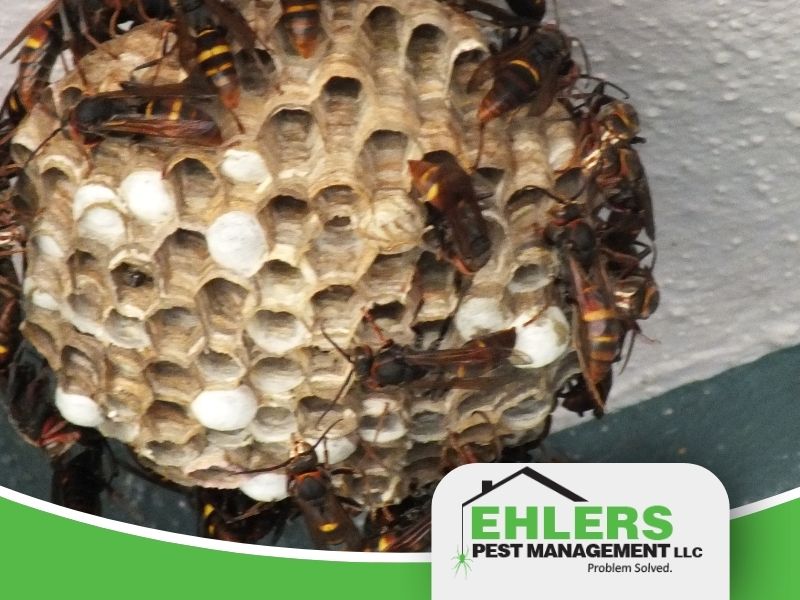
Several wasps clustered around a nest, with the Ehlers Pest Management LLC logo and slogan Problem Solved in the lower right corner, highlighting their expert pest control services.

Finding a wasp nest on your property is one of those moments where the next decision matters. Wasp nest removal in Milwaukee isn’t always a job for a professional, but knowing which situations are manageable yourself and which ones aren’t can be the difference between a quick fix and a painful mistake.

Here’s how to assess what you’re dealing with, what to do and avoid in the meantime, and when wasp nest removal genuinely calls for a professional.

First: Identify What You’re Actually Dealing With

Not all wasp nests are the same, and the right response depends heavily on what species built it and where it’s located.

  • Paper wasp nests are open, umbrella-shaped structures typically found under eaves, deck railings, and window frames. Colonies are relatively small, usually 20 to 30 adults, and the wasps are generally less aggressive unless the nest itself is disturbed.
  • Yellow jacket nests are usually hidden, located in the ground, inside wall voids, or in hollow trees and stumps. Yellow jackets are far more aggressive than paper wasps and will defend their nest vigorously if disturbed, even accidentally.
  • Bald-faced hornet nests are the large, gray, papery structures you’ve likely seen hanging from tree branches or attached to a home’s exterior. Colonies can reach several hundred workers by late summer and are highly defensive.

Take a photo from a safe distance if you can do so without getting close to the nest. Accurate identification is the first step toward the right removal approach.

What to Do If You Find a Wasp Nest

  • Keep your distance. Most stinging insect encounters happen when a nest is disturbed, often accidentally. Give the nest a wide berth and limit activity in the immediate area.
  • Warn others on the property. Let family members, employees, or anyone else who uses the area know where the nest is located so they can avoid it too.
  • Check for known allergies. If anyone in your household or workplace has a known allergy to stinging insect venom, treat the nest as a higher priority and consider professional removal sooner rather than later.
  • Note the nest’s location and accessibility. Is it within easy reach, or is it high up, inside a wall void, or in a hard-to-access area? This affects whether DIY treatment is even feasible.

What Not to Do

A few common mistakes turn a manageable wasp nest situation into a painful one:

  • Don’t disturb the nest to “check it out.” Poking, spraying with water, or knocking the nest to see how the colony reacts is one of the fastest ways to trigger a mass defensive response.
  • Don’t attempt removal at the wrong time of day. Wasps are most active during daylight hours. If DIY treatment is appropriate for the situation, early morning or dusk, when activity is lower, is safer than midday.
  • Don’t use a ladder near an aerial nest. Bald-faced hornet nests and large paper wasp nests positioned above eight feet should not be approached using a ladder. The combination of an aggressive colony and an elevated, unstable position is a serious injury risk.
  • Don’t seal off a yellow jacket ground nest entrance without treating it first. Trapped, agitated yellow jackets will often find another way out, sometimes into your home through a different gap.

When DIY Wasp Nest Removal Is Reasonable

For small, accessible paper wasp nests in a low-traffic area, with no known allergy concerns in the household, DIY treatment with an appropriately labeled aerosol product designed for wasp nests can be reasonable. Treat in early morning or dusk when the colony is least active, wear protective clothing, and have a clear, unobstructed retreat path before you begin.

When to Call a Wasp Exterminator in Milwaukee

Several situations call for professional wasp nest removal rather than a DIY attempt:

  • Yellow jacket ground nests or any nest inside a wall void. These require specialized treatment approaches and protective equipment that go beyond what’s available in a retail aerosol product.
  • Bald-faced hornet nests of any size. These colonies are highly aggressive and often too large for safe DIY treatment, particularly later in the season.
  • Nests located above eight feet or in hard-to-reach areas. The combination of height and an agitated colony creates a liability and safety risk that’s better handled with professional equipment.
  • Anyone in the household with a known venom allergy. Any nest on the property is a higher-stakes situation when allergy risk is present.
  • A nest that’s already been accidentally disturbed. If a lawnmower, foot traffic, or other activity has already agitated the colony, professional removal is the safer path forward.

Professional Wasp Nest Removal: What to Expect

A professional wasp exterminator in Milwaukee will identify the species before treatment, use appropriate protective equipment for the specific colony type, apply targeted product directly to the nest to eliminate the colony at the source, and remove accessible nests afterward to prevent reuse by future colonies.

Ehlers Pest Management provides wasp nest removal across Milwaukee and Southeastern Wisconsin. To schedule service or talk to our experienced team about a nest on your property, contact us today.

Frequently Asked Questions

Is it safe to remove a wasp nest myself?

For small, accessible paper wasp nests with no allergy concerns in the household, careful DIY removal can be reasonable. Yellow jacket ground nests, bald-faced hornet nests, and any nest in a hard-to-reach location are best left to a professional given the higher risk of a mass defensive response.

What time of day is best for wasp nest removal?

Early morning or dusk, when wasp activity is lowest, is the safest time for any nest treatment, whether DIY or professional. Midday treatment, when the colony is most active, carries higher risk.

Will a wasp nest come back after removal?

The same nest structure typically won’t be reused by a new colony once the original colony has been eliminated and the nest removed. However, a new colony can build a nest in a similar nearby location if the conditions that attracted the original colony haven’t changed.

How much does professional wasp nest removal cost in Milwaukee?

Pricing depends on the species, nest location, and accessibility. Ground nests and hidden wall void nests typically require more involved treatment than an accessible paper wasp nest, which affects cost. A technician can give you an accurate price after assessing your specific situation.

Categories Pest Treatment & Services

How Fast Can You Get Pest Control in Milwaukee? What to Expect

A person in protective gear sprays a substance on the floor near a window, holding a blue tank. The Ehlers Pest Management LLC logo appears in the lower right corner, highlighting their professional pest control services.

If you’re dealing with a pest problem right now, pest control response time in Milwaukee is probably the first thing on your mind. How soon can someone actually come out? Do you have to wait a week? Understanding what realistic scheduling looks like helps you set the right expectations and make a more informed decision about who to call.

Here’s what actually affects pest control scheduling in Milwaukee, what a reasonable timeline looks like, and how to schedule pest control in a way that gets you taken care of as efficiently as possible.

What Affects Pest Control Response Time in Milwaukee

Scheduling timelines vary based on a handful of practical factors, and understanding them helps explain why one company might get to you faster than another.

  • Time of year. Pest control companies in Milwaukee experience seasonal demand surges, particularly in spring as ants and other pests become active, and in fall as box elder bugs, lady beetles, and rodents move toward homes. Scheduling during peak season generally takes longer than during slower months.
  • Type of pest problem. Some issues require specialized equipment, specific technician certifications, or particular scheduling considerations, which can affect how quickly a company can accommodate a request.
  • Company size and staffing. Smaller, locally owned companies sometimes have more limited daily capacity than larger companies with more technicians on staff, though they often offer more personalized scheduling and direct communication in exchange.
  • Your location within the service area. Technician routing and territory assignments can affect how quickly a company can fit you into an existing schedule, particularly for areas at the edge of a company’s service footprint.

What a Realistic Timeline Looks Like

For most residential pest control requests in Milwaukee, a reasonable expectation is scheduling within a few business days of your initial call, with some flexibility depending on the season and the specific pest involved. Companies that promise instant, guaranteed same-day service for every situation regardless of circumstances are often setting an expectation they can’t consistently deliver.

At Ehlers Pest Management, we give you an honest answer when you call. If we can get to you quickly, we’ll tell you that. If our schedule means a few days’ wait, we’ll tell you that too, along with what to do in the meantime if your situation calls for it. We’d rather set an accurate expectation than make a promise that doesn’t hold up.

How to Schedule Pest Control in Milwaukee Efficiently

A few things you can do when you call help get you scheduled as efficiently as possible:

  • Be specific about what you’re seeing. The more detail you can provide, the type of pest, where you’re seeing activity, how long it’s been going on, the better our team can assess priority and prepare for the visit.
  • Mention any time constraints. If you have specific availability windows due to work, a rental property turnover, or another scheduling need, let us know upfront so we can work around it.
  • Ask about your options. If your first available appointment doesn’t work for your schedule, ask whether there are alternative time slots or whether a cancellation list is available.
  • Consider a service plan if you’re a recurring customer. Customers on an ongoing seasonal or quarterly plan typically have an easier scheduling relationship with their pest control provider, since visits are planned in advance rather than scheduled reactively.

When Timing Matters Most

Some pest situations genuinely benefit from quicker scheduling than others. A wasp nest near a frequently used entry point, a rodent issue in a food preparation area, or a bed bug situation in a multi-unit building are all examples where getting on the schedule sooner meaningfully changes the outcome. When you call, let your pest control provider know if your situation involves any of these factors so they can help prioritize appropriately within their existing schedule.

For situations that are uncomfortable but not actively worsening by the hour, a few days’ wait for the right technician and the right treatment plan is generally a better outcome than rushing into a less thorough visit.

What to Expect When You Call Ehlers

When you call Ehlers Pest Management, you’re talking to someone local who can give you an honest assessment of your situation and a realistic timeline based on our actual schedule, not a generic promise designed to get you off the phone. We’ll work with you to find a time that fits your situation and explain what to expect before your appointment.

To schedule service or talk to our experienced team about your specific pest problem, contact us today.